



All Multimedia
Access all multimedia to include images, video, audio, webcams, before-after imagery, and more. Filter and explore with filtering options to refine search.


PubTalk 7/2018— Extreme acid mine drainage at Iron Mountain California
PubTalk 7/2018— Extreme acid mine drainage at Iron Mountain CaliforniaTitle: Iron Mountain, California: An Extreme Acid Mine Drainage Environment
PubTalk 7/2018— Extreme acid mine drainage at Iron Mountain California
PubTalk 7/2018— Extreme acid mine drainage at Iron Mountain CaliforniaTitle: Iron Mountain, California: An Extreme Acid Mine Drainage Environment

Cooling lava in Kīlauea Volcano's lower East Rift Zone continues to pose ha
Cooling lava in Kīlauea Volcano's lower East Rift Zone continues to pose haView from the bank of the cooling lava channel near the Leilani Estates subdivision. The height difference between the channel (right) and upper bank (left) is about 8 m (26 ft). Although lava is not flowing from fissure 8, the lava flow field includes large areas of still-hot, rugged, and unstable lava surfaces.
Cooling lava in Kīlauea Volcano's lower East Rift Zone continues to pose ha
Cooling lava in Kīlauea Volcano's lower East Rift Zone continues to pose haView from the bank of the cooling lava channel near the Leilani Estates subdivision. The height difference between the channel (right) and upper bank (left) is about 8 m (26 ft). Although lava is not flowing from fissure 8, the lava flow field includes large areas of still-hot, rugged, and unstable lava surfaces.

Dr. Damian Menning, Geneticist with the USGS Alaska Science Center, preparing environmental samples containing Elodea species to test universal eDNA Elodea species primers that can be used to detect all five Elodea sp. in aquatic samples.
Dr. Damian Menning, Geneticist with the USGS Alaska Science Center, preparing environmental samples containing Elodea species to test universal eDNA Elodea species primers that can be used to detect all five Elodea sp. in aquatic samples.

Elkhorn Slough is a tidal river delta, salt marsh, and estuary in Monterey County, California. It is near the community of Moss Landing and is fed by Carneros Creek.
Elkhorn Slough is a tidal river delta, salt marsh, and estuary in Monterey County, California. It is near the community of Moss Landing and is fed by Carneros Creek.

Geneticist preparing environmental samples containing Elodea species
Geneticist preparing environmental samples containing Elodea speciesDr. Damian Menning, Geneticist with the USGS Alaska Science Center, preparing environmental samples containing Elodea species to test universal eDNA Elodea sp. primers that can be used to detect all five Elodea sp. in aquatic samples.
Geneticist preparing environmental samples containing Elodea species
Geneticist preparing environmental samples containing Elodea speciesDr. Damian Menning, Geneticist with the USGS Alaska Science Center, preparing environmental samples containing Elodea species to test universal eDNA Elodea sp. primers that can be used to detect all five Elodea sp. in aquatic samples.

Natural Bridges State Beach, shown here in the middle of the photo, is nestled amongst coastal neighborhoods in the southwestern part of Santa Cruz, California. View is looking south. The offices of the USGS Pacific Coastal and Marine Science Center are just a few hundred feet north, outside the bottom portion of the photograph.
Natural Bridges State Beach, shown here in the middle of the photo, is nestled amongst coastal neighborhoods in the southwestern part of Santa Cruz, California. View is looking south. The offices of the USGS Pacific Coastal and Marine Science Center are just a few hundred feet north, outside the bottom portion of the photograph.

USGS and Washington State Department of Ecology scientists are geared up and ready to start a topographic survey at the mouth of the Elwha River, using handheld computers and backpack-mounted GPS equipment. From left to right are Owen Warrick (USGS Volunteer), Jon Warrick (USGS), Andy Ritchie (USGS), Heather Weiner (WA State Dept.
USGS and Washington State Department of Ecology scientists are geared up and ready to start a topographic survey at the mouth of the Elwha River, using handheld computers and backpack-mounted GPS equipment. From left to right are Owen Warrick (USGS Volunteer), Jon Warrick (USGS), Andy Ritchie (USGS), Heather Weiner (WA State Dept.

This morning, USGS scientists flying over fissure 8 noticed a change in the vent
This morning, USGS scientists flying over fissure 8 noticed a change in the ventThis morning, USGS scientists flying over fissure 8 noticed a change in the vent from yesterday. Gas jets were throwing spatter—fragments of glassy lava (light gray deposits)—from small incandescent areas deep within the cone. This activity is an indication that the lower East Rift Zone eruption may be paused rather than pau (over).
This morning, USGS scientists flying over fissure 8 noticed a change in the vent
This morning, USGS scientists flying over fissure 8 noticed a change in the ventThis morning, USGS scientists flying over fissure 8 noticed a change in the vent from yesterday. Gas jets were throwing spatter—fragments of glassy lava (light gray deposits)—from small incandescent areas deep within the cone. This activity is an indication that the lower East Rift Zone eruption may be paused rather than pau (over).
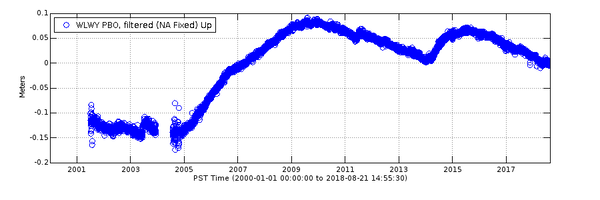
Vertical deformation at GPS station WLWY during 2001-2018
Vertical deformation at GPS station WLWY during 2001-2018Data from continuous GPS stations indicate how the ground is moving over time. Station WLWY, near White Lake on the Sour Creek resurgent dome in Yellowstone caldera, has been operating since 2001. This plot shows vertical ground motion recorded at the site.
Vertical deformation at GPS station WLWY during 2001-2018
Vertical deformation at GPS station WLWY during 2001-2018Data from continuous GPS stations indicate how the ground is moving over time. Station WLWY, near White Lake on the Sour Creek resurgent dome in Yellowstone caldera, has been operating since 2001. This plot shows vertical ground motion recorded at the site.

A collapse event occurred at the summit of Kīlauea this morning (July 24, 2018) at 6:41 a.m. HST, releasing energy equivalent to a magnitude-5.3 earthquake, which is similar to that released by previous collapse events. In this video, watch as today's event unfolds from the perspective of HVO's live-stream camera.
A collapse event occurred at the summit of Kīlauea this morning (July 24, 2018) at 6:41 a.m. HST, releasing energy equivalent to a magnitude-5.3 earthquake, which is similar to that released by previous collapse events. In this video, watch as today's event unfolds from the perspective of HVO's live-stream camera.

Common Murre flying in lower Cook Inlet, Alaska.
Common Murre flying in lower Cook Inlet, Alaska.

Conditions evolve at ocean entry, in Kīlauea Volcano's lower East Rift Zone
Conditions evolve at ocean entry, in Kīlauea Volcano's lower East Rift ZoneView from this morning's helicopter overflight of the Pohoiki boat ramp at Isaac Hale Park shows black sand, transported to the southwest by longshore currents, blocking the entrance to the small boat harbor.
Conditions evolve at ocean entry, in Kīlauea Volcano's lower East Rift Zone
Conditions evolve at ocean entry, in Kīlauea Volcano's lower East Rift ZoneView from this morning's helicopter overflight of the Pohoiki boat ramp at Isaac Hale Park shows black sand, transported to the southwest by longshore currents, blocking the entrance to the small boat harbor.

Cone of depression: Pumping a well can cause water level lowering
Cone of depression: Pumping a well can cause water level loweringGroundwater occurs in the saturated soil and rock below the water table. If the aquifer is shallow enough and permeable enough to allow water to move through it at a rapid-enough rate, then people can drill wells into it and withdraw water.
Cone of depression: Pumping a well can cause water level lowering
Cone of depression: Pumping a well can cause water level loweringGroundwater occurs in the saturated soil and rock below the water table. If the aquifer is shallow enough and permeable enough to allow water to move through it at a rapid-enough rate, then people can drill wells into it and withdraw water.

Lava continues to ooze into the ocean at scattered entries along the Kapoho (pic
Lava continues to ooze into the ocean at scattered entries along the Kapoho (picLava continues to ooze into the ocean at scattered entries along the Kapoho (pictured) and Ahalanui lobes.
Lava continues to ooze into the ocean at scattered entries along the Kapoho (pic
Lava continues to ooze into the ocean at scattered entries along the Kapoho (picLava continues to ooze into the ocean at scattered entries along the Kapoho (pictured) and Ahalanui lobes.

A sand bar has built up at the end of the Pohoiki boat ramp, but the ramp itself
A sand bar has built up at the end of the Pohoiki boat ramp, but the ramp itselfA sand bar has built up at the end of the Pohoiki boat ramp, but the ramp itself remains intact and there has been no significant lava advance toward the ramp in recent days.
A sand bar has built up at the end of the Pohoiki boat ramp, but the ramp itself
A sand bar has built up at the end of the Pohoiki boat ramp, but the ramp itselfA sand bar has built up at the end of the Pohoiki boat ramp, but the ramp itself remains intact and there has been no significant lava advance toward the ramp in recent days.

Edge of the Kīlauea vog plume near Waikoloa Village
Edge of the Kīlauea vog plume near Waikoloa VillageEdge of the Kīlauea vog plume near Waikoloa Village on the west side of Hawai‘i Island as it is blown by trade winds across the island and toward the Pacific Ocean. For more information on sulfur dioxide emissions and vog, see https://vog.ivhhn.org/.
Edge of the Kīlauea vog plume near Waikoloa Village
Edge of the Kīlauea vog plume near Waikoloa VillageEdge of the Kīlauea vog plume near Waikoloa Village on the west side of Hawai‘i Island as it is blown by trade winds across the island and toward the Pacific Ocean. For more information on sulfur dioxide emissions and vog, see https://vog.ivhhn.org/.

Torrential rainfall swamped western Japan in July of 2018. The rain caused mudslides that flooded cities, damaged buildings and rattled the
nation’s infrastructure. More than 170 people died.
Torrential rainfall swamped western Japan in July of 2018. The rain caused mudslides that flooded cities, damaged buildings and rattled the
nation’s infrastructure. More than 170 people died.

Installing dissolved oxygen sensors at the Salmon River near East Hampton, Connecticut
Installing dissolved oxygen sensors at the Salmon River near East Hampton, Connecticut

Today's morning overflight saw no new activity at any of the fissures in the lower East Rift Zone. Fissure 8 had only a sluggish lava puddle remaining in the cone, and other fissures, though steaming, showed no signs of reactivation.
Today's morning overflight saw no new activity at any of the fissures in the lower East Rift Zone. Fissure 8 had only a sluggish lava puddle remaining in the cone, and other fissures, though steaming, showed no signs of reactivation.

Fissure 8 may have slowed down, but HVO scientists are still on the ground in Leilani Estates, monitoring old ground cracks and marking ones that haven't been surveyed before. Monitoring these cracks over multiple days could detect any new signs of magma movement beneath the ground, one of the indicators that fissures might reactivate.
Fissure 8 may have slowed down, but HVO scientists are still on the ground in Leilani Estates, monitoring old ground cracks and marking ones that haven't been surveyed before. Monitoring these cracks over multiple days could detect any new signs of magma movement beneath the ground, one of the indicators that fissures might reactivate.