Survey Requirements for Road Overflow Indirect Measurements
Survey Requirements for Road Overflow Indirect MeasurementsIn this video, you will learn what and where to survey for a road overflow or broad-crested weir indirect measurement.
An official website of the United States government
Here's how you know
Official websites use .gov
A .gov website belongs to an official government organization in the United States.
Secure .gov websites use HTTPS
A lock () or https:// means you’ve safely connected to the .gov website. Share sensitive information only on official, secure websites.
Access all multimedia to include images, video, audio, webcams, before-after imagery, and more. Filter and explore with filtering options to refine search.
In this video, you will learn what and where to survey for a road overflow or broad-crested weir indirect measurement.
Annual time series of precipitation and average air temperature for three future climate models for Indian Wells Valley, California as simulated by the Basin Characterization Model. Three future climate projections were selected from among 20 models used for California’s Fourth Climate Change Assessment for application to Indian Wells Valley.
In the Leilani Estates subdivision, Hawaiian Volcano Observatory field crews monitoring fissure 8 captured this video of a whirlwind above the lava channel.
A winding strip of rainbow colors shows the bathymetry (depth) of the bed of the Mokelumne River just above its confluence with the San Joaquin in the Sacramento-San Joaquin River Delta east of San Francisco Bay.
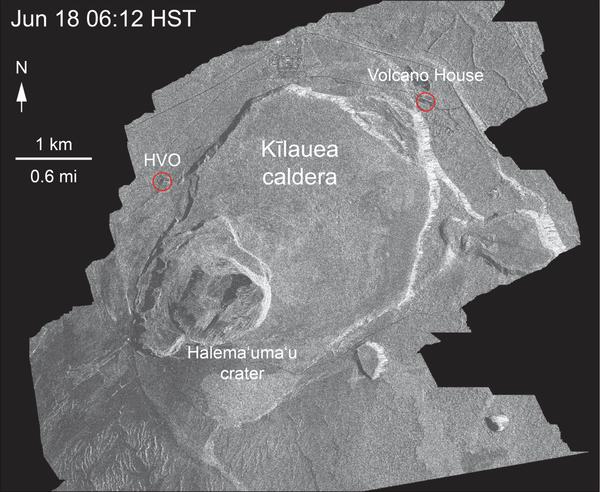
This animated GIF shows a sequence of radar amplitude images that were acquired by the Agenzia Spaziale Italiana CosmoSkyMed satellite system. The images illustrate changes to the caldera area of Kīlauea Volcano that occurred between May 5 and June 30 at about 6:00 a.m. HST.
Fountains from the fissure 8 spatter cone continue to supply lava to an open channel.
At the Kapoho coast, lava enters the ocean along the northern margin of the flow field.
Lava from fissure 8 is fed into a channel that travels about 13 km (8 mi) to the sea. A plumemarks the location of fissure 8, visible in the upper right; a small plume in the upper center marks the location of fissure 22.
Lava flows around islands in the lava channel. The direction of flow is from the upper right to lower left. Field crews can make a rough calculation of velocity by timing large blocks as they pass between two landmarks that are a known distance apart.
Lava was entering the ocean over a broad area this morning. This image shows an active entry area along the northern flow front at Kapoho. View to the south.
View of Kīlauea Volcano's summit. The brown visible dust coming from Halema‘uma‘u is from rockfalls.
Hawaiian Volcano Observatory geologist Matt Patrick acquires video of fissure 8 and the lava channel from Pohoiki Road/Highway 132. The video is used to document fountain behavior and lava flow characteristics, and how they change with time.
Spectrogram and wind data from stations on Stevenson Island for June 30, 2018. Warm colors in the spectrogram correspond to stronger seismic energy compared to cool colors. The ~1-second-period lake-generated microseism (outlined by the black box) that was generated on this day is correlated with elevated wind speeds (red circles) as a storm passed by overnight.
The USGS is developing methods to improve data collection during floods to gain new insight into the rise and fall of flood waters. In the past, the only data left behind after a flood was how high the water got, or the peak of the flood.
Aerial Image of the effects of the 2011 Missouri River Flood
Arial Image of the 2011 Missouri River Flood
One portion of the braided section of the fissure 8 lava channel.
High-resolution satellite data are useful for mapping cracks and deformation in the summit caldera at Kīlauea Volcano.
Fissure 8 and the proximal lava flow channel on the morning of June 29. Low fountaining within the cone is still producing a vigorous supply of lava to the channel.