U.S. flag

An official website of the United States government

Images

Volcano Hazard Program images.

Filter Total Items: 6273
Orange incandescent lava fountains erupting from black lava on crater floor
Aerial view of lava fountains within Halema‘uma‘u, Kīlauea, December 30, 2024

This oblique aerial photo was captured during a USGS Hawaiian Volcano Observatory overflight on the morning of Monday, December 30, 2024, providing a southwest-looking view of the active fountains of the ongoing eruption within Halema‘uma‘u at Kīlauea's summit. USGS photo by N. Deligne.

This oblique aerial photo was captured during a USGS Hawaiian Volcano Observatory overflight on the morning of Monday, December 30, 2024, providing a southwest-looking view of the active fountains of the ongoing eruption within Halema‘uma‘u at Kīlauea's summit. USGS photo by N. Deligne.

Orange lava fountains erupting in black lava spatter cones with white gas plume being emitted
Aerial view of lava fountains within Halema‘uma‘u, December 30, 2024

This aerial photo was captured during a USGS Hawaiian Volcano Observatory overflight on the morning of Monday, December 30, 2024, providing a south-looking telephoto overhead view of the lava fountains within Halema‘uma‘u at Kīlauea's summit. USGS photo by N. Deligne.

This aerial photo was captured during a USGS Hawaiian Volcano Observatory overflight on the morning of Monday, December 30, 2024, providing a south-looking telephoto overhead view of the lava fountains within Halema‘uma‘u at Kīlauea's summit. USGS photo by N. Deligne.

Orange lava fountains erupting inside of black lava spatter cone at the base of a crater wall
Low-angle view of active lava fountains within Halema‘uma‘u crater, Kīlauea, December 30, 2024

During a helicopter overflight on the morning of Monday, December 30, 2024, USGS Hawaiian Volcano Observatory geologists were provided a low-level view of the eruptive vents in the western wall of Halema‘uma‘u crater at Kīlauea's summit. USGS photo by N. Deligne.

Low-light photo of yellow glowing lava fountains feeding red and black lava flows on crater floor
Pre-dawn lava fountains and flows in Halema‘uma‘u crater

Photo of the lava fountains and flows within the western part of Halema‘uma‘u crater just before dawn on December 30, 2024. The lava fountains have started to build scoria cones around themselves with the fountains consistently reaching to 30 m (100 ft) high. These fountains are feeding lava flows that have covered the western quarter of the crater floor.

Photo of the lava fountains and flows within the western part of Halema‘uma‘u crater just before dawn on December 30, 2024. The lava fountains have started to build scoria cones around themselves with the fountains consistently reaching to 30 m (100 ft) high. These fountains are feeding lava flows that have covered the western quarter of the crater floor.

Aerial overview of Kīlauea summit caldera and white gas plume rising from eruption in crater
Aerial overview of Kaluapele (Kīlauea summit caldera) and eruption within Halema‘uma‘u, December 30, 2024

This aerial photo was captured during a USGS Hawaiian Volcano Observatory overflight on the morning of Monday, December 30, 2024, providing a southwest-looking overview of the ongoing Kīlauea summit eruption within Halema‘uma‘u. The lava fountains are visible in the center of the image, in the southwest corner of Halema‘uma‘u.

This aerial photo was captured during a USGS Hawaiian Volcano Observatory overflight on the morning of Monday, December 30, 2024, providing a southwest-looking overview of the ongoing Kīlauea summit eruption within Halema‘uma‘u. The lava fountains are visible in the center of the image, in the southwest corner of Halema‘uma‘u.

orange lava fountains erupting from black lava within crater
Fissure fountain from helicopter overflight on December 30

An Aerial view of two eruptive cones in the southwest corner of Halema‘uma‘u crater at Kīlauea's summit on the morning of December 30, 2024. The fissure fountains reached heights of approximately 30 meters (100 ft) and lava flows continue to cover a portion of the crater floor. USGS photo by H. Winslow.

An Aerial view of two eruptive cones in the southwest corner of Halema‘uma‘u crater at Kīlauea's summit on the morning of December 30, 2024. The fissure fountains reached heights of approximately 30 meters (100 ft) and lava flows continue to cover a portion of the crater floor. USGS photo by H. Winslow.

Geologist looking into crater where orange lava fountains are erupting
December 30, 2024 Kīlauea summit eruption

A USGS Hawaiian Volcano Observatory geologist uses a laser rangefinder to collect fountain height measurements from the eruption within Halema‘uma‘u crater at the summit of Kīlauea volcano. Fountain heights reached approximately 30–35 m (100–115 ft) on the morning of December 30, 2024.

A USGS Hawaiian Volcano Observatory geologist uses a laser rangefinder to collect fountain height measurements from the eruption within Halema‘uma‘u crater at the summit of Kīlauea volcano. Fountain heights reached approximately 30–35 m (100–115 ft) on the morning of December 30, 2024.

aerial view of orange lava fountains erupting from the base of a crater wall and a white gas plume being emitted
Aerial view of the active and inactive parts of the December 2024 flow field

Aerial view looking to the southwest of the active and inactive parts of the eruption within Halema‘uma‘u crater at the summit of Kīlauea. The dark black lava in the foreground covered most of the crater floor on the first day of the eruption, starting around 2:20 a.m. on December 23, 2024.

Aerial view looking to the southwest of the active and inactive parts of the eruption within Halema‘uma‘u crater at the summit of Kīlauea. The dark black lava in the foreground covered most of the crater floor on the first day of the eruption, starting around 2:20 a.m. on December 23, 2024.

Annotated photo of volcanic crater with orange lava fountains and white gas plume being emitted
Annotated photo of lava flows and tephra deposits of the southwest portion of Kaluapele (Kīlauea caldera)

This annotated image shows the lava flows and tephra deposits of the southwest portion of Kaluapele (Kīlauea's summit caldera). The photo was taken during a USGS Hawaiian Volcano Observatory overflight on the morning of Monday, December 30, 2024, with a view to the east.

low-light photo of orange lava fountains erupting within a black spatter cone
Close-up view of the lava fountains along the western wall of Halema‘uma‘u

A close-up photo taken just before dawn of the lava fountains in the western part of Halema‘uma‘u crater, at Kīlauea summit, on December 30, 2024. These lava fountains are consistently reaching 30 m (100 ft) high and building a spatter cone that is about 20 m (65 ft) high, 95 m (310 ft) long, and 60 m (200 ft) wide. Photo by U.S. Geological Survey geologist D.

A close-up photo taken just before dawn of the lava fountains in the western part of Halema‘uma‘u crater, at Kīlauea summit, on December 30, 2024. These lava fountains are consistently reaching 30 m (100 ft) high and building a spatter cone that is about 20 m (65 ft) high, 95 m (310 ft) long, and 60 m (200 ft) wide. Photo by U.S. Geological Survey geologist D.

Orange lava fountains erupting from within black spatter cones at the base of a rocky crater wall
Aerial image of active lava fountains and lava flows at Halema‘uma‘u, Kīlauea, December 30, 2024

This aerial photo was captured during a USGS Hawaiian Volcano Observatory overflight on the morning of Monday, December 30, 2024, providing a southwest-looking overview of the ongoing Kīlauea summit eruption within Halema‘uma‘u crater.

View of Mount Adams from a distance, scientists installing a monitoring station, and map where earthquakes have occurred.
Update on seismic activity at Mount Adams from September 2024 to early November 2024

Volcanoes tend to have seismicity that waxes and wanes over time. That’s considered normal and not necessarily a cause for concern. Let’s check on Mount Adams to see what USGS scientists are doing to learn more about its recent earthquake activity and what it could mean for this Cascade Range volcano.

Volcanoes tend to have seismicity that waxes and wanes over time. That’s considered normal and not necessarily a cause for concern. Let’s check on Mount Adams to see what USGS scientists are doing to learn more about its recent earthquake activity and what it could mean for this Cascade Range volcano.

Scientist uses a gas monitoring instrument pointed at volcanic vents to collect gas data
Volcanic gas measurements during the 2024 Nāpau eruption

A USGS scientist aims the viewfinder of an infrared spectrometer to measure the chemistry of volcanic gas on the last day of the Nāpau eruption, September 20, 2024. USGS photo by P. Nadeau.

A USGS scientist aims the viewfinder of an infrared spectrometer to measure the chemistry of volcanic gas on the last day of the Nāpau eruption, September 20, 2024. USGS photo by P. Nadeau.

Shaded relief location map for the East Gallatin-Reese Creek fault system in northwest Yellowstone National Park
A scientist is sitting in the lab, surrounded by volcano gas monitoring equipment, talking about his work.
USGS scientist Peter Kelly, recipient of the 2024 Dr. James R. Balsley Jr. Award for Excellence

USGS scientist Peter Kelly is recognized for his work to design, optimize, and commercialize Multi-GAS technology for monitoring of geothermal and volcanic gas emanations. Notably, he spent almost a decade designing, engineering, and perfecting a system of geochemical sensors for both portable and semi-permanent remote deployment.

USGS scientist Peter Kelly is recognized for his work to design, optimize, and commercialize Multi-GAS technology for monitoring of geothermal and volcanic gas emanations. Notably, he spent almost a decade designing, engineering, and perfecting a system of geochemical sensors for both portable and semi-permanent remote deployment.

A geologist in a bright orange shirt walks beside a newly-erupted lava flow, which barely reaches the height of their waist
Geologist examines new lava flow from Kīlauea's Southwest Rift Zone eruption, June 4, 2024

The eruption on Kīlauea's Southwest Rift Zone remained paused on Tuesday, June 4, but Hawaiian Volcano Observatory geologists visited the area to take measurements of the previous day's lava flows. Here, a geologist examines part of the lava flow from fissure 2.

orange glow of lava in the distance in the dark
Glow from the eruption of Kīlauea volcano - June 3, 2024

The glow from the eruption of Kīlauea volcano, visible from Volcano House in Hawai'i Volcanoes National Park during the early morning hours of June 3. Image courtesy of Volcano House. 

The glow from the eruption of Kīlauea volcano, visible from Volcano House in Hawai'i Volcanoes National Park during the early morning hours of June 3. Image courtesy of Volcano House. 

A distant crack in a field of lava emits glowing orange fountains of molten rock and plumes of white and gray clouds
Lava fountains and an ash plume from Kīlauea's Southwest Rift Zone fissure eruption of June 3

In this photo taken at about 6 a.m. HST on June 3, both lava fountains (left) and emissions of volcanic ash (right) are visible erupting from the new fissures in Kīlauea's Southwest Rift Zone. The ash is dark gray, while the remainder of the whitish plumes are composed of steam and other volcanic gases. USGS photo by Tricia Nadeau (HVO)

In this photo taken at about 6 a.m. HST on June 3, both lava fountains (left) and emissions of volcanic ash (right) are visible erupting from the new fissures in Kīlauea's Southwest Rift Zone. The ash is dark gray, while the remainder of the whitish plumes are composed of steam and other volcanic gases. USGS photo by Tricia Nadeau (HVO)

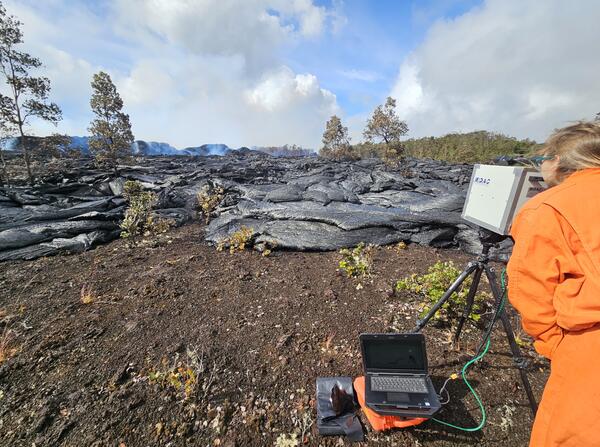
A female scientist standing next to a boxy instrument on a tripod, taking measurements of a gas plume in the distance
USGS HVO geochemist measuring gases released from Kīlauea Volcano's Southwest Rift Zone fissure eruption

A field team of HVO geochemists visited the site of Kīlauea's Southwest Rift Zone fissure eruption to measure gases released from the fissures. The team used a Fourier transform infrared (FTIR) spectrometer, an instrument that detects gas compositions on the basis of absorbed infrared light. USGS photo by Tricia Nadeau (HVO)

A field team of HVO geochemists visited the site of Kīlauea's Southwest Rift Zone fissure eruption to measure gases released from the fissures. The team used a Fourier transform infrared (FTIR) spectrometer, an instrument that detects gas compositions on the basis of absorbed infrared light. USGS photo by Tricia Nadeau (HVO)

lava erupting from a fissure
Aerial image of the Southwest Rift Zone eruption of Kīlauea

Aerial image of the Southwest Rift Zone eruption of Kīlauea, viewed during an overflight at approximately 6 a.m. on June 3, 2024. USGS image.

Bright orange lava fountains spew from long cracks in an older lava flow, shrouded in plumes of steam and volcanic gas
Lava fountains from new eruptive fissures southwest of Kīlauea's summit, June 3, 2024

Lava fountains from the June 3, 2024 fissure eruption in Kīlauea's Southwest Rift Zone were estimated to have reached as high as 20 meters (66 feet), with an average height of 10 meters (33 feet). 

Was this page helpful?