U.S. flag

An official website of the United States government

Images

Volcano Hazard Program images.

Filter Total Items: 6273
Color photograph of crater edge
September 2, 2022 — Kīlauea summit eruption monitoring

A telephoto view of the eastern end of Halema‘uma‘u crater floor, where lava flows erupted over the past year intersect the crater wall. The fissure that erupted in 1982 on Kīlauea caldera floor is visible as a ridge-like feature about 130 feet (40 meters) above these lava flows. USGS image by K. Mulliken.

A telephoto view of the eastern end of Halema‘uma‘u crater floor, where lava flows erupted over the past year intersect the crater wall. The fissure that erupted in 1982 on Kīlauea caldera floor is visible as a ridge-like feature about 130 feet (40 meters) above these lava flows. USGS image by K. Mulliken.

Color photograph of lava pond
September 2, 2022 — Kīlauea summit eruption monitoring

South of the active lava lake within Halema‘uma‘u, there is a much smaller lava pond. Lava flows that appear darker grey and shiny around this feature attest to recent overflows. Telephoto image taken from the south rim of Halema‘uma‘u on September 2, 2022. USGS image by K. Mulliken.

South of the active lava lake within Halema‘uma‘u, there is a much smaller lava pond. Lava flows that appear darker grey and shiny around this feature attest to recent overflows. Telephoto image taken from the south rim of Halema‘uma‘u on September 2, 2022. USGS image by K. Mulliken.

Color photograph of lava lake
September 2, 2022 — Kīlauea summit eruption monitoring

A view of the eruption in Halema‘uma‘u at the summit of Kīlauea, taken on September 2, 2022, by HVO geologists on the south rim of the crater. Nice weather allowed for clear views of the active lava lake, which is in approximately the center of the image.

A view of the eruption in Halema‘uma‘u at the summit of Kīlauea, taken on September 2, 2022, by HVO geologists on the south rim of the crater. Nice weather allowed for clear views of the active lava lake, which is in approximately the center of the image.

Color map of islands and nearby bathymetry
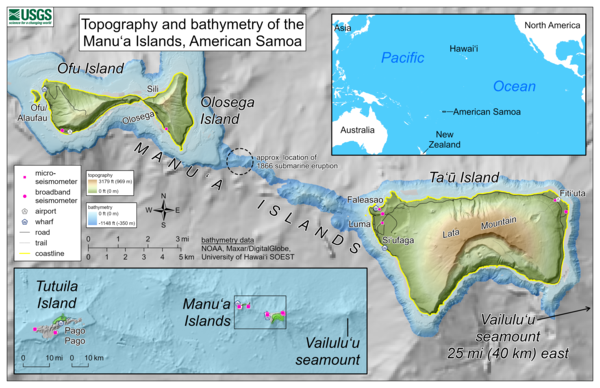
Topography and bathymetry of the Manu‘a Islands, American Samoa

This reference map depicts the topography and bathymetry of the volcanoes in the Manu‘a Islands, American Samoa, where seismic unrest has been ongoing for several weeks. The highest elevation in the area is Lata Mountain on Ta‘ū Island, standing 3,179 feet (969 meters) above sea level.

This reference map depicts the topography and bathymetry of the volcanoes in the Manu‘a Islands, American Samoa, where seismic unrest has been ongoing for several weeks. The highest elevation in the area is Lata Mountain on Ta‘ū Island, standing 3,179 feet (969 meters) above sea level.

Color map of islands and nearby bathymetry
Topography, bathymetry, and volcano monitoring network of the Manu‘a Islands, American Samoa

This reference map depicts the topography and bathymetry of the volcanoes in the Manu‘a Islands, American Samoa. The highest elevation in the area is Lata Mountain on Ta‘ū Island, standing 3,179 feet (969 meters) above sea level.

color map of lava flow forecast
Oblique view of an example simulation showing lava flow advance

Oblique view of an example simulation showing lava flow advance from Fissure 22 (white line segments) of the 2018 Kīlauea lower East Rift Zone eruption. Color contours show the lava flow front in 1-hour increments. The simulated flow entered the ocean after 22 hours elapsed, comparable to the actual timeframe it took that lava flow to reach the ocean.

Oblique view of an example simulation showing lava flow advance from Fissure 22 (white line segments) of the 2018 Kīlauea lower East Rift Zone eruption. Color contours show the lava flow front in 1-hour increments. The simulated flow entered the ocean after 22 hours elapsed, comparable to the actual timeframe it took that lava flow to reach the ocean.

Color map of eruption at summit of volcano
Kīlauea Volcano crater filling as of September 2022

This map of the Kīlauea summit is mostly identical to the September 13, 2022, eruption reference map, but also included here are west to east topographic profiles across the caldera.

This map of the Kīlauea summit is mostly identical to the September 13, 2022, eruption reference map, but also included here are west to east topographic profiles across the caldera.

Color map of globe
Map showing location of Ta'ū volcano in American Samoa and Wake Island

Wake Island is about 2,800 miles (4,500 km) northwest of Ta'ū volcano in American Samoa. Both are located in the Pacific Ocean. 

Scientist collecting a rock sample
August 30, 2022 — Collecting Rock Samples on Ta‘ū Island

A USGS Hawaiian Volcano Observatory geologist collects a rock sample using a rock hammer on Ta‘ū Island, American Samoa. HVO staff are in American Samoa responding to earthquake activity. While there to install monitoring instrumentation, they are also collecting rock samples to better understand past volcanic activity in American Samoa. USGS image by J. Chang.

A USGS Hawaiian Volcano Observatory geologist collects a rock sample using a rock hammer on Ta‘ū Island, American Samoa. HVO staff are in American Samoa responding to earthquake activity. While there to install monitoring instrumentation, they are also collecting rock samples to better understand past volcanic activity in American Samoa. USGS image by J. Chang.

Color photograph of scientist collecting rock sample
August 30, 2022 — Collecting Rock Samples on Ta‘ū Island

A USGS Hawaiian Volcano Observatory geologist collects a sample of a pāhoehoe lava flow above a thick ‘a‘ā lava flow on Ta‘ū Island, American Samoa. At that location, samples of a sequence of alternating pāhoehoe and ‘a‘ā lava flows were sampled to help reconstruct the eruptive history of Ta‘ū volcano.

A USGS Hawaiian Volcano Observatory geologist collects a sample of a pāhoehoe lava flow above a thick ‘a‘ā lava flow on Ta‘ū Island, American Samoa. At that location, samples of a sequence of alternating pāhoehoe and ‘a‘ā lava flows were sampled to help reconstruct the eruptive history of Ta‘ū volcano.

Color photograph of volcanic deposits
August 26, 2022 — Base of a tuff cone on Ta‘ū Island, American Samoa

The base of a tuff cone near the coast of Ta‘ū Island in American Samoa. Tuff cones are created from phreatomagmatic processes through the interaction of lava with shallow seawater. This part of the tuff cone contains mostly sand size material that hosts larger blocks and bombs that are up to several feet (one meter) in diameter.

The base of a tuff cone near the coast of Ta‘ū Island in American Samoa. Tuff cones are created from phreatomagmatic processes through the interaction of lava with shallow seawater. This part of the tuff cone contains mostly sand size material that hosts larger blocks and bombs that are up to several feet (one meter) in diameter.

color photograph of volcanic deposits
August 26, 2022 — Tuff cone on Ta‘ū Island in American Samoa

A cliff on Ta‘ū island in American Samoa, exposing part of a tuff cone that was created from phreatomagmatic processes through the interaction of lava with shallow seawater. This part of the tuff cone contains mostly sand-sized material that hosts larger blocks and bombs that are up to several feet (one meter) in diameter.

A cliff on Ta‘ū island in American Samoa, exposing part of a tuff cone that was created from phreatomagmatic processes through the interaction of lava with shallow seawater. This part of the tuff cone contains mostly sand-sized material that hosts larger blocks and bombs that are up to several feet (one meter) in diameter.

Color photograph of volcano-monitoring station
HVO permanent, continuously operating GNSS site

HVO permanent, continuously operating GNSS site in Hawai‘i Volcanoes National Park co-located with seismic instrumentation. USGS photo by K. Kamibayashi.

HVO permanent, continuously operating GNSS site in Hawai‘i Volcanoes National Park co-located with seismic instrumentation. USGS photo by K. Kamibayashi.

Color photograph of instrument in field
HVO semi-permanent GNSS site

Photo of a GNSS monitoring site deployed by the USGS Hawaiian Volcano Observatory (HVO) on the floor of Kīlauea caldera as part of the rapid response to the December 2020 Halema‘uma‘u eruption.

Photo of a GNSS monitoring site deployed by the USGS Hawaiian Volcano Observatory (HVO) on the floor of Kīlauea caldera as part of the rapid response to the December 2020 Halema‘uma‘u eruption.

Color photograph of volcano-monitoring instruments
GNSS receivers, antennas, and associated cables

Staging of new state-of-the-art GNSS receivers, antennas, and associated cables acquired through the Additional Supplemental Appropriations for Disaster Relief Act of 2019 for the USGS Hawaiian Volcano Observatory. USGS photo by A.P Ellis. 

Staging of new state-of-the-art GNSS receivers, antennas, and associated cables acquired through the Additional Supplemental Appropriations for Disaster Relief Act of 2019 for the USGS Hawaiian Volcano Observatory. USGS photo by A.P Ellis. 

Color photograph of crater floor and lava lake
August 24, 2022 — Overview of Halema‘uma‘u eruption, Kīlauea volcano

This overview photograph of the Halema‘uma‘u eruption at the summit of Kīlauea was captured by a HVO geologist in the morning of August 24, 2022, from the webcam site on the west rim of the crater.

Color photograph of volcano slopes
August 22, 2022 — View of the summit region of Ta‘ū island

A view of the summit region of Ta‘ū island, in the Manu‘a island group of American Samoa. Ta‘ū island is the exposed top of a volcano that formed as a result of volcanic activity at the Samoa hotspot. Most of the volcano is under the ocean surface.

A view of the summit region of Ta‘ū island, in the Manu‘a island group of American Samoa. Ta‘ū island is the exposed top of a volcano that formed as a result of volcanic activity at the Samoa hotspot. Most of the volcano is under the ocean surface.

Color photograph of people installing field instrument
August 23, 2022 — Installing a seismometer on Ta‘ū island

A broadband seismometer being installed on Ta‘ū island near Fiti‘uta on August 23, 2022, by the USGS Hawaiian Volcano Observatory, NOAA National Weather Service, and with help from the American Samoan government and local residents of Ta‘ū island.

A broadband seismometer being installed on Ta‘ū island near Fiti‘uta on August 23, 2022, by the USGS Hawaiian Volcano Observatory, NOAA National Weather Service, and with help from the American Samoan government and local residents of Ta‘ū island.

Color photograph of scientists installing instrument
August 22, 2022 — USGS Hawaiian Volcano Observatory scientist setting up a seismometer on Ta‘ū Island

A broadband seismometer was installed on Ta‘ū island on August 22, 2022, by the USGS Hawaiian Volcano Observatory and NOAA National Weather Service team. This is one of two broadband seismometers that have been placed on Ta‘ū island to help detect earthquakes that started to be felt in the region starting in late July. USGS photo by D. Downs.

A broadband seismometer was installed on Ta‘ū island on August 22, 2022, by the USGS Hawaiian Volcano Observatory and NOAA National Weather Service team. This is one of two broadband seismometers that have been placed on Ta‘ū island to help detect earthquakes that started to be felt in the region starting in late July. USGS photo by D. Downs.

Color photograph of ocean and island in distance
August 20, 2022 — View of Faleāsao tuff cone on Ta‘ū Island and Ofu-Olosega island in the distance

An afternoon view of the tuff cone near Faleāsao village located in northwest Ta‘ū island, with the islands of Ofu and Olosega visible in the distance. This tuff cone, which is thousands of years old, formed when hot magma interacted with either shallow groundwater or sea water. There are several tuff cones located within the northwest corner of Ta‘ū island.

An afternoon view of the tuff cone near Faleāsao village located in northwest Ta‘ū island, with the islands of Ofu and Olosega visible in the distance. This tuff cone, which is thousands of years old, formed when hot magma interacted with either shallow groundwater or sea water. There are several tuff cones located within the northwest corner of Ta‘ū island.

Color photograph of earthquake monitoring device
August 19, 2022 — Microseismometer installed in the Manu‘a islands of American Samoa

A Raspberry Shake microseismometer was installed on Ta‘ū island, American Samoa, on August 19, 2022, by the USGS Hawaiian Volcano Observatory and NOAA National Weather Service team. This is one of several microseismometers that have been placed within the Manu‘a islands to help detect earthquakes in the region that started to be felt in late July. USGS photo by D.

A Raspberry Shake microseismometer was installed on Ta‘ū island, American Samoa, on August 19, 2022, by the USGS Hawaiian Volcano Observatory and NOAA National Weather Service team. This is one of several microseismometers that have been placed within the Manu‘a islands to help detect earthquakes in the region that started to be felt in late July. USGS photo by D.

Was this page helpful?