This photograph shows two channels of lava coming over the sea clif...
This photograph shows two channels of lava coming over the sea clif...This photograph shows two channels of lava coming over the sea cliff, reaching the new lava delta.


Official websites use .gov
A .gov website belongs to an official government organization in the United States.

Secure .gov websites use HTTPS
A lock () or https:// means you’ve safely connected to the .gov website. Share sensitive information only on official, secure websites.

Volcano Hazard Program images.

This photograph shows two channels of lava coming over the sea cliff, reaching the new lava delta.
This photograph shows two channels of lava coming over the sea cliff, reaching the new lava delta.

View looking southwest of the Pu‘u ‘Ō‘ō cone and crater. The fume sources on the northeast flank (lower left) mark the path of the lava tube that is feeding flows on the pali. The vent feeding the tube is the fuming area near the crater rim (center); an active circular lava pond is immediately behind the vent.
View looking southwest of the Pu‘u ‘Ō‘ō cone and crater. The fume sources on the northeast flank (lower left) mark the path of the lava tube that is feeding flows on the pali. The vent feeding the tube is the fuming area near the crater rim (center); an active circular lava pond is immediately behind the vent.

pāhoehoe flows spreading on the coastal plain about 0.6 km from the base of the pali. When visited this morning, the flows had spread out considerably as they filled in low areas of the coastal plain. The leading edge of the flows were about 2.5 km from the ocean.
pāhoehoe flows spreading on the coastal plain about 0.6 km from the base of the pali. When visited this morning, the flows had spread out considerably as they filled in low areas of the coastal plain. The leading edge of the flows were about 2.5 km from the ocean.

Close view of the Pu‘u ‘Ō‘ō crater. Incandescent spatter cone stands above fume rising from the main vent area. Lava is still erupting in the lava pond, marked by the smooth shiny surface behind the spatter cone, but the level appears to have stabilized overnight.
Close view of the Pu‘u ‘Ō‘ō crater. Incandescent spatter cone stands above fume rising from the main vent area. Lava is still erupting in the lava pond, marked by the smooth shiny surface behind the spatter cone, but the level appears to have stabilized overnight.

Active pāhoehoe, fed by a lava tube originating at Pu‘u ‘Ō‘ō, has been migrating downslope within the Royal Gardens subdivision over the past week. The flow front is outlined by the white dotted line. The flow is running alongside a forested kipuka, triggering brush fires visible in the photo.
Active pāhoehoe, fed by a lava tube originating at Pu‘u ‘Ō‘ō, has been migrating downslope within the Royal Gardens subdivision over the past week. The flow front is outlined by the white dotted line. The flow is running alongside a forested kipuka, triggering brush fires visible in the photo.

Map showing Pu‘u ‘Ō‘ō and the extent of nearby lava flows. The currently active flow (episode 61) is shown as the two shades of red—pink is the extent of the flow from September 21 to November 21, and bright red marks flow expansion from November 21 to December 2. The contour interval on Pu‘u ‘Ō‘ō is 5 m.
Map showing Pu‘u ‘Ō‘ō and the extent of nearby lava flows. The currently active flow (episode 61) is shown as the two shades of red—pink is the extent of the flow from September 21 to November 21, and bright red marks flow expansion from November 21 to December 2. The contour interval on Pu‘u ‘Ō‘ō is 5 m.

This photograph, taken from the east rim of Pu‘u ‘Ō‘ō crater, shows a cone in the crater which was occasionally spitting minor amounts of spatter from the incandescent opening at its top.
This photograph, taken from the east rim of Pu‘u ‘Ō‘ō crater, shows a cone in the crater which was occasionally spitting minor amounts of spatter from the incandescent opening at its top.

Map showing the extent of lava flows erupted during Kīlauea's ongoing east rift zone eruption and labeled with the years in which they were active.
Map showing the extent of lava flows erupted during Kīlauea's ongoing east rift zone eruption and labeled with the years in which they were active.

Map showing the extent of lava flows erupted during Kīlauea's ongoing east rift zone eruption and labeled with the years in which they were active.
Map showing the extent of lava flows erupted during Kīlauea's ongoing east rift zone eruption and labeled with the years in which they were active.

A collapse of a thin portion of the roof over the lava tube reveals the lava stream beneath the surface. The fluid stream is the bright orange color, with the dark orange area to the left representing the hot, incandescent tube wall. The lava stream today was relatively slow moving in the tube, perhaps reflecting a low rate of lava supply to the flow front.
A collapse of a thin portion of the roof over the lava tube reveals the lava stream beneath the surface. The fluid stream is the bright orange color, with the dark orange area to the left representing the hot, incandescent tube wall. The lava stream today was relatively slow moving in the tube, perhaps reflecting a low rate of lava supply to the flow front.

Map showing Pu‘u ‘Ō‘ō and the extent of nearby lava flows. The currently active flow (episode 61) is shown as the two shades of red—pink is the extent of the flow from September 21 to November 10, and bright red marks flow expansion from November 10 to November 21. The contour interval on Pu‘u ‘Ō‘ō is 5 m.
Map showing Pu‘u ‘Ō‘ō and the extent of nearby lava flows. The currently active flow (episode 61) is shown as the two shades of red—pink is the extent of the flow from September 21 to November 10, and bright red marks flow expansion from November 10 to November 21. The contour interval on Pu‘u ‘Ō‘ō is 5 m.

For a brief period this afternoon a vigorously spattering vent at the east end of Pu‘u ‘Ō‘ō crater fed a swiftly moving river of lava that cascaded into the deeper portions of the crater. The cascade was over within about ten minutes of this photograph, but the vent continued to spatter.
For a brief period this afternoon a vigorously spattering vent at the east end of Pu‘u ‘Ō‘ō crater fed a swiftly moving river of lava that cascaded into the deeper portions of the crater. The cascade was over within about ten minutes of this photograph, but the vent continued to spatter.

Map showing the extent of lava flows erupted during Kīlauea's ongoing east rift zone eruption and labeled with the years in which they were active.
Map showing the extent of lava flows erupted during Kīlauea's ongoing east rift zone eruption and labeled with the years in which they were active.

This photograph, looking east, shows a large skylight on the lava tube that is supplying lava to surface flows north of Royal Gardens subdivision. The tube trace, which heads southeast, is marked by the line of fume sources in the upper right portion of the image.
This photograph, looking east, shows a large skylight on the lava tube that is supplying lava to surface flows north of Royal Gardens subdivision. The tube trace, which heads southeast, is marked by the line of fume sources in the upper right portion of the image.

Map showing Pu‘u ‘Ō‘ō and the extent of nearby lava flows. The currently active flow (episode 61) is shown as the two shades of red—pink is the extent of the flow from September 21 to November 3, and bright red marks flow expansion from November 3 to November 10. The contour interval on Pu‘u ‘Ō‘ō is 5 m
Map showing Pu‘u ‘Ō‘ō and the extent of nearby lava flows. The currently active flow (episode 61) is shown as the two shades of red—pink is the extent of the flow from September 21 to November 3, and bright red marks flow expansion from November 3 to November 10. The contour interval on Pu‘u ‘Ō‘ō is 5 m

A close-up view of the skylight. The flowing lava stream in the tube was easily visible.
A close-up view of the skylight. The flowing lava stream in the tube was easily visible.
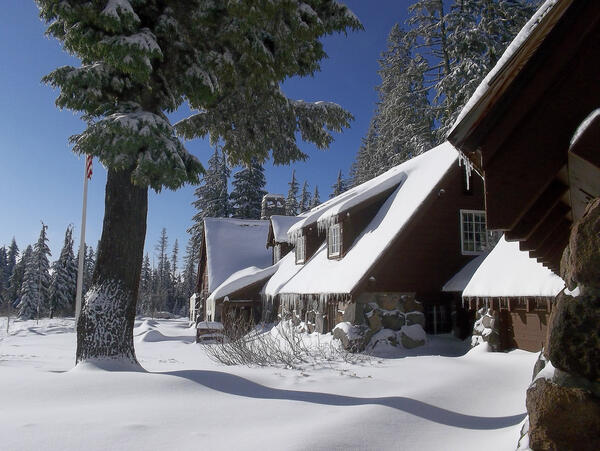
Steel Information Center in Winter at Crater Lake National Park.
Steel Information Center in Winter at Crater Lake National Park.

Photo of the lava lake within the vent inset within the east wall and floor of Halema‘uma‘u Crater on March 3, 2011, just days before the Kamoamoa fissure eruption caused the lake level to drop much deeper and out of sight.
Photo of the lava lake within the vent inset within the east wall and floor of Halema‘uma‘u Crater on March 3, 2011, just days before the Kamoamoa fissure eruption caused the lake level to drop much deeper and out of sight.

Map showing Pu‘u ‘Ō‘ō and the extent of nearby lava flows. The flows of the currently active episode 61 east flank phase (September 21-ongoing) are the two shades of red—pink is the extent of the flow from September 21 to October 25, and bright red marks flow expansion from October 25 to November 3. The trace of the tube carrying lava downslope is shown in yellow.
Map showing Pu‘u ‘Ō‘ō and the extent of nearby lava flows. The flows of the currently active episode 61 east flank phase (September 21-ongoing) are the two shades of red—pink is the extent of the flow from September 21 to October 25, and bright red marks flow expansion from October 25 to November 3. The trace of the tube carrying lava downslope is shown in yellow.

View looking northwest through rain at the silvery flows at the front of the active episode 61 flow field. Pu‘u ‘Ō‘ō is hidden in the clouds in the top left part of the photo. The ‘A‘ā flow at bottom center is the inactive terminus of the initial flow emplaced on September 21-22, 2011, after the episode 61 fissure on Pu‘u ‘Ō‘ō's east flank opened on September 21.
View looking northwest through rain at the silvery flows at the front of the active episode 61 flow field. Pu‘u ‘Ō‘ō is hidden in the clouds in the top left part of the photo. The ‘A‘ā flow at bottom center is the inactive terminus of the initial flow emplaced on September 21-22, 2011, after the episode 61 fissure on Pu‘u ‘Ō‘ō's east flank opened on September 21.

Ground view looking at the terminus of the active episode 61 pAHOEHEO flows. Pu‘u ‘Ō‘ō, the source of the flows, is hidden in the clouds at the top of the photo, just left of center.
Ground view looking at the terminus of the active episode 61 pAHOEHEO flows. Pu‘u ‘Ō‘ō, the source of the flows, is hidden in the clouds at the top of the photo, just left of center.