



Fissure 3 opened around 6:00 a.m. HST on Friday, May 4, with weak fuming from a crack on Kaupili Street. This fuming increased, as did rumbling sounds. Eventually spatter was ejected and accumulated around the fissure. Large, loud bubble bursts were common at this fissure.
Videos
Volcano Hazard Program videos.
Filter Total Items: 842

Kīlauea East Rift Zone Eruption (May 4, 2018)
Fissure 3 opened around 6:00 a.m. HST on Friday, May 4, with weak fuming from a crack on Kaupili Street. This fuming increased, as did rumbling sounds. Eventually spatter was ejected and accumulated around the fissure. Large, loud bubble bursts were common at this fissure.

Kīlauea East Rift Zone Eruption (May 4, 2018)
Fissure 2 opened around 1:00 a.m. HST on Friday, May 4, with a small area of spattering in a residential driveway. Within an hour the spattering was more vigorous, with spatter reaching about 30 meters (100 feet). This spatter was thrown over the power lines and landed on Makamae Street.
Fissure 2 opened around 1:00 a.m. HST on Friday, May 4, with a small area of spattering in a residential driveway. Within an hour the spattering was more vigorous, with spatter reaching about 30 meters (100 feet). This spatter was thrown over the power lines and landed on Makamae Street.

Kīlauea East Rift Zone Eruption (May 3, 2018)
This small fissure = opened in the Leilani Estates subdivision on the lower East Rift Zone of Kilauea Volcano around 5:00 p.m. Lava erupted from the fissure until about 6:30pm, when it became inactive.
This small fissure = opened in the Leilani Estates subdivision on the lower East Rift Zone of Kilauea Volcano around 5:00 p.m. Lava erupted from the fissure until about 6:30pm, when it became inactive.

Repeated overflows onto the Halema‘uma‘u crater floor (April 27, 2018)
Repeated overflows onto the Halema‘uma‘u crater floor (April 27, 2018)This time-lapse video from 7:30 p.m. April 25 to 7:30 p.m. April 26 shows Halema‘uma‘u lava lake producing intermittent overflows onto the crater floor. The largest of these flows was from approximately 6:15 a.m. to 10:30 a.m. on April 26 and covered about 90 acres (2/3) of the crater floor.
Repeated overflows onto the Halema‘uma‘u crater floor (April 27, 2018)
Repeated overflows onto the Halema‘uma‘u crater floor (April 27, 2018)This time-lapse video from 7:30 p.m. April 25 to 7:30 p.m. April 26 shows Halema‘uma‘u lava lake producing intermittent overflows onto the crater floor. The largest of these flows was from approximately 6:15 a.m. to 10:30 a.m. on April 26 and covered about 90 acres (2/3) of the crater floor.

Kīlauea Volcano - April 26th, 2018
Vigorous overflows from Kīlauea's summit lava lake covered a large portion of the floor of Halema‘uma‘u this morning. In this video, the view starts from the north and heads south, showing the north and east sides of Halema‘uma‘u crater.
Vigorous overflows from Kīlauea's summit lava lake covered a large portion of the floor of Halema‘uma‘u this morning. In this video, the view starts from the north and heads south, showing the north and east sides of Halema‘uma‘u crater.

Rising Lava Lake
Vigorous overflows from Kīlauea's summit lava lake covered a large portion of the floor of Halema‘uma‘u this morning. In this video, the view starts from the north and heads south, showing the north and east sides of Halema‘uma‘u crater.
Vigorous overflows from Kīlauea's summit lava lake covered a large portion of the floor of Halema‘uma‘u this morning. In this video, the view starts from the north and heads south, showing the north and east sides of Halema‘uma‘u crater.

Time-Lapse Showing Lava Lake Flows
This time-lapse video from 7:30 p.m. April 25 to 7:30 p.m. April 26 shows Halema‘uma‘u lava lake producing intermittent overflows onto the crater floor. The largest of these flows was from approximately 6:15 a.m. to 10:30 a.m. on April 26 and covered about 90 acres (2/3) of the crater floor.
This time-lapse video from 7:30 p.m. April 25 to 7:30 p.m. April 26 shows Halema‘uma‘u lava lake producing intermittent overflows onto the crater floor. The largest of these flows was from approximately 6:15 a.m. to 10:30 a.m. on April 26 and covered about 90 acres (2/3) of the crater floor.

Intermittent Lava Flows on Crater Floor
On Kīlauea Volcano's summit, the Halema‘uma‘u lava lake's high standing lake level produced intermittent overflows onto the crater floor. Smaller overflows and spattering have started to build a few discontinuous levees and a spatter cone around the lake margin, shown in these video clips taken from the lakes north and northeastern margin.
On Kīlauea Volcano's summit, the Halema‘uma‘u lava lake's high standing lake level produced intermittent overflows onto the crater floor. Smaller overflows and spattering have started to build a few discontinuous levees and a spatter cone around the lake margin, shown in these video clips taken from the lakes north and northeastern margin.

Kīlauea Volcano - April 25th, 2018
On Kīlauea Volcano's summit, the Halema‘uma‘u lava lake's high standing lake level produced intermittent overflows onto the crater floor.
On Kīlauea Volcano's summit, the Halema‘uma‘u lava lake's high standing lake level produced intermittent overflows onto the crater floor.

Overview of the Lake from Halema`uma`u Crater Rim
Rising summit lake levels peaked last night, producing small overflows onto the Halema'uma'u Crater floor. The lake remains high this afternoon, with spattering along the lake margins. The lake level IS just a couple meters (yards) below the crater rim.
Rising summit lake levels peaked last night, producing small overflows onto the Halema'uma'u Crater floor. The lake remains high this afternoon, with spattering along the lake margins. The lake level IS just a couple meters (yards) below the crater rim.

A virtual flyover of Pu‘u ‘Ō‘ō
This video shows a virtual flyover of Pu‘u ‘Ō‘ō, the active vent on Kīlauea's East Rift Zone. The 3-D model was constructed from thermal images collected by USGS Hawaiian Volcano Observatory geologists during a helicopter overflight on April 18.
This video shows a virtual flyover of Pu‘u ‘Ō‘ō, the active vent on Kīlauea's East Rift Zone. The 3-D model was constructed from thermal images collected by USGS Hawaiian Volcano Observatory geologists during a helicopter overflight on April 18.

Time-Lapse on Rim of Pu`u `Ō`ō
This time-lapse image sequence taken by a time-lapse camera on the rim of Pu‘u ‘Ō‘ō's west pit, spans March 20 to April 18. The sequence, of approximately one image per day, shows the growth of the lava pond within the west pit as it developed into a perched lava pond. This sequence is looped 4 times.
This time-lapse image sequence taken by a time-lapse camera on the rim of Pu‘u ‘Ō‘ō's west pit, spans March 20 to April 18. The sequence, of approximately one image per day, shows the growth of the lava pond within the west pit as it developed into a perched lava pond. This sequence is looped 4 times.

Rockfall and Explosion from Overlook Crater
Video: At 10:28 a.m. HST this morning (April 6), rock falls from the Overlook crater wall into Kīlauea Volcano's summit lava lake triggered an explosive event. This video, taken by the K2cam, shows a dark pulsing plume of ash and debris.
Video: At 10:28 a.m. HST this morning (April 6), rock falls from the Overlook crater wall into Kīlauea Volcano's summit lava lake triggered an explosive event. This video, taken by the K2cam, shows a dark pulsing plume of ash and debris.

Video of Kīlauea Volcano's summit lava lake
Video: Clear skies and sunshine provided a spectacular view of Kīlauea Volcano's summit lava lake this morning. Spattering on the north side and center of the lake surface—a departure from its more common location on the southeast side of the lake—occasionally happens when the surface flow direction reverses.
Video: Clear skies and sunshine provided a spectacular view of Kīlauea Volcano's summit lava lake this morning. Spattering on the north side and center of the lake surface—a departure from its more common location on the southeast side of the lake—occasionally happens when the surface flow direction reverses.

USGS Scientist Talks About Lava Lake in Halema‘uma‘u Crater
USGS Scientist Talks About Lava Lake in Halema‘uma‘u CraterUSGS–Hawaiian Volcano Observatory research geologist Matt Patrick talks about the lava lake in the Halema‘uma‘u Crater at the Kīlauea Volcano (Hawaii). Dr. Patrick describes the eruption that created the lava lake and points out features of the lake including moving crustal plates, gas bursts, spatter and collapse scars on the crater rim. Dr.
USGS Scientist Talks About Lava Lake in Halema‘uma‘u Crater
USGS Scientist Talks About Lava Lake in Halema‘uma‘u CraterUSGS–Hawaiian Volcano Observatory research geologist Matt Patrick talks about the lava lake in the Halema‘uma‘u Crater at the Kīlauea Volcano (Hawaii). Dr. Patrick describes the eruption that created the lava lake and points out features of the lake including moving crustal plates, gas bursts, spatter and collapse scars on the crater rim. Dr.

Yellowstone Volcano Observatory Scientists Host Facebook Live Event
Yellowstone Volcano Observatory Scientists Host Facebook Live EventUSGS–Yellowstone Volcano Observatory Scientist-in-Charge Mike Poland, Deputy Scientist-in-Charge Wendy Stovall, and Chief Seismologist Jamie Farrell answer questions from the public about Yellowstone earthquakes, deformation, eruptive history, the magmatic plumbing system, and more, during a USGS Volcanoes Facebook Live event recorded on March 7, 2018, at the USGS–C
Yellowstone Volcano Observatory Scientists Host Facebook Live Event
Yellowstone Volcano Observatory Scientists Host Facebook Live EventUSGS–Yellowstone Volcano Observatory Scientist-in-Charge Mike Poland, Deputy Scientist-in-Charge Wendy Stovall, and Chief Seismologist Jamie Farrell answer questions from the public about Yellowstone earthquakes, deformation, eruptive history, the magmatic plumbing system, and more, during a USGS Volcanoes Facebook Live event recorded on March 7, 2018, at the USGS–C

Time-lapse image sequence of small collapse in Pu‘u ‘Ō‘ō in February
Time-lapse image sequence of small collapse in Pu‘u ‘Ō‘ō in FebruaryThis time-lapse image sequence spans just over an hour (7:50 a.m. to 9:00 a.m.) on February 10. The sequence, which is repeated 20 times in this "movie," shows subsidence and collapse of the northeast rim of the west pit within the Pu‘u ‘Ō‘ō crater on Kīlauea's East Rift Zone.
Time-lapse image sequence of small collapse in Pu‘u ‘Ō‘ō in February
Time-lapse image sequence of small collapse in Pu‘u ‘Ō‘ō in FebruaryThis time-lapse image sequence spans just over an hour (7:50 a.m. to 9:00 a.m.) on February 10. The sequence, which is repeated 20 times in this "movie," shows subsidence and collapse of the northeast rim of the west pit within the Pu‘u ‘Ō‘ō crater on Kīlauea's East Rift Zone.
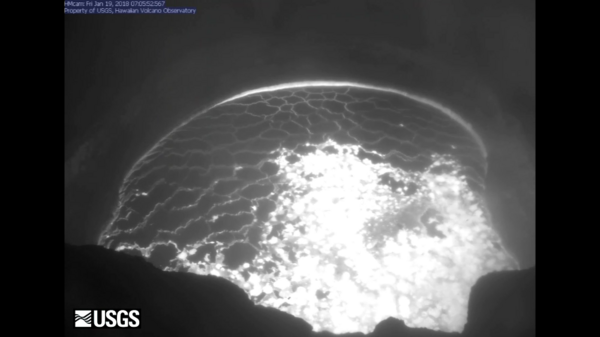
Rockfalls trigger explosions in Kīlauea Volcano's summit lava lake
Rockfalls trigger explosions in Kīlauea Volcano's summit lava lakeThis video shows a rockfall and subsequent explosion that occurred at 7:03 a.m. HST today within the "Overlook crater" at the summit of Kīlauea. This collapse was followed by a smaller rockfall at 7:07 a.m. (not shown in video).
Rockfalls trigger explosions in Kīlauea Volcano's summit lava lake
Rockfalls trigger explosions in Kīlauea Volcano's summit lava lakeThis video shows a rockfall and subsequent explosion that occurred at 7:03 a.m. HST today within the "Overlook crater" at the summit of Kīlauea. This collapse was followed by a smaller rockfall at 7:07 a.m. (not shown in video).

Listen to Earthquakes
Seismometers record vibrations from a wide assortment of ground motion events. Each event type has a distinctive ground-motion signal with unique frequency and amplitude—its own seismic signature. Seismologists are trained to identify the source of seismic events seen on a webicorder based on its ‘seismic signature’.
Seismometers record vibrations from a wide assortment of ground motion events. Each event type has a distinctive ground-motion signal with unique frequency and amplitude—its own seismic signature. Seismologists are trained to identify the source of seismic events seen on a webicorder based on its ‘seismic signature’.

Kīlauea Summit Eruption — Lava Returns to Halemaʻumaʻu
Kīlauea Summit Eruption — Lava Returns to HalemaʻumaʻuIn March 2008, a new volcanic vent opened within Halema‘uma‘u, a crater at the summit of Kīlauea Volcano in Hawaiʻi Volcanoes National Park on the Island of Hawaiʻi. This new vent is one of two ongoing eruptions on the volcano. The other is on Kīlauea’s East Rift Zone, where vents have been erupting nearly nonstop since 1983.
Kīlauea Summit Eruption — Lava Returns to Halemaʻumaʻu
Kīlauea Summit Eruption — Lava Returns to HalemaʻumaʻuIn March 2008, a new volcanic vent opened within Halema‘uma‘u, a crater at the summit of Kīlauea Volcano in Hawaiʻi Volcanoes National Park on the Island of Hawaiʻi. This new vent is one of two ongoing eruptions on the volcano. The other is on Kīlauea’s East Rift Zone, where vents have been erupting nearly nonstop since 1983.

Breakouts Active on Coastal Plain
Breakouts remain active on the coastal plain, near the base of the pali. This pāhoehoe breakout was pouring into a small crack when HVO geologists encountered It this afternoon.
Breakouts remain active on the coastal plain, near the base of the pali. This pāhoehoe breakout was pouring into a small crack when HVO geologists encountered It this afternoon.