U.S. flag

An official website of the United States government

Videos

Earthquake Hazards Program videos.

Filter Total Items: 67
Shaking of Frontier Building — Anchorage, Alaska, During Mw7.1 Earthquake, January 24, 2016

This video presents a visualization of shaking that was recorded in the Frontier Building in Anchorage, Alaska, during the Mw7.1 earthquake, January 24, 2016, Iniskin, Alaska. It exhibits how a tall building behaves and performs during strong earthquake shaking.

Flat Canyon Trench Excavation, Wasatch Fault Zone, Utah

A time-lapse video of the excavation of the trench for a paleoseismology research project at Flat Canyon, Utah, along the Wasatch fault zone.
 

Elastic Rebound
Elastic Rebound
Elastic Rebound

Elastic rebound is what happens to the crustal material on either side of a fault during an earthquake. The idea is that a fault is stuck until the strain accumulated in the rock on either side of the fault has overcome the friction making it stick.

Elastic rebound is what happens to the crustal material on either side of a fault during an earthquake. The idea is that a fault is stuck until the strain accumulated in the rock on either side of the fault has overcome the friction making it stick.

Shadow Zone
Shadow Zone
Shadow Zone

The shadow zone is the area of the earth from angular distances of 104 to 140 degrees that, for a given earthquake, that does not receive any direct P waves. The shadow zone results from S waves (not shown in animation) being stopped entirely by the liquid core and P waves being bent (refracted) by the liquid core.

The shadow zone is the area of the earth from angular distances of 104 to 140 degrees that, for a given earthquake, that does not receive any direct P waves. The shadow zone results from S waves (not shown in animation) being stopped entirely by the liquid core and P waves being bent (refracted) by the liquid core.

Wavefront
Wavefront
Wavefront

The wavefront is the instantaneous boundary between the seismic waves in the earth material, and the material that the seismic energy has not yet reached. As a seismic wave propagates through the earth, the wavefront moves.

The wavefront is the instantaneous boundary between the seismic waves in the earth material, and the material that the seismic energy has not yet reached. As a seismic wave propagates through the earth, the wavefront moves.

Foreshocks, Mainshocks, and Aftershocks

Aftershocks are earthquakes that follow the largest shock of an earthquake sequence. They are smaller than the mainshock and within 1-2 fault lengths distance from the mainshock fault. Aftershocks can continue over a period of weeks, months, or years.

Aftershocks are earthquakes that follow the largest shock of an earthquake sequence. They are smaller than the mainshock and within 1-2 fault lengths distance from the mainshock fault. Aftershocks can continue over a period of weeks, months, or years.

Directivity
Directivity
Directivity

Directivity is an effect of a fault rupturing whereby earthquake ground motion in the direction of rupture propagation is more severe than that in other directions from the earthquake source.

Directivity is an effect of a fault rupturing whereby earthquake ground motion in the direction of rupture propagation is more severe than that in other directions from the earthquake source.

Thrust Fault
Thrust Fault
Thrust Fault

A thrust fault is a reverse fault with a dip of 45° or less, a very low angle. This animation shows a reverse fault which is a steeper-angle fault, but it moves the same way.

A thrust fault is a reverse fault with a dip of 45° or less, a very low angle. This animation shows a reverse fault which is a steeper-angle fault, but it moves the same way.

Great Circle
Great Circle
Great Circle

The shortest path between two points on the surface of a sphere lies along a great circle. On a 2-dimensional map, this looks like a line, but when it's on a 3-dimensional sphere, it's an arc... part of a circle.

The shortest path between two points on the surface of a sphere lies along a great circle. On a 2-dimensional map, this looks like a line, but when it's on a 3-dimensional sphere, it's an arc... part of a circle.

Attenuation
Attenuation
Attenuation

When you throw a pebble in a pond, it makes waves on the surface that move out from the place where the pebble entered the water. The waves are largest where they are formed and gradually get smaller as they move away. This decrease in size, or amplitude, of the waves is called attenuation.

When you throw a pebble in a pond, it makes waves on the surface that move out from the place where the pebble entered the water. The waves are largest where they are formed and gradually get smaller as they move away. This decrease in size, or amplitude, of the waves is called attenuation.

Normal Fault
Normal Fault
Normal Fault

Normal, or Dip-slip, faults are inclined fractures where the blocks have mostly shifted vertically. If the rock mass above an inclined fault moves down, the fault is termed normal, whereas if the rock above the fault moves up, the fault is termed a Reverse fault.

Normal, or Dip-slip, faults are inclined fractures where the blocks have mostly shifted vertically. If the rock mass above an inclined fault moves down, the fault is termed normal, whereas if the rock above the fault moves up, the fault is termed a Reverse fault.

Divergent
Divergent
Divergent

A divergent boundary is where two adjacent tectonic plates are moving away from each other.

A divergent boundary is where two adjacent tectonic plates are moving away from each other.

Horst and Graben
Horst and Graben
Horst and Graben

A horst is an upthrown block lying between two steep-angled fault blocks. A graben is a down-dropped block of the earth's crust resulting from extension, or pulling, of the crust.

A horst is an upthrown block lying between two steep-angled fault blocks. A graben is a down-dropped block of the earth's crust resulting from extension, or pulling, of the crust.

Liquefaction
Liquefaction
Liquefaction

Liquefaction is a process by which water-saturated sediment temporarily loses strength and acts like a fluid... like when you wiggle your toes in the wet sand near the water at the beach. This effect can be caused by earthquake shaking.

Liquefaction is a process by which water-saturated sediment temporarily loses strength and acts like a fluid... like when you wiggle your toes in the wet sand near the water at the beach. This effect can be caused by earthquake shaking.

Strike-Slip Fault
Strike-Slip Fault
Strike-Slip Fault

Strike-slip faults are vertical (or nearly vertical) fractures where the blocks have mostly moved horizontally. If the block opposite an observer looking across the fault moves to the right, the slip style is termed right-lateral; if the block moves to the left, the motion is termed left-lateral.

Strike-slip faults are vertical (or nearly vertical) fractures where the blocks have mostly moved horizontally. If the block opposite an observer looking across the fault moves to the right, the slip style is termed right-lateral; if the block moves to the left, the motion is termed left-lateral.

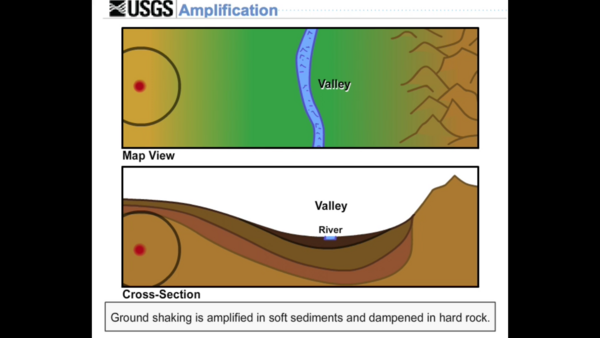
Amplification
Amplification
Amplification

Shaking at a site may be increased, or amplified, by focusing of seismic energy caused by the materials in basins or by surface topography such as mountains.

Shaking at a site may be increased, or amplified, by focusing of seismic energy caused by the materials in basins or by surface topography such as mountains.

Asperity
Asperity
Asperity

An asperity is an area on a fault that is stuck. The earthquake rupture usually begins at an asperity.

An asperity is an area on a fault that is stuck. The earthquake rupture usually begins at an asperity.

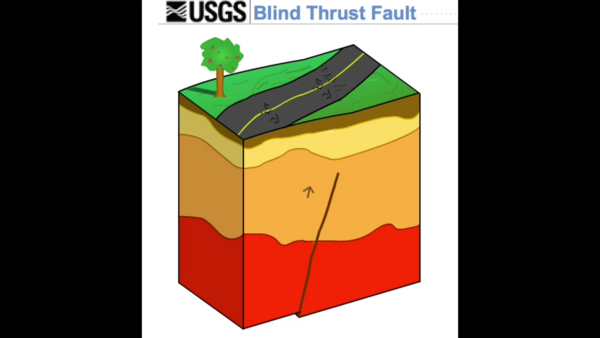
Blind Thrust Fault
Blind Thrust Fault
Blind Thrust Fault

A thrust fault that does not rupture all the way up to the surface so there is no evidence of it on the ground. It is buried under the uppermost layers of rock in the crust.

A thrust fault that does not rupture all the way up to the surface so there is no evidence of it on the ground. It is buried under the uppermost layers of rock in the crust.

Preparedness Now
Preparedness Now
Preparedness Now

This film depicts the realistic outcome of a hypothetical, but plausible, magnitude 7.8 earthquake on the San Andreas fault in Southern CA.

This film depicts the realistic outcome of a hypothetical, but plausible, magnitude 7.8 earthquake on the San Andreas fault in Southern CA.

Preparedness Now

This film takes you on a visceral journey through the USGS ShakeOut Earthquake Scenario.

This film takes you on a visceral journey through the USGS ShakeOut Earthquake Scenario.

Was this page helpful?