Lake Abert, Oregon is one of the 20 terminal lakes identified by USGS partners as priority ecosystems for study by the Saline Lakes Ecosystems IWAA.
Images
Multimedia related to the Species Management Research Program are shown below. Click on an image to see a larger view and additional details.
Lake Abert, Oregon is one of the 20 terminal lakes identified by USGS partners as priority ecosystems for study by the Saline Lakes Ecosystems IWAA.
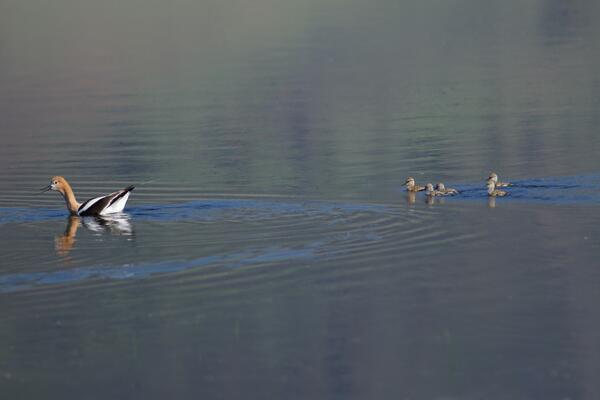
American Avocet are a bird that relies heavily on the Saline Lakes ecosystem during their spring migration periods. Over 50% of these birds exist here. Part of their use includes using the terminal lakes there to breed.
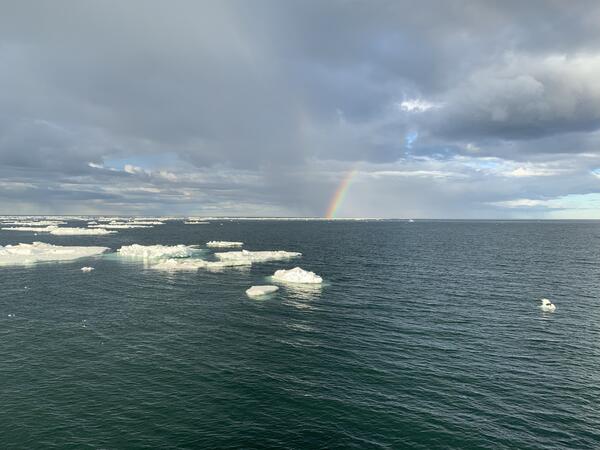
A rainbow emerges from an evening shower in the Chukchi Sea. USGS and the U.S.
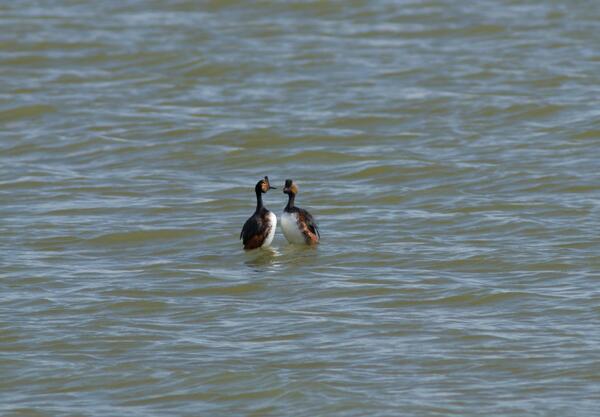
Eared grebes in a courtship behavior in the Great Salt Lake. They are one of many migratory birds in the Great Basin that rely on terminal lakes and wetlands in the area to stop rest and feed.
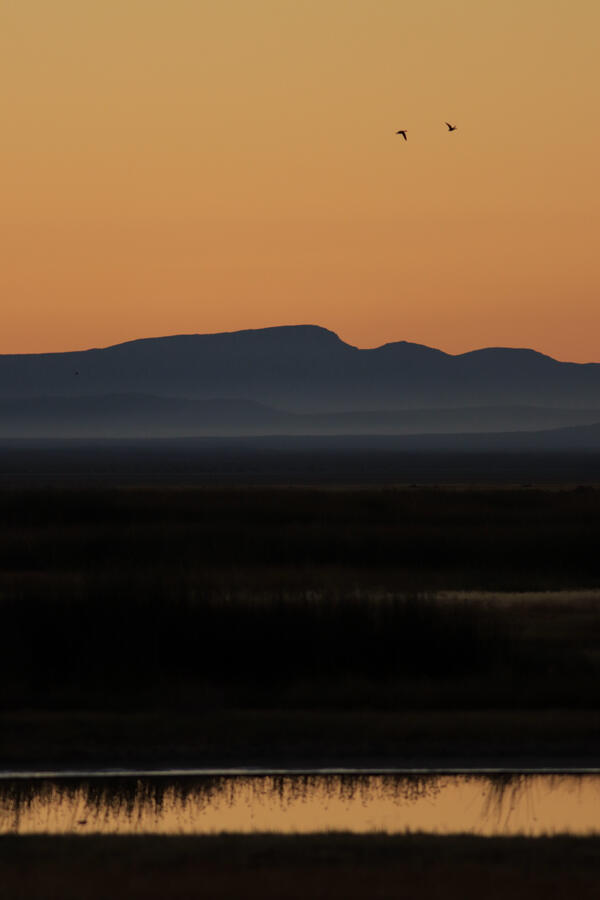
Photograph of Summer Lake Wildlife Area, an important stopping spot for migratory birds on their spring and fall migration flights.
Lone goose at sunrise at Summer Lake Wildlife Area
Lone goose at sunrise at Summer Lake Wildlife AreaLooking east on Bullgate Pond at sunrise with lone tule white-fronted goose (Anser albifrons elgasi) in upper right, Summer Lake Wildlife Area, near Summer Lake, Oregon.
Lone goose at sunrise at Summer Lake Wildlife Area
Lone goose at sunrise at Summer Lake Wildlife AreaLooking east on Bullgate Pond at sunrise with lone tule white-fronted goose (Anser albifrons elgasi) in upper right, Summer Lake Wildlife Area, near Summer Lake, Oregon.
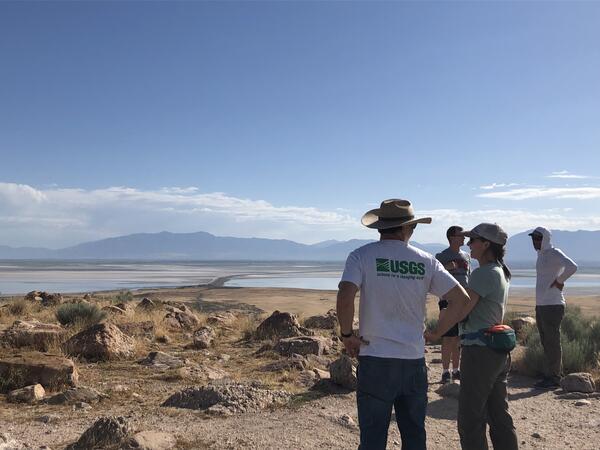
Scientist looking out onto the GSL from Antelope Island
Scientist looking out onto the GSL from Antelope IslandThese scientists are working on The Great Salt Lake to determine the amount of water and qualities of it. This will help them in developing better management techniques that will work to support the migratory birds that frequent the area.
Scientist looking out onto the GSL from Antelope Island
Scientist looking out onto the GSL from Antelope IslandThese scientists are working on The Great Salt Lake to determine the amount of water and qualities of it. This will help them in developing better management techniques that will work to support the migratory birds that frequent the area.
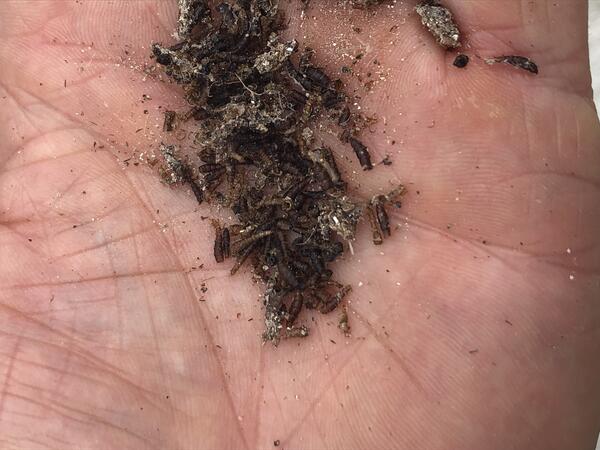
These brine flies are an important fuel source for migratory birds, giving them energy for long flights.
This passive acoustic recording device has been deployed in Montana (MT) as part of the North American Bat Monitoring Programs (NABat) summertime survey efforts. It has an ultrasonic microphone placed at the top of a 10ft pole that records echolocating bats fro
Another Columbia spotted frog (Rana luteiventris) collected for methylmercury sampling in Montana.
Another Columbia spotted frog (Rana luteiventris) collected for methylmercury sampling in Montana.A Columbia spotted frog (Rana luteiventris) collected for methylmercury sampling in Montana.
Another Columbia spotted frog (Rana luteiventris) collected for methylmercury sampling in Montana.
Another Columbia spotted frog (Rana luteiventris) collected for methylmercury sampling in Montana.A Columbia spotted frog (Rana luteiventris) collected for methylmercury sampling in Montana.
Who's who? Print casts of grizzly (top) and black bear (bottom).
Who's who? Print casts of grizzly (top) and black bear (bottom).Who's who? These are print casts of front and back paw prints of a grizzly bear (top) and black bear (bottom). The casts on the right are the front paws of each species; the casts on the left are the back. How do you tell?
Who's who? Print casts of grizzly (top) and black bear (bottom).
Who's who? Print casts of grizzly (top) and black bear (bottom).Who's who? These are print casts of front and back paw prints of a grizzly bear (top) and black bear (bottom). The casts on the right are the front paws of each species; the casts on the left are the back. How do you tell?
Source: USGS National Wetlands Research Center. Photographer: Brad M. Glorioso. St. Tammany Parish, Louisiana
Necturus beyeri - Gulf Coast Waterdog
Source: USGS National Wetlands Research Center. Photographer: Brad M. Glorioso. St. Tammany Parish, Louisiana
Necturus beyeri - Gulf Coast Waterdog
Bat, bird, and insect activity can be monitored with pairs of thermal-imaging cameras mounted on the wind turbines, and automatically recorded to a computer inside the base of the turbine.
Equipment used during a shore-counted portion of the annual range-wide sea otter census. On the clipboard is a paper map, with sea otter locations, numbers, behavior and habitat recorded, as well as some other environmental variables. The spotting scope is used to view sea otters that are far away, and binoculars are used to scan areas for otters.
Three of the nine wild sea otter populations in the U.S. are federally listed as threatened. In California, USGS biologists have lead an annual population census to assess the local populations' recovery, working closely with state agencies and the Monterey Bay Aquarium.
Pallid sturgeon free embryo at approximately 2 days post-hatch
Pallid sturgeon free embryo at approximately 2 days post-hatchPallid sturgeon free embryo at approximately 2 days post-hatch, approximately 11-12 mm (about 0.45 of an inch) in length.
Pallid sturgeon free embryo at approximately 2 days post-hatch
Pallid sturgeon free embryo at approximately 2 days post-hatchPallid sturgeon free embryo at approximately 2 days post-hatch, approximately 11-12 mm (about 0.45 of an inch) in length.
Pallid sturgeon free embryo at approximately 5 days post-hatch
Pallid sturgeon free embryo at approximately 5 days post-hatchFigure 3. Pallid sturgeon free embryo at approximately 5 days post-hatch, approximately 14-15 mm (about 0.57 of an inch) in length.
Pallid sturgeon free embryo at approximately 5 days post-hatch
Pallid sturgeon free embryo at approximately 5 days post-hatchFigure 3. Pallid sturgeon free embryo at approximately 5 days post-hatch, approximately 14-15 mm (about 0.57 of an inch) in length.
Pallid sturgeon free embryo at approximately 10 days post-hatch
Pallid sturgeon free embryo at approximately 10 days post-hatchPallid sturgeon free embryo at approximately 10 days post-hatch, approximately 19-20 mm (about 0.77 of an inch) in length.
Pallid sturgeon free embryo at approximately 10 days post-hatch
Pallid sturgeon free embryo at approximately 10 days post-hatchPallid sturgeon free embryo at approximately 10 days post-hatch, approximately 19-20 mm (about 0.77 of an inch) in length.
A U.S. Geological Survey hydraulic habitat assessment boat in not enough water.
USGS fish biologist Dr. Pat Braaten and student contractor Garrett Cook inspect contents of a larval fish net during night sampling on the Upper Missouri River.
USGS Fish Biologist Dave Combs searches through net contents for larval fish during night sampling on the Upper Missouri River.