



Endocrine Disruption
Endocrine Disruption
Filter Total Items: 40

Sublethal Effects of Contaminants in Aquatic Food Webs—Research Challenges and Considerations for Future Studies
U.S. Geological Survey (USGS) and academic scientists partnered to identify challenges and provide considerations for future scientific study designs to advance our understanding of the often subtle sublethal effects of contaminants on individuals, populations, communities, and entire aquatic food webs.

No Evidence of Toxicity to Birds Ingesting Neonicotinoid-Coated Wheat Seeds During Controlled Laboratory Study
Scientists determined what happens to the neonicotinoid insecticide, imidacloprid, on coated wheat seeds once ingested by Japanese quail (Coturnix japonica)—a model species for free-range, seed-eating, upland game birds. Imidacloprid was found to be rapidly adsorbed, metabolized, and excreted, and resulted in no overt signs of toxicity during a controlled laboratory study.

Can There be Unintended Benefits when Wastewater Treatment Infrastructure is Upgraded?
Science from the U.S. Geological Survey (USGS) and other entities has shown that a mixture of natural and synthetic estrogens and other similar chemicals are discharged from wastewater treatment plants (WWTPs) to streams and rivers.

Are Tumors in Wild Fish Harvested in the Great Lakes Region Related to Contaminants in Water Resources?
Our specialized teams of scientists are working in our laboratories and at field sites around the Great Lakes in collaboration with other federal and state resource agencies to document the prevalence of skin and liver tumors in fish. Tumor prevalence in white suckers ( Catostomus commersonii), a fish harvested as a food source by local communities, is related to the degree of urbanization in the...

Bioactive Chemicals Research Laboratory
The Bioactive Chemicals Research Laboratory applies a collaborative transdisciplinary approach to conduct research to minimize the risk to human and aquatic organism health from exposure to contaminants in water supplies.

Environmental Chemistry Core Technology Team
About the Research The Environmental Chemistry Laboratory Core Technology Team (CTT) as part of the Environmental Health Program develops and applies innovative methods of sampling and analysis to answer critical questions about the occurrence, distribution, fate and transport, and biological exposure of chemical in all environmental matrices (water, air, tissues, sediments, and others).
Outdoor Resources Integrated Science Team
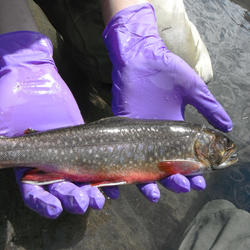
The Outdoor Resources Integrated Science Team studies how contaminants, pathogens, and other environmental stressors affect the health of fish and wildlife that support recreational and cultural traditions, providing practical science that guides responsible land and water use, supports informed stewardship, and helps ensure resilient outdoor resources for all communities.

Endocrine Active Chemical Screening Tests Optimized to Improve Precision, Accuracy, and Timeliness
Scientists optimized existing endocrine active chemical screening tests to improve their precision, accuracy, and ability to screen more samples in a shorter time-frame. The optimization was done to more rapidly obtain results from the bioassays so that research on the risks of endocrine active chemical exposure can proceed more rapidly.

Endocrine Disrupting Compounds in the Chesapeake Bay Watershed Science Team
The Chesapeake Bay is the largest estuary in the United States and provides critical resources to fish, wildlife and people. For more than a decade, recreational fish species have been plagued with skin lesions and intersex conditions (the presence of male and female sex characteristics in the same fish) that biologists attributed to exposures to endocrine disrupting chemicals (EDCs)...

Study Highlights the Complexity of Chemical Mixtures in United States Streams
A new study highlights the complexity of chemical mixtures in streams and advances the understanding of wildlife and human exposure to complex chemical mixtures.

Gestodene Affects Fish Reproductive Behavior in Laboratory Exposure Study
Short-term laboratory exposure of adult fathead minnows to the human contraceptive progestin, gestodene (GES), at environmentally relevant concentrations induced rapid and negative effects on reproductive health and suggests that wild fish may be similarly affected.

Synthetic Progestin Affects Fish Reproductive Development and Behavior in Laboratory Exposure Study
Scientists conducted laboratory experiments on levonorgestrel (a synthetic progestin) and observed differential effects to males (reproductive behavior) and females (masculinization) of eastern mosquitofish ( Gambusia holbrooki).