
U.S. flag

An official website of the United States government

Images

Browse images from a wide range of science topics covered by USGS.

Filter Total Items: 960
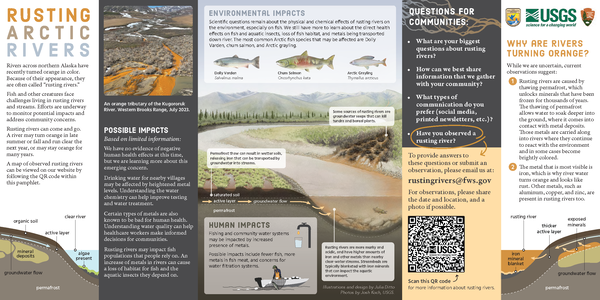
Orange, gray, and white, three-panel pamphlet describing rusting arctic rivers.
Rusting Arctic Rivers Pamphlet

Rivers across northern Alaska have recently turned orange in color. Because of their appearance, they are often called “rusting rivers.”

Rivers across northern Alaska have recently turned orange in color. Because of their appearance, they are often called “rusting rivers.”

Scientist, Paul Hershberger, leans over a green tank of fish in the Seattle wet lab
Scientist, Paul Hershberger Works in the Wet Lab

In this photo, Paul Hershberger is conducting research in the Seattle Western Fisheries Research Center wet laboratory. He is working to study diseases in fish.

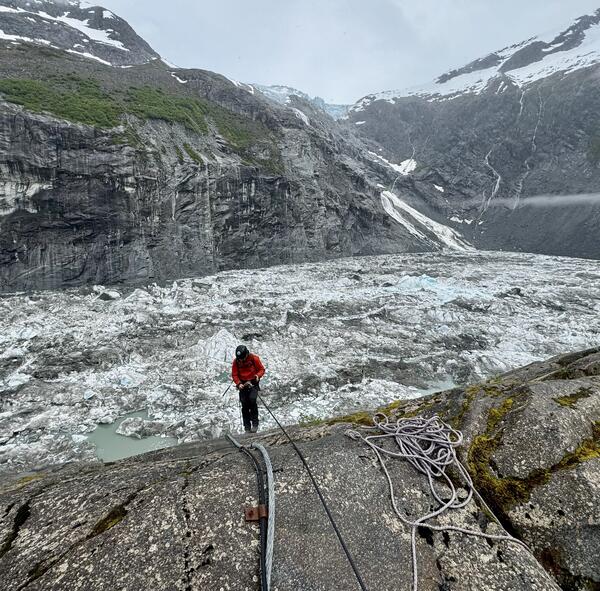
Person in a red jacket standing near a basin covered in ice.
Suicide Basin above Juneau Alaska

USGS staff inspecting monitoring equipment in Suicide Basin. Suicide Basin is a side basin of the Mendenhall Glacier above Juneau, Alaska.

USGS staff inspecting monitoring equipment in Suicide Basin. Suicide Basin is a side basin of the Mendenhall Glacier above Juneau, Alaska.

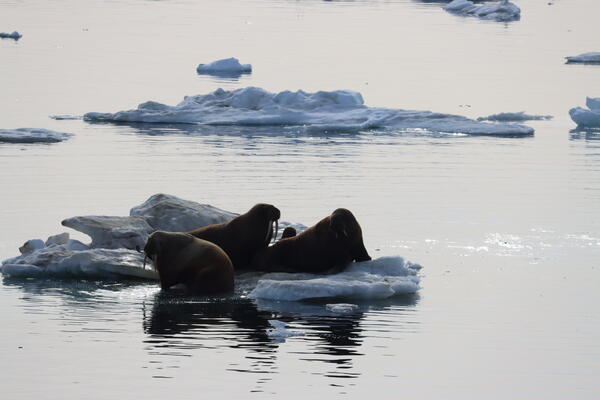
Three walruses laying on sea ice.
Pacific walruses hauled out on sea ice evaluating their surroundings

A small group of Pacific walruses consider entering the water as they assess their surroundings.  A calf can be seen in the back of the group.  USGS and the U.S.

An orange stream flowing into a larger blue river.
Orange staining in a side channel of the Nakolikurok Creek

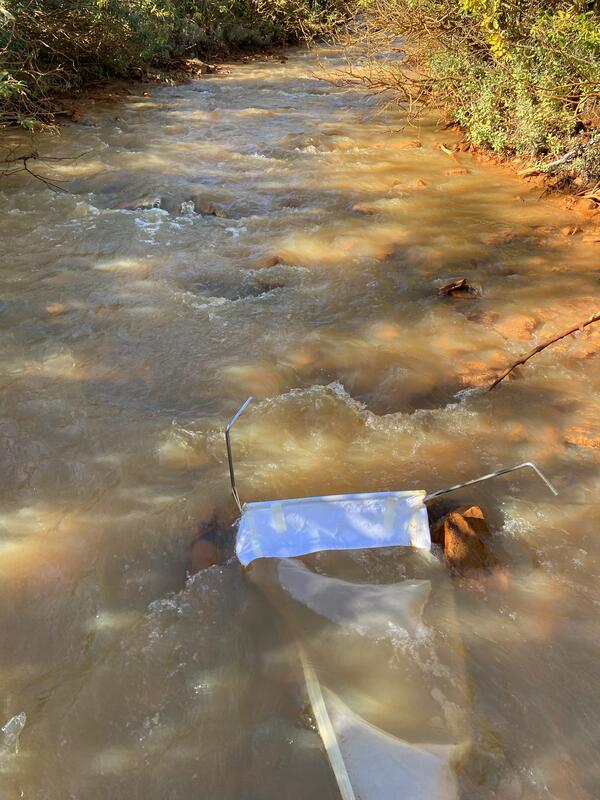
Orange streams are increasingly common in the Brooks Range of northern Alaska. The orange stream color reflects oxidized iron, but also often indicates elevated heavy metal concentrations. Our ongoing study aims to document these occurrences and the timing of their onset.
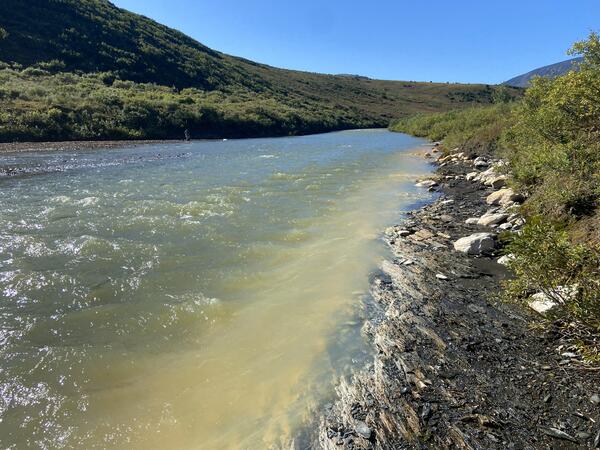
Orange streams are increasingly common in the Brooks Range of northern Alaska. The orange stream color reflects oxidized iron, but also often indicates elevated heavy metal concentrations. Our ongoing study aims to document these occurrences and the timing of their onset.
Brown grass clumps surrounded by green grass.
Emergence of acidic waters from a seep in the Agashashok River Watershed

Orange streams are increasingly common in the Brooks Range of northern Alaska. The orange stream color reflects oxidized iron, but also often indicates elevated heavy metal concentrations. Our ongoing study aims to document these occurrences and the timing of their onset.

Orange streams are increasingly common in the Brooks Range of northern Alaska. The orange stream color reflects oxidized iron, but also often indicates elevated heavy metal concentrations. Our ongoing study aims to document these occurrences and the timing of their onset.

A person standing behind a pale orange river.
An orange tributary of the Igning River, Gates of the Arctic National Park and Preserve, Alaska

Orange streams are increasingly common in the Brooks Range of northern Alaska. The orange stream color reflects oxidized iron, but also often indicates elevated heavy metal concentrations. Our ongoing study aims to document these occurrences and the timing of their onset.

Two people in a boat and one of the people sitting and holding water sampling equiptment.
USGS staff collecting water quality samples on the Yukon River at Eagle

USGS staff sample the Yukon River for cyanide after a heap leach failure occurred upstream at the Eagle Gold Mine in the Yukon, Canada.

Grey fish with large dorsal fin laying on sand.
Arctic Grayling (Thymallus arctus) caught in the Nakolikuruk River near an orange tributary, Noatak National Preserve, Alaska

Orange streams are increasingly common in the Brooks Range of northern Alaska. The orange stream color reflects oxidized iron, but also often indicates elevated heavy metal concentrations. Our ongoing study aims to document these occurrences and the timing of their onset.

A man in a blue jacket standing in front of a river.
Surveying for "rusting rivers" in the Nakolikurok Creek watershed, Noatak National Preserve, Alaska

Orange streams are increasingly common in the Brooks Range of northern Alaska. The orange stream color reflects oxidized iron, but also often indicates elevated heavy metal concentrations. Our ongoing study aims to document these occurrences and the timing of their onset.
Two people walking up an orange creek bed.
Researchers walking to a site to sample rusting in the Nakolikurok Creek Watershed

Orange streams are increasingly common in the Brooks Range of northern Alaska. The orange stream color reflects oxidized iron, but also often indicates elevated heavy metal concentrations. Our ongoing study aims to document these occurrences and the timing of their onset.

Orange streams are increasingly common in the Brooks Range of northern Alaska. The orange stream color reflects oxidized iron, but also often indicates elevated heavy metal concentrations. Our ongoing study aims to document these occurrences and the timing of their onset.
Orange-stained rock along a creek bed.
Researchers following orange staining up the braidplain of the Nakolikurok Creek

Orange streams are increasingly common in the Brooks Range of northern Alaska. The orange stream color reflects oxidized iron, but also often indicates elevated heavy metal concentrations. Our ongoing study aims to document these occurrences and the timing of their onset.
Orange streams are increasingly common in the Brooks Range of northern Alaska. The orange stream color reflects oxidized iron, but also often indicates elevated heavy metal concentrations. Our ongoing study aims to document these occurrences and the timing of their onset.
A blue creek running down a hillside into an orange river.
A seep emanates from a hillslope in the Nakolikurok Creek Watershed, blackening vegetation and staining the streambanks orange

Orange streams are increasingly common in the Brooks Range of northern Alaska. The orange stream color reflects oxidized iron, but also often indicates elevated heavy metal concentrations. Our ongoing study aims to document these occurrences and the timing of their onset.

Two people sampling water from an orange creek.
Two scientists sample the orange water of a seep in the Kelly River Watershed, Alaska

Orange streams are increasingly common in the Brooks Range of northern Alaska. The orange stream color reflects oxidized iron, but also often indicates elevated heavy metal concentrations. Our ongoing study aims to document these occurrences and the timing of their onset.
Orange streams are increasingly common in the Brooks Range of northern Alaska. The orange stream color reflects oxidized iron, but also often indicates elevated heavy metal concentrations. Our ongoing study aims to document these occurrences and the timing of their onset.
Orange stained rock along a creek.
Orange staining in the braidplain of the Nakolikurok Creek

Orange streams are increasingly common in the Brooks Range of northern Alaska. The orange stream color reflects oxidized iron, but also often indicates elevated heavy metal concentrations. Our ongoing study aims to document these occurrences and the timing of their onset.
Orange streams are increasingly common in the Brooks Range of northern Alaska. The orange stream color reflects oxidized iron, but also often indicates elevated heavy metal concentrations. Our ongoing study aims to document these occurrences and the timing of their onset.
Person walking through green grass next to an orange creek.
A scientist walks uphill towards the source of an orange seep

Orange streams are increasingly common in the Brooks Range of northern Alaska. The orange stream color reflects oxidized iron, but also often indicates elevated heavy metal concentrations. Our ongoing study aims to document these occurrences and the timing of their onset.
Orange streams are increasingly common in the Brooks Range of northern Alaska. The orange stream color reflects oxidized iron, but also often indicates elevated heavy metal concentrations. Our ongoing study aims to document these occurrences and the timing of their onset.
Two people walking across and orange seep.
Two scientists investigating the source of an orange seep

Orange streams are increasingly common in the Brooks Range of northern Alaska. The orange stream color reflects oxidized iron, but also often indicates elevated heavy metal concentrations. Our ongoing study aims to document these occurrences and the timing of their onset.
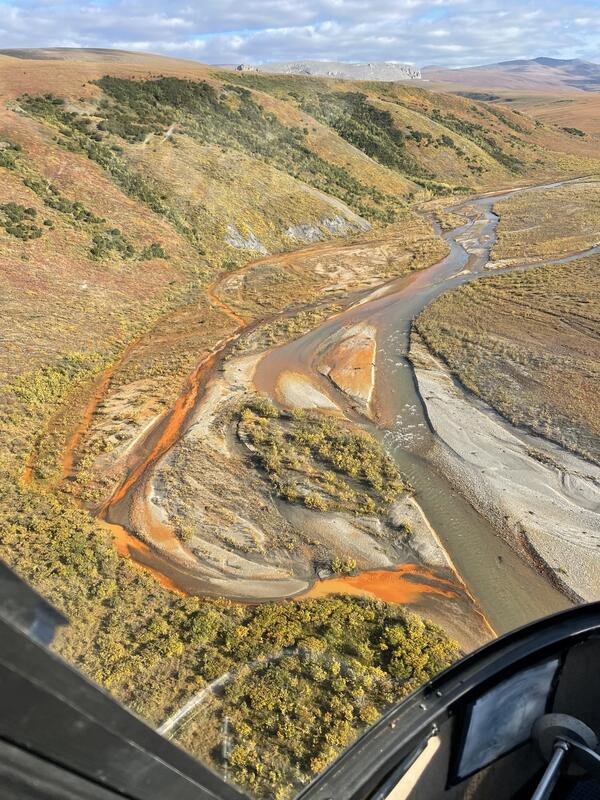
Orange streams are increasingly common in the Brooks Range of northern Alaska. The orange stream color reflects oxidized iron, but also often indicates elevated heavy metal concentrations. Our ongoing study aims to document these occurrences and the timing of their onset.

Orange stream with brown mountain in background.
Orange staining and blackened vegetation where a seep emerges from a debris fan

Orange streams are increasingly common in the Brooks Range of northern Alaska. The orange stream color reflects oxidized iron, but also often indicates elevated heavy metal concentrations. Our ongoing study aims to document these occurrences and the timing of their onset.

Orange streams are increasingly common in the Brooks Range of northern Alaska. The orange stream color reflects oxidized iron, but also often indicates elevated heavy metal concentrations. Our ongoing study aims to document these occurrences and the timing of their onset.

Satellite image showing the Beaufort Sea and a small slice of coast by Prudhoe Bay
Landsat 9 View of Beaufort Sea Melt Ponds

This Landsat 9 image from June 13, 2024, shows the Beaufort Sea near Prudhoe Bay, Alaska, using the Shortwave Infrared, Near Infrared, and Reds (Band 6|5|4), and sharpened with the with Panchromatic band (Band 8). The cyan tones highlight sea ice and melt ponds, while the red areas represent land and vegetation.

This Landsat 9 image from June 13, 2024, shows the Beaufort Sea near Prudhoe Bay, Alaska, using the Shortwave Infrared, Near Infrared, and Reds (Band 6|5|4), and sharpened with the with Panchromatic band (Band 8). The cyan tones highlight sea ice and melt ponds, while the red areas represent land and vegetation.

Orange river on a brown landscape and snowy mountains in the background.
An orange tributary of the Kugururok River, Noatak National Preserve in Alaska

Orange streams are increasingly common in the Brooks Range of northern Alaska. The orange stream color reflects oxidized iron, but also often indicates elevated heavy metal concentrations. Our ongoing study aims to document these occurrences and the timing of their onset.

Orange streams are increasingly common in the Brooks Range of northern Alaska. The orange stream color reflects oxidized iron, but also often indicates elevated heavy metal concentrations. Our ongoing study aims to document these occurrences and the timing of their onset.

Was this page helpful?