



Barry Arm is a Large Glacier-Permafrost-Related Landslide
USGS and its partners are monitoring potential changes and tsunami hazards
USGS and its partners are monitoring potential changes and tsunami hazards
Bees and Berries
Fact sheet discusses enhancing climate adaptation for native communities in western Alaska and more
Fact sheet discusses enhancing climate adaptation for native communities in western Alaska and more
USGS Invests Millions in Critical-Minerals Mapping in Alaska
USGS Arctic Research
The USGS and its partners are addressing important issues in a rapidly changing Arctic
The USGS and its partners are addressing important issues in a rapidly changing Arctic
Avian Influenza Research
Since 2006, the Alaska Science Center has been part of the State and Federal interagency team for the detection and response to highly pathogenic (HPAI) viruses in North America
Since 2006, the Alaska Science Center has been part of the State and Federal interagency team for the detection and response to highly pathogenic (HPAI) viruses in North America
Barry Arm Landslide and Tsunami Hazard
USGS will determine the requirements for a monitoring and/or surveillance strategy for the Barry Arm landslide
USGS will determine the requirements for a monitoring and/or surveillance strategy for the Barry Arm landslide
Alaska Region
USGS in Alaska conducts science for decision-making in five major areas: natural hazards; energy & minerals; water quality, streamflow & ice; wildlife, fish & habitat; and geospatial mapping. The Alaska Regional Office provides management and strategic coordination among the Alaska Science Center, the Volcano Science Center, & other partners operating in AK.
Alaska Science Center
Alaska Science Center

4210 University Drive
Anchorage, AK 99508
Phone: (907) 786-7000
Volcano Science Center
Volcano Science Center

4230 University Drive
Anchorage, AK 99508
Phone: (907) 786-7497
Climate Adaptation Science Center
Climate Adaptation Science Center

4230 University Drive
Anchorage, AK 99508
Phone: 907-301-7830
News
September is National Preparedness Month
September is National Preparedness Month
Science Spotlight: USGS Monitoring of Glacial Outburst Flood in Juneau Alaska
Science Spotlight: USGS Monitoring of Glacial Outburst Flood in Juneau Alaska
USGS Scientist and National Weather Service and University of Alaska Southeast colleagues receive Alaska State Legislature Recognition for Response to Juneau’s annual Suicide Basin Outburst Floods
USGS Scientist and National Weather Service and University of Alaska Southeast colleagues receive Alaska State Legislature Recognition for Response to Juneau’s annual Suicide Basin Outburst Floods
Publications
Extensive glacier loss in the coterminous United States Extensive glacier loss in the coterminous United States
Glaciers populate the mountain ranges of the western conterminous United States and despite their importance to alpine hydrology, their area and volume change have never been comprehensively evaluated. Since the mid-Twentieth Century about one-quarter of the glaciers have disappeared and the overall area and volume are reduced by one-third. The pattern of glacier shrinkage suggests most...
Landscape controls river continuum dissolved organic carbon in northeastern Alaska Landscape controls river continuum dissolved organic carbon in northeastern Alaska
Rivers draining continuous permafrost landscapes on the North Slope of Alaska span from the mountains to the coast, integrating gradients in vegetation, soil organic matter, and hydrologic flow. We investigated how these landscape transitions influence dissolved organic carbon (DOC) concentrations, radiocarbon ages, and export along the river continuum over seasonal timeframes in...
DRIFteRS: A dataset of drift invertebrate densities in streams and rivers across western North America, 1997–2024 DRIFteRS: A dataset of drift invertebrate densities in streams and rivers across western North America, 1997–2024
Prey availability is among the most influential and highly variable determinants of fish growth and freshwater habitat carrying capacity, yet it remains understudied compared to physical habitat variables (Ouellet et al., 2025; Rosenfeld et al., 2014; Weber et al., 2017). We often lack a clear understanding of how much food is available to fishes, how it varies spatially and temporally...
Science

Walrus Research
The USGS Alaska Science Center conducts long-term research on the Pacific walrus to provide scientific information to Department of Interior management agencies and Alaska Native co-management partners. In addition, the USGS Pacific walrus research program collaborates with the U.S. Fish and Wildlife Service (USFWS) and the State of Alaska’s Department of Fish and Game and Alaska Native co...

Wolverine Glacier
Wolverine Glacier is located in Alaska’s Kenai Mountains, along the western flank of Prince William Sound. Glacier observations began in 1966 and continue through present as the western most USGS Benchmark Glacier.
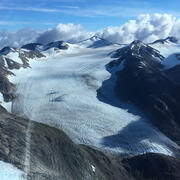
Lemon Creek Glacier
Lemon Creek Glacier is located in southeast Alaska, at the southernmost tip of the Juneau Icefield. Glacier observations began at this site in 1953 and continue through present, serving as a central site between glaciers in the contiguous USA and those in mainland Alaska.