



David J Dean
David Dean studies hydrology, geomorphology, and sediment transport of rivers in arid and semi-arid ecosystems.
River Sediment Dynamics webpage
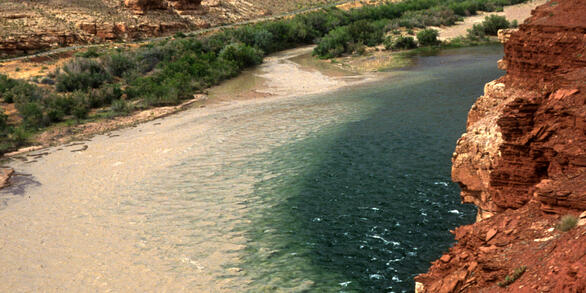
Information about the the Southwest Biological Science Center Grand Canyon Monitoring and Research Station's River Sediment Dynamics group.
River Sediment Dynamics Portal

Download portal for continuous suspended-sediment and other related data collected by the River Sediment Dynamics group.
Geomorphic Changes in the Rio Grande of the Big Bend

Read Dave Dean's USGS Fact Sheet about his research on the Rio Grande in the Big Bend Region.
As a research hydrologist with the GCMRC and SBSC, I conduct original research linking hydrology and sediment transport to fluvial geomorphic processes. My research is conducted in the Rio Grande in the Big Bend region of far west Texas, the Green and Yampa Rivers in Dinosaur National Monument, the Green and Colorado Rivers in Canyonlands National Park, the Little Colorado River and its tributaries in northern Arizona, and the Colorado River in Grand Canyon National Park. My research aims to quantify how hydrologic and geomorphic processes respond to factors such as large-scale water development and management, the widespread establishment of non-native riparian plants, and anthropogenic modifications to fluvial bottomlands. All of these perturbations directly affect how water and sediment are routed through fluvial drainage networks, which controls the geomorphic behavior, and biologic processes of these river systems.
Much of my work incorporates the use of acoustic instrumentation to passively monitor suspended-sediment transport processes on rivers with high suspended-sediment loads. This work is paired with measurements of geomorphic change using a variety of data and techniques including: high-resolution topographic data collected with real-time-kinematic GPS and LIDAR, aerial imagery, and analysis of historical hydrologic and geomorphic data. My work is directly relevant to the primary scientific understanding of the hydrologic and geomorphic behavior of these rivers, as well as the management actions that may help mitigate fluvial perturbations that have occurred. My work also focuses on the biogeomorphic interactions between stream flow, sediment transport, and riparian vegetation, and how those interactions can result in negative and/or positive feedbacks of geomorphic change.
Professional Experience
2014 - present: Research Hydrologist, USGS Southwest Biological Science Center, Grand Canyon Monitoring and Research Center
2009 - 2014: Research Associate/Lab Manager, Department of Watershed Sciences, Geomorphology Lab, Utah State University
2006: Staff Scientist, StreamLab 2006, National Center for Earth Surface Dynamics, Saint Anthony Falls Laboratory, University of MN
2005: Laboratory Instructor, Environmental Geology, University of Saint Thomas, St. Paul, MN
2002, 2004, 2006: Instructor, Geologic Field Camp in Southeastern U.S., University of Saint Thomas, St. Paul, MN
2002 - 2004: Staff Geologist, Meisch & Associates, Ltd., Environmental Consultants, Oakdale, MN
Education and Certifications
M.S., 2006-2009: Utah State University, Logan, UT. Thesis: "A River Transformed: Historic Geomorphic Changes of the Lower Rio Grande in the Big Bend Region of Texas, Chihuahua, and Coahuila"
B.A., 1997-2001: University of St. Thomas, St. Paul, MN, majors in geology and geography
Science and Products
Self-limitation of sand storage in a bedrock-canyon river arising from the interaction of flow and grain size Self-limitation of sand storage in a bedrock-canyon river arising from the interaction of flow and grain size
The roles of flood magnitude and duration in controlling channel width and complexity on the Green River in Canyonlands, Utah, USA The roles of flood magnitude and duration in controlling channel width and complexity on the Green River in Canyonlands, Utah, USA
Does channel narrowing by floodplain growth necessarily indicate sediment surplus? Lessons from sediment‐transport analyses in the Green and Colorado rivers, Canyonlands, Utah Does channel narrowing by floodplain growth necessarily indicate sediment surplus? Lessons from sediment‐transport analyses in the Green and Colorado rivers, Canyonlands, Utah
Channel narrowing by inset floodplain formation of the lower Green River in the Canyonlands region, Utah Channel narrowing by inset floodplain formation of the lower Green River in the Canyonlands region, Utah
Geomorphic change and biogeomorphic feedbacks in a dryland river: The Little Colorado River, Arizona, USA Geomorphic change and biogeomorphic feedbacks in a dryland river: The Little Colorado River, Arizona, USA
Optimal timing of high-flow experiments for sandbar deposition Optimal timing of high-flow experiments for sandbar deposition
Long-term evolution of sand transport through a river network: Relative influences of a dam versus natural changes in grain size from sand waves Long-term evolution of sand transport through a river network: Relative influences of a dam versus natural changes in grain size from sand waves
Quantifying geomorphic change at ephemeral stream restoration sites using a coupled-model approach Quantifying geomorphic change at ephemeral stream restoration sites using a coupled-model approach
Long-term continuous acoustical suspended-sediment measurements in rivers – Theory, evaluation, and results from 14 stations on five rivers Long-term continuous acoustical suspended-sediment measurements in rivers – Theory, evaluation, and results from 14 stations on five rivers
Sediment supply versus local hydraulic controls on sediment transport and storage in a river with large sediment loads Sediment supply versus local hydraulic controls on sediment transport and storage in a river with large sediment loads
Using 15-minute acoustic data to analyze suspended-sediment dynamics in the Rio Grande in the Big Bend Region Using 15-minute acoustic data to analyze suspended-sediment dynamics in the Rio Grande in the Big Bend Region
Physically based method for measuring suspended-sediment concentration and grain size using multi-frequency arrays of acoustic-doppler profilers Physically based method for measuring suspended-sediment concentration and grain size using multi-frequency arrays of acoustic-doppler profilers
Non-USGS Publications**
**Disclaimer: The views expressed in Non-USGS publications are those of the author and do not represent the views of the USGS, Department of the Interior, or the U.S. Government.
Three podcasts about the Rio Grande with David Dean. Click the link below to listen and read the accompanying article.
Science and Products
Self-limitation of sand storage in a bedrock-canyon river arising from the interaction of flow and grain size Self-limitation of sand storage in a bedrock-canyon river arising from the interaction of flow and grain size
The roles of flood magnitude and duration in controlling channel width and complexity on the Green River in Canyonlands, Utah, USA The roles of flood magnitude and duration in controlling channel width and complexity on the Green River in Canyonlands, Utah, USA
Does channel narrowing by floodplain growth necessarily indicate sediment surplus? Lessons from sediment‐transport analyses in the Green and Colorado rivers, Canyonlands, Utah Does channel narrowing by floodplain growth necessarily indicate sediment surplus? Lessons from sediment‐transport analyses in the Green and Colorado rivers, Canyonlands, Utah
Channel narrowing by inset floodplain formation of the lower Green River in the Canyonlands region, Utah Channel narrowing by inset floodplain formation of the lower Green River in the Canyonlands region, Utah
Geomorphic change and biogeomorphic feedbacks in a dryland river: The Little Colorado River, Arizona, USA Geomorphic change and biogeomorphic feedbacks in a dryland river: The Little Colorado River, Arizona, USA
Optimal timing of high-flow experiments for sandbar deposition Optimal timing of high-flow experiments for sandbar deposition
Long-term evolution of sand transport through a river network: Relative influences of a dam versus natural changes in grain size from sand waves Long-term evolution of sand transport through a river network: Relative influences of a dam versus natural changes in grain size from sand waves
Quantifying geomorphic change at ephemeral stream restoration sites using a coupled-model approach Quantifying geomorphic change at ephemeral stream restoration sites using a coupled-model approach
Long-term continuous acoustical suspended-sediment measurements in rivers – Theory, evaluation, and results from 14 stations on five rivers Long-term continuous acoustical suspended-sediment measurements in rivers – Theory, evaluation, and results from 14 stations on five rivers
Sediment supply versus local hydraulic controls on sediment transport and storage in a river with large sediment loads Sediment supply versus local hydraulic controls on sediment transport and storage in a river with large sediment loads
Using 15-minute acoustic data to analyze suspended-sediment dynamics in the Rio Grande in the Big Bend Region Using 15-minute acoustic data to analyze suspended-sediment dynamics in the Rio Grande in the Big Bend Region
Physically based method for measuring suspended-sediment concentration and grain size using multi-frequency arrays of acoustic-doppler profilers Physically based method for measuring suspended-sediment concentration and grain size using multi-frequency arrays of acoustic-doppler profilers
Non-USGS Publications**
**Disclaimer: The views expressed in Non-USGS publications are those of the author and do not represent the views of the USGS, Department of the Interior, or the U.S. Government.
Three podcasts about the Rio Grande with David Dean. Click the link below to listen and read the accompanying article.