



Scientists from the USGS Western Ecological Research Center (WERC) are conducting a "social attraction" study for seabirds in the Don Edwards San Francisco Bay National Wildlife Refuge. Historically, this region offered wetland habitats to local wildlife. With the introduction of industrial salt ponds and human development, however, much of this habitat was lost.
Josh T Ackerman
Dr. Ackerman is a Principal Investigator with USGS and an Associate in the Department of Wildlife, Fish, and Conservation Biology at the University of California-Davis.
Avian mercury exposure and toxicological risk across western North America: A synthesis
Avian mercury exposure and toxicological risk across western North America: A synthesis

Mercury contamination of birds is prevalent in many areas throughout western North America, and large-scale ecological attributes are important factors influencing bird mercury concentrations. This report synthesizes the available data on mercury contamination of birds in western North America.
Development of methylmercury toxicity reference values in birds
Development of methylmercury toxicity reference values in birds

Birds are used as bioindicators of environmental mercury contamination, and toxicity reference values are needed for injury assessments. We conducted a comprehensive review, summarized data from 168 studies, performed a series of meta-analyses, and developed new toxicity reference values for the effects of methylmercury on birds.
Josh's research expertise is in wildlife ecology and ecotoxicology, and his research program focuses on bird ecology, wetland management and restoration, contaminant bioaccumulation in fish and wildlife, and effects of contaminants on animal health and populations.
Science and Products
Filter Total Items: 20
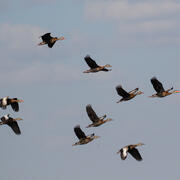
Tackling avian influenza with automated detection for an early warning system
The USGS is collaborating with agricultural and wildlife management partners to address the threat of highly-pathogenic avian influenza (HPAI) to wildlife, domestic poultry, and livestock. Partners include federal (U.S. Fish and Wildlife Service and U.S. Department of Agriculture) and non-federal agencies as well as State government, private organizations, and academic institutions. Our...

Healthy Fish and Wildlife: Community Livelihoods, Fishing and Hunting Heritage, Recreation, and Economic Security
Healthy fish and wildlife underpin the economic vitality, food security, recreational enjoyment, and cultural heritage of fishing and hunting in communities across the United States. Fishing and hunting resources scale from the personal recreation of families to multi-billion-dollar industries. Recognizing these critical connections, the U.S. Geological Survey (USGS) works to understand, protect...
By
Ecosystems Mission Area, Contaminant Biology, Environmental Health Program, Toxic Substances Hydrology, California Water Science Center, Central Midwest Water Science Center, Columbia Environmental Research Center, Eastern Ecological Science Center, Forest and Rangeland Ecosystem Science Center, Upper Midwest Environmental Sciences Center, Upper Midwest Water Science Center

Estimating Methylmercury Injury to Birds—“The Bird Mercury Tool”
U.S. Geological Survey (USGS) scientists have developed a tool that can be used by practitioners to help interpret injury to birds caused by methylmercury contamination. This tool was developed from a comprehensive review of 168 studies and summarizing data on the effects of methylmercury on birds.

Avian Influenza Prevalence Correlated to Mercury Concentrations in Wild Waterfowl
Low pathogenic avian influenza infections were directly correlated with blood mercury concentrations in wild waterfowl, indicating that mercury exposure may be related to pathogen susceptibility. Further study is needed to determine if and how mercury and other environmental contaminant exposures may affect disease susceptibility in wildlife.

Ecologically-Driven Exposure Pathways Science Team
The Ecologically-Driven Exposure Pathways Integrated Science Team identifies how ecological pathways and physiological processes within a single organism can alter exposure and toxicity of contaminants and pathogens and seek to understand outcomes at different scales from individuals to populations and ecosystems.

Wetland Management Technique Designed to Reduce Mercury in Water and Fish Tested During a Short-Term Field Study
Results from a 3-year study indicate there was support for the use of open- and deep-water treatment pools at the downstream end of seasonal wetlands to reduce methylmercury concentrations in water exported from the wetlands, but the treatment had no measurable effect on wetland fish. Questions remain about the long-term potential for mercury removal using this wetland management strategy.

Establishing Forster's Tern Nesting Colonies
Scientists from the USGS Western Ecological Research Center (WERC) are conducting a "social attraction" study for seabirds in the Don Edwards San Francisco Bay National Wildlife Refuge. Historically, this region offered wetland habitats to local wildlife. With the introduction of industrial salt ponds and human development, however, much of this habitat was lost.

Photograph Showing White-Faced Ibis Nesting
Photograph showing white-faced ibis nesting at Bear River Migratory Bird Refuge, Great Salt Lake, Utah. U.S.
Photograph showing white-faced ibis nesting at Bear River Migratory Bird Refuge, Great Salt Lake, Utah. U.S.

Foster's Tern (Sterna forsteri) While Hunting in Flight
Foster's Tern (Sterna forsteri) While Hunting in FlightPhoto of Foster's Tern (Sterna forsteri) while hunting. Forster’s terns are among the most at-risk wildlife species to mercury toxicity in western North America.
Foster's Tern (Sterna forsteri) While Hunting in Flight
Foster's Tern (Sterna forsteri) While Hunting in FlightPhoto of Foster's Tern (Sterna forsteri) while hunting. Forster’s terns are among the most at-risk wildlife species to mercury toxicity in western North America.
Science and Products
Filter Total Items: 20
Tackling avian influenza with automated detection for an early warning system
The USGS is collaborating with agricultural and wildlife management partners to address the threat of highly-pathogenic avian influenza (HPAI) to wildlife, domestic poultry, and livestock. Partners include federal (U.S. Fish and Wildlife Service and U.S. Department of Agriculture) and non-federal agencies as well as State government, private organizations, and academic institutions. Our...
Healthy Fish and Wildlife: Community Livelihoods, Fishing and Hunting Heritage, Recreation, and Economic Security
Healthy fish and wildlife underpin the economic vitality, food security, recreational enjoyment, and cultural heritage of fishing and hunting in communities across the United States. Fishing and hunting resources scale from the personal recreation of families to multi-billion-dollar industries. Recognizing these critical connections, the U.S. Geological Survey (USGS) works to understand, protect...
By
Ecosystems Mission Area, Contaminant Biology, Environmental Health Program, Toxic Substances Hydrology, California Water Science Center, Central Midwest Water Science Center, Columbia Environmental Research Center, Eastern Ecological Science Center, Forest and Rangeland Ecosystem Science Center, Upper Midwest Environmental Sciences Center, Upper Midwest Water Science Center
Estimating Methylmercury Injury to Birds—“The Bird Mercury Tool”
U.S. Geological Survey (USGS) scientists have developed a tool that can be used by practitioners to help interpret injury to birds caused by methylmercury contamination. This tool was developed from a comprehensive review of 168 studies and summarizing data on the effects of methylmercury on birds.
Avian Influenza Prevalence Correlated to Mercury Concentrations in Wild Waterfowl
Low pathogenic avian influenza infections were directly correlated with blood mercury concentrations in wild waterfowl, indicating that mercury exposure may be related to pathogen susceptibility. Further study is needed to determine if and how mercury and other environmental contaminant exposures may affect disease susceptibility in wildlife.
Ecologically-Driven Exposure Pathways Science Team
The Ecologically-Driven Exposure Pathways Integrated Science Team identifies how ecological pathways and physiological processes within a single organism can alter exposure and toxicity of contaminants and pathogens and seek to understand outcomes at different scales from individuals to populations and ecosystems.
Wetland Management Technique Designed to Reduce Mercury in Water and Fish Tested During a Short-Term Field Study
Results from a 3-year study indicate there was support for the use of open- and deep-water treatment pools at the downstream end of seasonal wetlands to reduce methylmercury concentrations in water exported from the wetlands, but the treatment had no measurable effect on wetland fish. Questions remain about the long-term potential for mercury removal using this wetland management strategy.
Establishing Forster's Tern Nesting Colonies
Scientists from the USGS Western Ecological Research Center (WERC) are conducting a "social attraction" study for seabirds in the Don Edwards San Francisco Bay National Wildlife Refuge. Historically, this region offered wetland habitats to local wildlife. With the introduction of industrial salt ponds and human development, however, much of this habitat was lost.
Scientists from the USGS Western Ecological Research Center (WERC) are conducting a "social attraction" study for seabirds in the Don Edwards San Francisco Bay National Wildlife Refuge. Historically, this region offered wetland habitats to local wildlife. With the introduction of industrial salt ponds and human development, however, much of this habitat was lost.
Photograph Showing White-Faced Ibis Nesting
Photograph showing white-faced ibis nesting at Bear River Migratory Bird Refuge, Great Salt Lake, Utah. U.S.
Photograph showing white-faced ibis nesting at Bear River Migratory Bird Refuge, Great Salt Lake, Utah. U.S.
Foster's Tern (Sterna forsteri) While Hunting in Flight
Foster's Tern (Sterna forsteri) While Hunting in FlightPhoto of Foster's Tern (Sterna forsteri) while hunting. Forster’s terns are among the most at-risk wildlife species to mercury toxicity in western North America.
Foster's Tern (Sterna forsteri) While Hunting in Flight
Foster's Tern (Sterna forsteri) While Hunting in FlightPhoto of Foster's Tern (Sterna forsteri) while hunting. Forster’s terns are among the most at-risk wildlife species to mercury toxicity in western North America.