U.S. flag

An official website of the United States government

Images

Images intro.
Filter Total Items: 51
color photograph of volcanic deposits
August 26, 2022 — Tuff cone on Ta‘ū Island in American Samoa

A cliff on Ta‘ū island in American Samoa, exposing part of a tuff cone that was created from phreatomagmatic processes through the interaction of lava with shallow seawater. This part of the tuff cone contains mostly sand-sized material that hosts larger blocks and bombs that are up to several feet (one meter) in diameter.

A cliff on Ta‘ū island in American Samoa, exposing part of a tuff cone that was created from phreatomagmatic processes through the interaction of lava with shallow seawater. This part of the tuff cone contains mostly sand-sized material that hosts larger blocks and bombs that are up to several feet (one meter) in diameter.

Color photograph of volcanic deposits
August 26, 2022 — Base of a tuff cone on Ta‘ū Island, American Samoa

The base of a tuff cone near the coast of Ta‘ū Island in American Samoa. Tuff cones are created from phreatomagmatic processes through the interaction of lava with shallow seawater. This part of the tuff cone contains mostly sand size material that hosts larger blocks and bombs that are up to several feet (one meter) in diameter.

The base of a tuff cone near the coast of Ta‘ū Island in American Samoa. Tuff cones are created from phreatomagmatic processes through the interaction of lava with shallow seawater. This part of the tuff cone contains mostly sand size material that hosts larger blocks and bombs that are up to several feet (one meter) in diameter.

Color photograph of volcano slopes
August 22, 2022 — View of the summit region of Ta‘ū island

A view of the summit region of Ta‘ū island, in the Manu‘a island group of American Samoa. Ta‘ū island is the exposed top of a volcano that formed as a result of volcanic activity at the Samoa hotspot. Most of the volcano is under the ocean surface.

A view of the summit region of Ta‘ū island, in the Manu‘a island group of American Samoa. Ta‘ū island is the exposed top of a volcano that formed as a result of volcanic activity at the Samoa hotspot. Most of the volcano is under the ocean surface.

Color photograph of people installing field instrument
August 23, 2022 — Installing a seismometer on Ta‘ū island

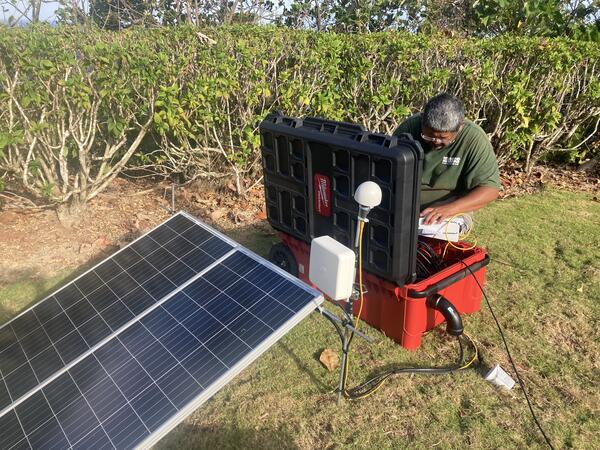
A broadband seismometer being installed on Ta‘ū island near Fiti‘uta on August 23, 2022, by the USGS Hawaiian Volcano Observatory, NOAA National Weather Service, and with help from the American Samoan government and local residents of Ta‘ū island.

A broadband seismometer being installed on Ta‘ū island near Fiti‘uta on August 23, 2022, by the USGS Hawaiian Volcano Observatory, NOAA National Weather Service, and with help from the American Samoan government and local residents of Ta‘ū island.

Color photograph of scientists installing instrument
August 22, 2022 — USGS Hawaiian Volcano Observatory scientist setting up a seismometer on Ta‘ū Island

A broadband seismometer was installed on Ta‘ū island on August 22, 2022, by the USGS Hawaiian Volcano Observatory and NOAA National Weather Service team. This is one of two broadband seismometers that have been placed on Ta‘ū island to help detect earthquakes that started to be felt in the region starting in late July. USGS photo by D. Downs.

A broadband seismometer was installed on Ta‘ū island on August 22, 2022, by the USGS Hawaiian Volcano Observatory and NOAA National Weather Service team. This is one of two broadband seismometers that have been placed on Ta‘ū island to help detect earthquakes that started to be felt in the region starting in late July. USGS photo by D. Downs.

Color photograph of ocean and island in distance
August 20, 2022 — View of Faleāsao tuff cone on Ta‘ū Island and Ofu-Olosega island in the distance

An afternoon view of the tuff cone near Faleāsao village located in northwest Ta‘ū island, with the islands of Ofu and Olosega visible in the distance. This tuff cone, which is thousands of years old, formed when hot magma interacted with either shallow groundwater or sea water. There are several tuff cones located within the northwest corner of Ta‘ū island.

An afternoon view of the tuff cone near Faleāsao village located in northwest Ta‘ū island, with the islands of Ofu and Olosega visible in the distance. This tuff cone, which is thousands of years old, formed when hot magma interacted with either shallow groundwater or sea water. There are several tuff cones located within the northwest corner of Ta‘ū island.

Color photograph of earthquake monitoring device
August 19, 2022 — Microseismometer installed in the Manu‘a islands of American Samoa

A Raspberry Shake microseismometer was installed on Ta‘ū island, American Samoa, on August 19, 2022, by the USGS Hawaiian Volcano Observatory and NOAA National Weather Service team. This is one of several microseismometers that have been placed within the Manu‘a islands to help detect earthquakes in the region that started to be felt in late July. USGS photo by D.

A Raspberry Shake microseismometer was installed on Ta‘ū island, American Samoa, on August 19, 2022, by the USGS Hawaiian Volcano Observatory and NOAA National Weather Service team. This is one of several microseismometers that have been placed within the Manu‘a islands to help detect earthquakes in the region that started to be felt in late July. USGS photo by D.

Color plot of earthquake counts over time
Ta'ū seismicity detected from Wake Island

Earthquakes in oceanic environments can generate pressure waves that travel long distances within the ocean itself. Much like seismographs record ground shaking, this energy is recorded by submerged hydrophones measuring pressure changes in water.

Earthquakes in oceanic environments can generate pressure waves that travel long distances within the ocean itself. Much like seismographs record ground shaking, this energy is recorded by submerged hydrophones measuring pressure changes in water.

A thermal image of people standing near the water's edge on a beach.
Thermal image of ocean and groundwater

Thermal infrared image of two USGS researchers standing on the coastline and looking out (up on the image) over a coastal groundwater plume that is non-visible to the naked eye but can be observed in this thermal image due to the temperature differences between the cooler (blue) groundwater and warmer (pink) ocean water over the coral reefs.

Thermal infrared image of two USGS researchers standing on the coastline and looking out (up on the image) over a coastal groundwater plume that is non-visible to the naked eye but can be observed in this thermal image due to the temperature differences between the cooler (blue) groundwater and warmer (pink) ocean water over the coral reefs.

Underwater photograph of a shallow area with coral reef and sand.
Porites and Acropora corals in American Samoa

Porites and Acropora coral species in reef flat pools in the National Park of American Samoa on Ofu, Manuʻa Islands Group, American Samoa.

A man pushes a pole upright into its stabilization frame, surrounded by other equipment and palm trees.
Installing a thermal imaging system

USGS scientists install a thermal imaging system in the National Park of American Samoa off the south shore of Ofu, Manua. The system detects temperature variations, like a colder freshwater plume that emanates from the shore.

USGS scientists install a thermal imaging system in the National Park of American Samoa off the south shore of Ofu, Manua. The system detects temperature variations, like a colder freshwater plume that emanates from the shore.

Underwater photo of divers wearing oxygen tanks, placing instruments on coral reef.
Divers install monitoring instruments on coral reef

Dive operations with National Park Service and the National Park of American Samoa installing tide, wave, temperature, and salinity sensors on the fore reef in NPSA off the south shore of Ofu, Manuʻa.

Dive operations with National Park Service and the National Park of American Samoa installing tide, wave, temperature, and salinity sensors on the fore reef in NPSA off the south shore of Ofu, Manuʻa.

Image: Tsunami Recovery in American Samoa
Tsunami Study in American Samoa

Aluminum roofs and debris transported behind the village of Tula on the east shore of American Samoa following the Tsunami that hit the island on Sept. 29, 2009. The tsunami runup was 16-26 feet in Tula.

Aluminum roofs and debris transported behind the village of Tula on the east shore of American Samoa following the Tsunami that hit the island on Sept. 29, 2009. The tsunami runup was 16-26 feet in Tula.

Image: Tsunami Recovery in American Samoa
Tsunami Study in American Samoa

Tsunami flow depth indicator at Fagasa, American Samoa following the tsunami that hit the island on Sept. 29, 2009. Vegetation is brown where it was submerged by the tsunami and green above.

Tsunami flow depth indicator at Fagasa, American Samoa following the tsunami that hit the island on Sept. 29, 2009. Vegetation is brown where it was submerged by the tsunami and green above.

Image: Tsunami Recovery in American Samoa
Tsunami Study in American Samoa

Car thrown into building in Pago Pago, American Samoa during the tsunami that struck the island on Sept. 29, 2009.

Image: Tsunami Recovery in American Samoa
Tsunami Study in American Samoa

Boat thrown onto fish pond in Maloata, American Samoa following the tsunami that hit the island on Sept. 29, 2009.

Image: Tsunami Recovery in American Samoa
Tsunami Study in American Samoa

Tsunami sand deposit at Alao, American Samoa following the tsunami on Sept. 29, 2009. Light colored sand deposited during the tsunami overlies darker soil that was there before the tsunami.

Tsunami sand deposit at Alao, American Samoa following the tsunami on Sept. 29, 2009. Light colored sand deposited during the tsunami overlies darker soil that was there before the tsunami.

Image: Tsunami Recovery in American Samoa
Tsunami Study in American Samoa

Tsunami flow depth at Alofau, American Samoa following the tsunami that hit the island on Sept. 29, 2009.

Image: Tsunami Recovery in American Samoa
Tsunami Study in American Samoa

Only the foundation of a house in Fagasa, American Samoa remains after the tsunami hit on Sept. 29, 2009.

Image: Tsunami Recovery in American Samoa
Tsunami Study in American Samoa

Cars damaged by the tsunami in Fagasa, American Samoa. The tsunami hit the island on Sept. 29, 2009.

Was this page helpful?