



Surface water
The world's surface-water resources—the water in rivers, lakes, and ice and snow—are vitally important to the everyday life of not only people, but to all life on, in, and above the Earth. And, of course, surface water is an intricate part of the water cycle, on which all life depends.
Surface water is the most recognizable part of the water cycle because we can actually see it. Lakes and rivers may be the first types of surface water that come to mind but don't forget those snowbanks in your front yard! We think of oceans when we think of surface water but did you remember to add glaciers to your list? The Water Science School has plenty to teach you about the different types of surface water but also how it is measured, how it affects us, how we can use it, and so much more.
Surface Water Basics
-

Lakes and Reservoirs
A lake really is just another component of Earth's surface water. A lake is where surface-water runoff and groundwater seepage have accumulated in a low spot in the landscape.
Rivers, Streams, and Creeks
Rivers? Streams? Creeks? These are all names for water flowing on the Earth's surface. Whatever you call them and no matter how large they are, they are invaluable for all life on Earth and are important components of the Earth's water cycle.
Rivers and the Landscape
Creeks and streams begin their lives as smaller water bodies that run downhill until they merge to form bigger rivers. Rivers are a mighty factor when it comes to shaping the physical landscape — just ask the Grand Canyon. Find out more here.
Sediment and Suspended Sediment
Water in nature is never really totally clear, especially in surface water, such as rivers and lakes. Water has color and some extent of dissolved and suspended material, usually dirt particles (suspended sediment). Suspended sediment is an important factor in determining the quality of water.
Rivers of the World: World's Longest Rivers
Ever wondered about what is the longest river in the world? Or in the United States? Find out here.
Uses of Streamflow Information
The U.S. Geological Survey (USGS) has been measuring the amount of water flowing in rivers since the 19th century. Having reliable past and present streamflow information is vital for many reasons, both at the personal and national level.
Monthly and Yearly Streamflow Patterns
The U.S. Geological Survey (USGS) has been measuring streamflow at thousands of streams for many decades and at some locations for over a century. When extensive records of past streamflows exist, it is possible to see a pattern of streamflow variation by month and season.
Sea Level and Climate
Sea level and climate. If you wondering how they relate to one another all you need to think of is water storage. How does the earth store water during cold periods and how is water stored when the earth warms? If you're curious about the delicate connection the earth has between climate and sea level, don't stop here. Read on!
Glaciers and Icecaps
Glaciers are a big item when we talk about the world's water supply. Almost 10 percent of the world's land mass is currently covered with glaciers, mostly in places like Greenland and Antarctica. You can think of a glacier as a frozen river, and like rivers, they "flow" downhill, erode the landscape, and move water along in the Earth's water cycle.
Watersheds and Drainage Basins
When looking at the location of rivers and the amount of streamflow in rivers, the key concept is the river's "watershed". What is a watershed? Easy, if you are standing on ground right now, just look down. You're standing, and everyone is standing, in a watershed.
Events and Hazards
-

The 100-Year Flood
A 100-year flood happened last year so it won't happen for another 99 years, right? Not exactly. Misinterpretation of terminology often leads to confusion about flood recurrence intervals. Read on to learn more.
Floods and Recurrence Intervals
A major storm or hurricane hits your area and on the radio you hear reference to a "100-year flood". But what exactly is a "100-year flood"? The term "100-year flood" is often used to describe a flood of great magnitude, but there is a lot more to it.
Impervious Surfaces and Flooding
Superhighways! Streets and pavement! Driveways! House roofs! These are all "impervious surfaces"; impervious to the water from precipitation. When it rains in this locale, water no longer seeps into the ground, but now runs off into storm sewers and then quickly into local creeks. Localized flooding is too often the result.
Storm-Tide Monitoring
It is important to understand how hurricanes and major storms affect coastal areas that are also subject to tidal flows. The only way to do this is to deploy many monitoring sites in the path of these storms, and collect data before, during, and after the storm passes. USGS often deploys this storm-tide monitoring equipment.
High-Water Marks and Flooding
At places where the U.S. Geological Survey (USGS) does not have real-time monitoring equipment, we use high-water marks to measure the maximum height (stream stage) of a flood or high-water event.
Floods: Things to Know
The following topics provide background on some of the scientific issues regarding floods.
How Much Water Flows During a Storm?
If a low-lying area near a river near you usually gets about 50 inches of rain a year, you might think "Well, that is about 1 inch per week, so that won't cause any flooding". But nature doesn't think the same way, and often a large percentage of a year's precipitation can fall in a major storm, in a single day. Your river might not react much to a 1-inch rain, but things will be much different if...
Tsunamis and Tsunami Hazards
You don't hear about tsunamis very often, but when they do strike, they can be huge newsmakers and can have drastic and devastating effects. The occurrence and potential for tsunamis on the coasts of the United States is not out of the question. Read on to learn about tsunamis.
Surface Water Quality
-

Runoff: Surface and Overland Water Runoff
When rain falls onto the landscape, it doesn't just sit there and wait to be evaporated by the sun or lapped up by the local wildlife—it begins to move (due to gravity). Some of it seeps into the ground to refresh groundwater, but most of it flows down gradient as surface runoff. Runoff is an integral part of the natural water cycle.
Urbanization and Water Quality
There's no end to the effects that urbanization can have on water bodies. Millions of people; landscape manipulation; waste material; dumping of chemicals and fertilizers; withdrawing water for peoples' uses. As you expect, urbanization rarely improves water quality, but in order to prevent problems, one needs to understand how urbanization affects local waters.
Surface Water and the Water Cycle
-

Freshwater (Lakes and Rivers) and the Water Cycle
Freshwater on the land surface is a vital part of the water cycle for everyday human life. On the landscape, freshwater is stored in rivers, wetlands, lakes, reservoirs, creeks, and streams. Most of the water people use everyday comes from these sources of water on the land surface.
Ice, Snow, and Glaciers and the Water Cycle
The water stored in glaciers moves very slowly compared to water in rivers, but both are part of the water cycle. Did you know? Large continental glaciers (such as on Greenland or Antarctica) as well as sea-ice (ice floating at the surface of the oceans) influence the weather, too. The color white reflects sunlight (heat) more than darker colors, and as ice is so white, sunlight is reflected back...
Oceans and Seas and the Water Cycle
The oceans are, by far, the largest storehouse of water on earth — over 96% of all of Earth's water exists in the oceans. Not only do the oceans provide evaporated water to the water cycle, they also allow water to move all around the globe as ocean currents.
Surface Runoff and the Water Cycle
When water "runs off" the land surface, that’s runoff! Due to gravity, the water you wash your car with runs down the driveway as you work, and rain runs downhill. Runoff is an important component of the water cycle.
Snowmelt Runoff and the Water Cycle
Perhaps you've never seen snow. Or, perhaps you built a snowman this very afternoon and perhaps you saw your snowman begin to melt. Regardless of your experience with snow and associated snowmelt, runoff from snowmelt is an important component of the global movement of water, possibly even if you live where it never snows. Note: This section of the Water Science School discusses the Earth's...
Streamflow and the Water Cycle
What is streamflow? How do streams get their water? To learn about streamflow and its role in the water cycle, continue reading.
Springs and the Water Cycle
A spring is a place where water moving underground finds an opening to the land surface and emerges, sometimes as just a trickle, maybe only after a rain, and sometimes in a continuous flow. Spring water can also emerge from heated rock underground, giving rise to hot springs.
Hydroelectricity
-

Hydroelectric Power Water Use
Hydropower, or hydroenergy, is a form of renewable energy that uses the water stored in dams, as well as flowing in rivers to create electricity in hydropower plants. The falling water rotates blades of a turbine, which then spins a generator that converts the mechanical energy of the spinning turbine into electrical energy. Hydroelectric power is a significant component of electricity production...
Hydroelectric Power: How it Works
So just how do we get electricity from water? Actually, hydroelectric and coal-fired power plants produce electricity in a similar way. In both cases a power source is used to turn a propeller-like piece called a turbine.-
Hydroelectric Power: Advantages of Production and Usage
Nothing is perfect on Earth, and that includes the production of electricity using flowing water. Hydroelectric-production facilities are indeed not perfect (a dam costs a lot to build and also can have negative effects on the environment and local ecology), but there are a number of advantages of hydroelectric-power production as opposed to fossil-fuel power production. 
Three Gorges Dam: The World's Largest Hydroelectric Plant
The Three Gorges Dam on the Yangtze River in China is the world's biggest hydroelectric facility.
Measuring Surface Water
-

How Streamflow is Measured
How can one tell how much water is flowing in a river? Can we simply measure how high the water surface of the stream is? Sometimes it can be that simple. The height of the surface of the water is called the stream stage or gage height. However, the USGS has more accurate ways of determining how much water is flowing in a river. Read on to learn more.
How Does the USGS Collect Streamflow Data?
The USGS follows four basic steps for collecting streamflow data. The following is an example of a streamgage. More portable methods are also occasionally used. Read on to learn more.
Crest Gage: A Quick Way to Measure River Stage
The maximum height rivers reach during storms and floods is an important "data point" to document. In places where there are not dedicated monitoring equipment, the U.S. Geological Survey (USGS) often uses "crest stage gages" to record a one-time measurement of the flood peak.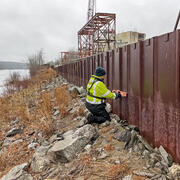
High-Water Marks
High-water marks are like footprints left behind by a flood — they show how high the water reached during a flood event. High-water marks serve as valuable data points for both educational purposes and scientific research, helping us understand past and recent flood events. Collecting this information is an essential and time-sensitive task for understanding flood risk and improving public safety.
What is Hydrology?
"Hydro" comes from the Greek word for... water. Hydrology is the study of water and hydrologists are scientists who study water. Read on to learn more.
A Day in the Life of a USGS Water Scientist
If you have to spend time in other people's shoes before judging them, you'd have to do a lot more than walk a mile to understand a USGS water scientist. For example, if you were Hydrologic Technician, or "Hydrotech," John Jastram, you would be perched 40 feet above a river as you made water-quality measurements from a swaying cable car. And if you were Hydrotech Karl Dydak, you would actually be...
Resources and activities
-


Surface Water Questions & Answers
Our planet is covered in water. We see it in our oceans and on land we see it in our lakes and rivers. The vast amount of water on the Earth's surface is in the oceans, and only a relatively small amount exists as fresh surface water on land. Yet, it is vitally important to all life on Earth. Here at the Water Science School we have the answers to your questions about surface water.