



James Irwin(left) and David Scott(right) training in the Lunar Roving Vehicle training version known also known as the "Grover"
Images
Browse here for some of our available imagery. We may get permission to use some non-USGS images and these should be marked and are subject to copyright laws. USGS Astrogeology images can be freely downloaded.
Filter Total Items: 351

Apollo Grover Historical Photo: B1
James Irwin(left) and David Scott(right) training in the Lunar Roving Vehicle training version known also known as the "Grover"

USGS IMAP 594: (RLC-9) Geologic map of the Sabine DM region of the moon
USGS IMAP 594: (RLC-9) Geologic map of the Sabine DM region of the moonUSGS IMAP 594: (RLC-9) Geologic map of the Sabine DM region of the moon
By: N.J. Trask
Map and associated documents are available from the USGS Publications Warehouse: https://doi.org/10.3133/i594
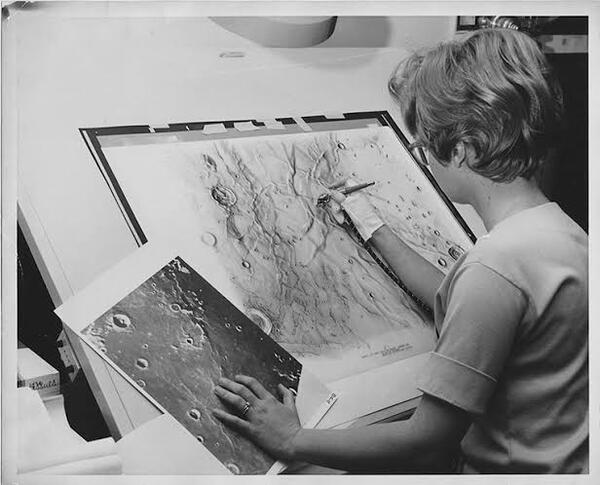
Pat Bridges mapping the Moon, one airbrush stroke at a time
Pat Bridges mapping the Moon, one airbrush stroke at a timeMapper Pat Bridges sits at a workstation, adding an incredible level of detail to lunar features.
Pat Bridges mapping the Moon, one airbrush stroke at a time
Pat Bridges mapping the Moon, one airbrush stroke at a timeMapper Pat Bridges sits at a workstation, adding an incredible level of detail to lunar features.

USGS IMAP 622: (ORB II-13 (100)) Geologic map of the Maestlin G region of the moon
USGS IMAP 622: (ORB II-13 (100)) Geologic map of the Maestlin G region of the moonUSGS IMAP 622: (ORB II-13 (100)) Geologic map of the Maestlin G region of the moon
By: M.H.Carr and S.R. Titley
Map and associated documents are available from the USGS Publications Warehouse: https://doi.org/10.3133/i622

USGS IMAP 586: (RLC-15) Geologic map of the Alphonsus GA region of the moon
USGS IMAP 586: (RLC-15) Geologic map of the Alphonsus GA region of the moonUSGS IMAP 586: (RLC-15) Geologic map of the Alphonsus GA region of the moon
By: J.F. McCauley
Map and associated documents are available from the USGS Publications Warehouse: https://doi.org/10.3133/i586
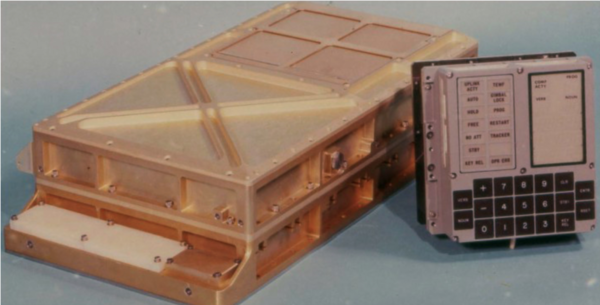
Apollo Guidance Computer (left) and DSKY (shorthand for "display and keyboard," right)
Apollo Guidance Computer (left) and DSKY (shorthand for "display and keyboard," right)Photo of the Apollo Guidance Computer (AGC, left) and DSKY ("display and keyboard," right) that provided computation and electronic interfaces for guidance, navigation, and control of the spacecraft.
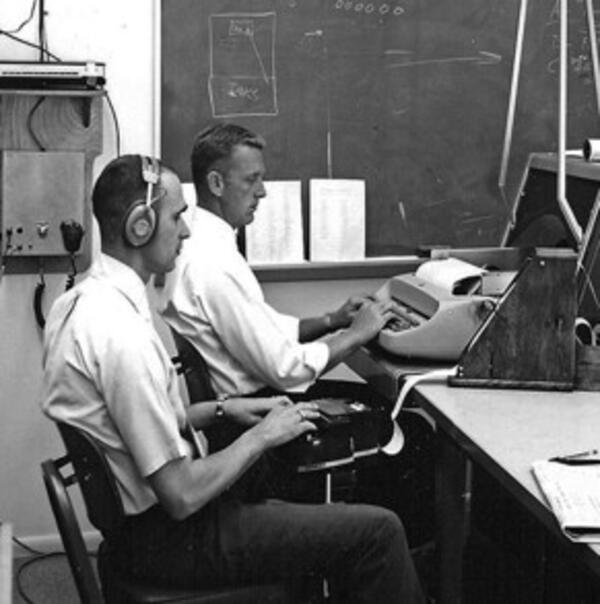
Stenographers and Typists were in high demand, typing the astronaut's conversations into text and producing copies of new documents quickly
Stenographers and Typists were in high demand, typing the astronaut's conversations into text and producing copies of new documents quicklyA typist (background) and a stenographer (foreground) are typing out astronaut conversations in real time during the Apollo missions (or more likely, practicing for the main event).
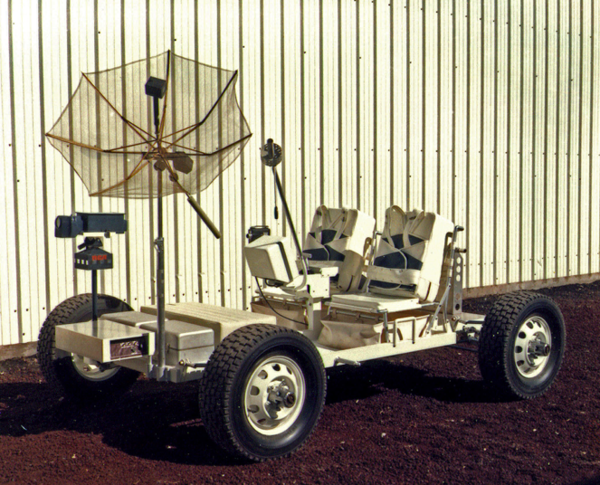
An early photo of Grover the Geologic Rover outside the original machine shop
An early photo of Grover the Geologic Rover outside the original machine shopGrover followed the original blueprints with only a few small modifications to run on Earth, but it is certain that the vehicle that roamed the Moon was almost identical to our Grover. On the seats of Grover are bulky backpacks worn by the astronauts on the Moon. It was very easy to leave the vehicle while wearing the packs.

Crater Creation
Blasting craters for a new section of the Cinder Lakes outside Flagstaff, Ariz.(July 1968). USGS Astrogeology constructed a mockup of a section of the moon's Sea of Tranquillity in a cinder field to aid with training and time-and-motion studies.
Blasting craters for a new section of the Cinder Lakes outside Flagstaff, Ariz.(July 1968). USGS Astrogeology constructed a mockup of a section of the moon's Sea of Tranquillity in a cinder field to aid with training and time-and-motion studies.

Flynn Creek Drill Core 67-01: Box 5 (FC67-1_Box_005)
Flynn Creek Drill Core 67-01: Box 5 (FC67-1_Box_005)Between 1967 and 1979, USGS scientist Dr. David Roddy conducted a drilling program at Flynn Creek crater. The drilling program produced more than 3.8 km of nearly continuous core from 18 separate drill holes. These samples are now contained in 2,261 standard core storage boxes at the USGS in Flagstaff, Arizona.
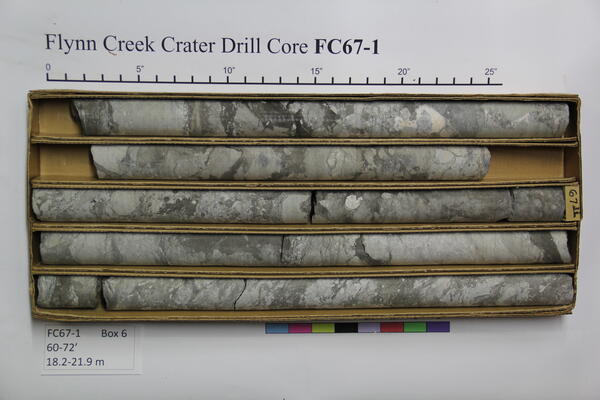
Flynn Creek Drill Core 67-01: Box 6 (FC67-1_Box_006)
Flynn Creek Drill Core 67-01: Box 6 (FC67-1_Box_006)Between 1967 and 1979, USGS scientist Dr. David Roddy conducted a drilling program at Flynn Creek crater. The drilling program produced more than 3.8 km of nearly continuous core from 18 separate drill holes. These samples are now contained in 2,261 standard core storage boxes at the USGS in Flagstaff, Arizona.
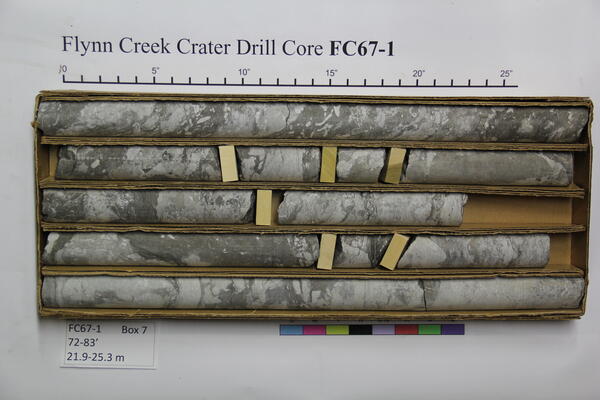
Flynn Creek Drill Core 67-01: Box 7 (FC67-1_Box_007)
Flynn Creek Drill Core 67-01: Box 7 (FC67-1_Box_007)Between 1967 and 1979, USGS scientist Dr. David Roddy conducted a drilling program at Flynn Creek crater. The drilling program produced more than 3.8 km of nearly continuous core from 18 separate drill holes. These samples are now contained in 2,261 standard core storage boxes at the USGS in Flagstaff, Arizona.
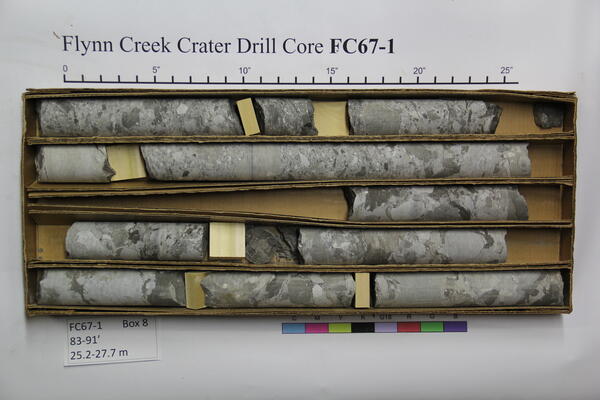
Flynn Creek Drill Core 67-01: Box 8 (FC67-1_Box_008)
Flynn Creek Drill Core 67-01: Box 8 (FC67-1_Box_008)Between 1967 and 1979, USGS scientist Dr. David Roddy conducted a drilling program at Flynn Creek crater. The drilling program produced more than 3.8 km of nearly continuous core from 18 separate drill holes. These samples are now contained in 2,261 standard core storage boxes at the USGS in Flagstaff, Arizona.
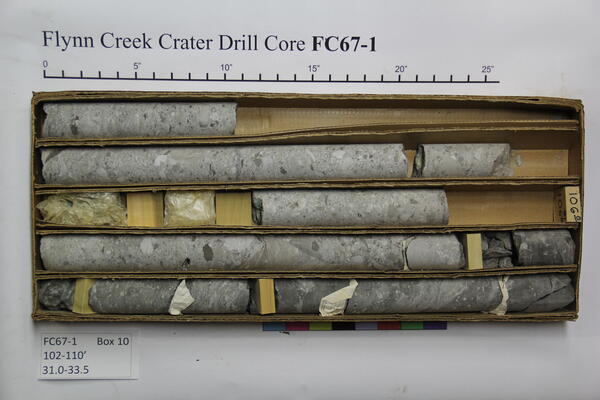
Flynn Creek Drill Core 67-01: Box 10 (FC67-1_Box_010)
Flynn Creek Drill Core 67-01: Box 10 (FC67-1_Box_010)Between 1967 and 1979, USGS scientist Dr. David Roddy conducted a drilling program at Flynn Creek crater. The drilling program produced more than 3.8 km of nearly continuous core from 18 separate drill holes. These samples are now contained in 2,261 standard core storage boxes at the USGS in Flagstaff, Arizona.
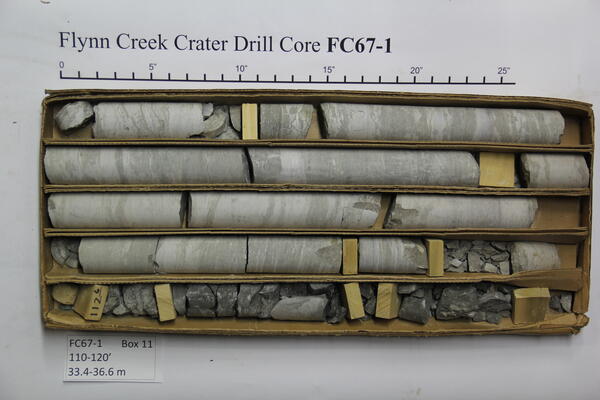
Flynn Creek Drill Core 67-01: Box 11 (FC67-1_Box_011)
Flynn Creek Drill Core 67-01: Box 11 (FC67-1_Box_011)Between 1967 and 1979, USGS scientist Dr. David Roddy conducted a drilling program at Flynn Creek crater. The drilling program produced more than 3.8 km of nearly continuous core from 18 separate drill holes. These samples are now contained in 2,261 standard core storage boxes at the USGS in Flagstaff, Arizona.
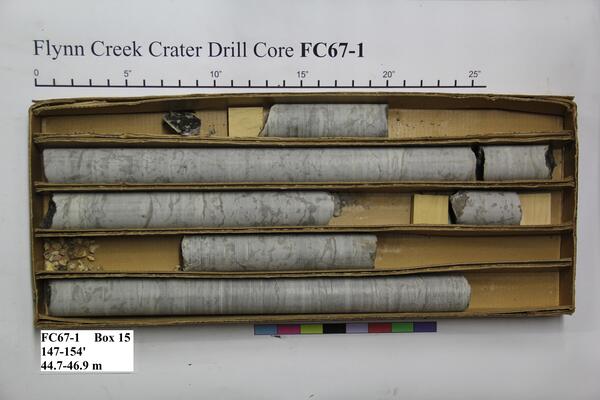
Flynn Creek Drill Core 67-01: Box 15 (FC67-1_Box_015)
Flynn Creek Drill Core 67-01: Box 15 (FC67-1_Box_015)Between 1967 and 1979, USGS scientist Dr. David Roddy conducted a drilling program at Flynn Creek crater. The drilling program produced more than 3.8 km of nearly continuous core from 18 separate drill holes. These samples are now contained in 2,261 standard core storage boxes at the USGS in Flagstaff, Arizona.

Flynn Creek Drill Core 67-01: Box 17 (FC67-1_Box_017)
Flynn Creek Drill Core 67-01: Box 17 (FC67-1_Box_017)Between 1967 and 1979, USGS scientist Dr. David Roddy conducted a drilling program at Flynn Creek crater. The drilling program produced more than 3.8 km of nearly continuous core from 18 separate drill holes. These samples are now contained in 2,261 standard core storage boxes at the USGS in Flagstaff, Arizona.
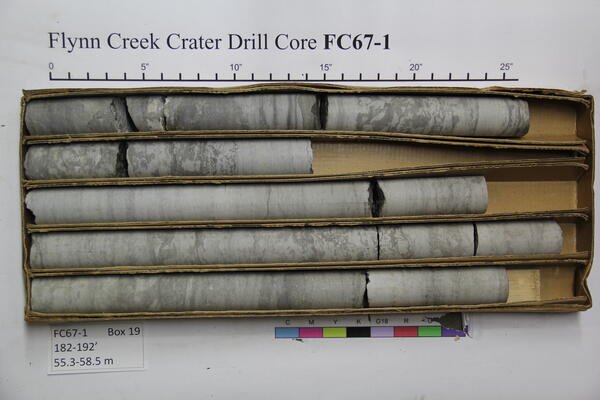
Flynn Creek Drill Core 67-01: Box 19 (FC67-1_Box_019)
Flynn Creek Drill Core 67-01: Box 19 (FC67-1_Box_019)Between 1967 and 1979, USGS scientist Dr. David Roddy conducted a drilling program at Flynn Creek crater. The drilling program produced more than 3.8 km of nearly continuous core from 18 separate drill holes. These samples are now contained in 2,261 standard core storage boxes at the USGS in Flagstaff, Arizona.

Flynn Creek Drill Core 67-01: Box 20 (FC67-1_Box_020)
Flynn Creek Drill Core 67-01: Box 20 (FC67-1_Box_020)Between 1967 and 1979, USGS scientist Dr. David Roddy conducted a drilling program at Flynn Creek crater. The drilling program produced more than 3.8 km of nearly continuous core from 18 separate drill holes. These samples are now contained in 2,261 standard core storage boxes at the USGS in Flagstaff, Arizona.

Flynn Creek Drill Core 67-01: Box 23 (FC67-1_Box_023)
Flynn Creek Drill Core 67-01: Box 23 (FC67-1_Box_023)Between 1967 and 1979, USGS scientist Dr. David Roddy conducted a drilling program at Flynn Creek crater. The drilling program produced more than 3.8 km of nearly continuous core from 18 separate drill holes. These samples are now contained in 2,261 standard core storage boxes at the USGS in Flagstaff, Arizona.
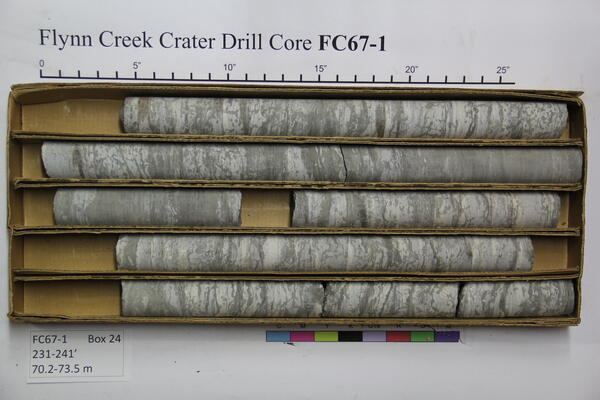
Flynn Creek Drill Core 67-01: Box 24 (FC67-1_Box_024)
Flynn Creek Drill Core 67-01: Box 24 (FC67-1_Box_024)Between 1967 and 1979, USGS scientist Dr. David Roddy conducted a drilling program at Flynn Creek crater. The drilling program produced more than 3.8 km of nearly continuous core from 18 separate drill holes. These samples are now contained in 2,261 standard core storage boxes at the USGS in Flagstaff, Arizona.