



Evaluating the Risks of Tire-Derived Compounds to Fish in the Chesapeake Bay Watershed
Tires contain a chemical known as 6PPD which prevents them from quickly breaking down. Microscopic tire particles, generated mainly from the friction of tires on roads, release 6PPD-quinone (6PPDQ) when they come into contact with oxygen. During precipitation events, 6PPDQ can be washed off roads, harming fish in nearby waterways. In response to requests from fishery managers, the USGS is studying 6PPDQ in the Chesapeake to understand its potential effects on sensitive species like brook trout. This work can help protect and recover priority fish species in the Chesapeake and support the outdoor recreation economy for generations to come.
Providing Management-Relevant Information in the Chesapeake and Beyond
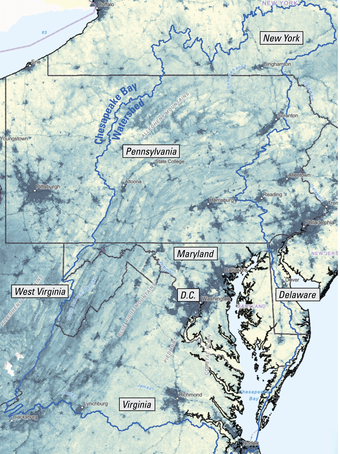
A web mapping tool was recently released by the USGS that shows where likely sources of 6PPDQ exist in different parts of the continental United States (a heat map, fig. 1). This tool allows direct user interaction with the data, enabling closer examination of areas of concern, and prioritization of sampling areas. Click here to explore this web mapping tool, which was developed by a multidisciplinary group of scientists from the USGS Environmental Health Program's Geospatial Analyses and Applications Team.
To better understand the occurrence and magnitude of 6PPDQ in the Chesapeake Bay watershed, the USGS began sampling for 6PPDQ at 12 river locations in Pennsylvania, Maryland, and Washington D.C. in 2024. This work was expanded to 26 river locations throughout the watershed in 2025. These river locations are part of the Nontidal Monitoring Network (NTN) and were selected using insights from the 6PPDQ web mapping tool about 6PPDQ risk factors and brook trout habitat. To augment this work, the USGS is also evaluating how 6PPDQ varies over the course of storm events in two urban streams near Washington D.C. using automated samplers, capable of timed sample collection throughout the duration of a rain event.
The USGS plans to continue these studies next year and to use this work to provide information to state and local partners about the occurrence of 6PPDQ and its potential impacts on key fish species in the Chesapeake Bay watershed.
Publication Details
Gordon, S.E., Williams, B.M., Jones, D.K., Hansen, J.D., Greer, J.B., Smalling, K., and Lane, R.F., 2025, Presumptive sources and relative heat index of 6PPD-quinone at the NHDPlusV2 catchment scale across the conterminous U.S.: U.S. Geological Survey data release, https://doi.org/10.5066/P1WBVJEU.
For More Information
| Web mapping tool | USGS Chesapeake NTN research | 6PPDQ sampling in the Anacostia watershed |
|---|---|---|
| Stephanie E. Gordon Physical Scientist, Eastern Ecological Science Center Email: sgordon@usgs.gov | Rebecca M. Gorney Biologist, New York Water Science Center Email: rgorney@usgs.gov | Tristan Mohs Physical Scientist, MD-DE-DC Water Science Center Email: tmohs@usgs.gov |
| Brianna M. Williams Geographer, New Jersey Water Science Center Email: bmwilliams@usgs.gov |
Tires contain a chemical known as 6PPD which prevents them from quickly breaking down. Microscopic tire particles, generated mainly from the friction of tires on roads, release 6PPD-quinone (6PPDQ) when they come into contact with oxygen. During precipitation events, 6PPDQ can be washed off roads, harming fish in nearby waterways. In response to requests from fishery managers, the USGS is studying 6PPDQ in the Chesapeake to understand its potential effects on sensitive species like brook trout. This work can help protect and recover priority fish species in the Chesapeake and support the outdoor recreation economy for generations to come.
Providing Management-Relevant Information in the Chesapeake and Beyond
A web mapping tool was recently released by the USGS that shows where likely sources of 6PPDQ exist in different parts of the continental United States (a heat map, fig. 1). This tool allows direct user interaction with the data, enabling closer examination of areas of concern, and prioritization of sampling areas. Click here to explore this web mapping tool, which was developed by a multidisciplinary group of scientists from the USGS Environmental Health Program's Geospatial Analyses and Applications Team.
To better understand the occurrence and magnitude of 6PPDQ in the Chesapeake Bay watershed, the USGS began sampling for 6PPDQ at 12 river locations in Pennsylvania, Maryland, and Washington D.C. in 2024. This work was expanded to 26 river locations throughout the watershed in 2025. These river locations are part of the Nontidal Monitoring Network (NTN) and were selected using insights from the 6PPDQ web mapping tool about 6PPDQ risk factors and brook trout habitat. To augment this work, the USGS is also evaluating how 6PPDQ varies over the course of storm events in two urban streams near Washington D.C. using automated samplers, capable of timed sample collection throughout the duration of a rain event.
The USGS plans to continue these studies next year and to use this work to provide information to state and local partners about the occurrence of 6PPDQ and its potential impacts on key fish species in the Chesapeake Bay watershed.
Publication Details
Gordon, S.E., Williams, B.M., Jones, D.K., Hansen, J.D., Greer, J.B., Smalling, K., and Lane, R.F., 2025, Presumptive sources and relative heat index of 6PPD-quinone at the NHDPlusV2 catchment scale across the conterminous U.S.: U.S. Geological Survey data release, https://doi.org/10.5066/P1WBVJEU.
For More Information
| Web mapping tool | USGS Chesapeake NTN research | 6PPDQ sampling in the Anacostia watershed |
|---|---|---|
| Stephanie E. Gordon Physical Scientist, Eastern Ecological Science Center Email: sgordon@usgs.gov | Rebecca M. Gorney Biologist, New York Water Science Center Email: rgorney@usgs.gov | Tristan Mohs Physical Scientist, MD-DE-DC Water Science Center Email: tmohs@usgs.gov |
| Brianna M. Williams Geographer, New Jersey Water Science Center Email: bmwilliams@usgs.gov |