



A least tern chick rests in the sand before being banded on Poplar Island, MD
Images
Eastern Ecological Science Center images.
Filter Total Items: 5127

Least tern on Poplar Island
A least tern chick rests in the sand before being banded on Poplar Island, MD

Banding a least tern chick
A researcher bands an endangered Least Tern chick on Poplar Island, MD
A researcher bands an endangered Least Tern chick on Poplar Island, MD

Planting the pollinator garden at the Conte Lab
Sam Droege (fore) arrived from Patuxent with plants for the Conte Lab's new pollinator garden. Sam Parker (back) assists with the planting.
Sam Droege (fore) arrived from Patuxent with plants for the Conte Lab's new pollinator garden. Sam Parker (back) assists with the planting.
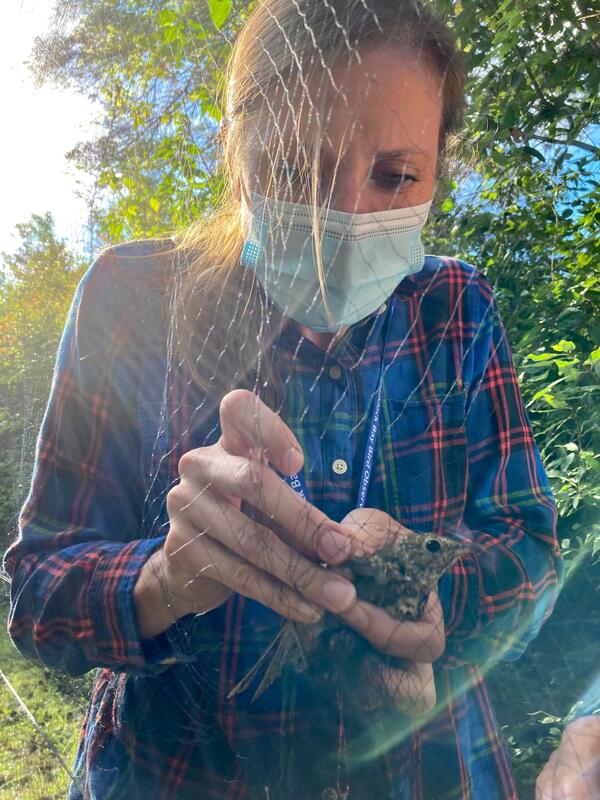
Biologist Stephanie Egger extracts a thrush from a mist net.
Biologist Stephanie Egger extracts a thrush from a mist net.Bird Banding Laboratory Biologist, Stephanie Egger, extracts a thrush from a mist net.
Biologist Stephanie Egger extracts a thrush from a mist net.
Biologist Stephanie Egger extracts a thrush from a mist net.Bird Banding Laboratory Biologist, Stephanie Egger, extracts a thrush from a mist net.

Installation of a Water Temperature Logger in Blue Blazes Run
Installation of a Water Temperature Logger in Blue Blazes RunZachary Kelly installs a water temperature logger in Blue Blazes Run, a headwater stream in Catoctin Mountain Park, MD.
Installation of a Water Temperature Logger in Blue Blazes Run
Installation of a Water Temperature Logger in Blue Blazes RunZachary Kelly installs a water temperature logger in Blue Blazes Run, a headwater stream in Catoctin Mountain Park, MD.

Installation of a Water Temperature Logger in Catoctin Mountain Park
Installation of a Water Temperature Logger in Catoctin Mountain ParkKarmann Kessler and Zachary Kelly install a water temperature logger in Big Hunting Creek in Catoctin Mountain Park, MD.
Installation of a Water Temperature Logger in Catoctin Mountain Park
Installation of a Water Temperature Logger in Catoctin Mountain ParkKarmann Kessler and Zachary Kelly install a water temperature logger in Big Hunting Creek in Catoctin Mountain Park, MD.

Collecting shad for study at Holyoke fish lift
Steve Walk and crew collect 80+ American shad from the trap at the Holyoke fish lift on the Connecticut River. Shad behavior will be studied in Kevin Mulligan's V-Trap study.
Steve Walk and crew collect 80+ American shad from the trap at the Holyoke fish lift on the Connecticut River. Shad behavior will be studied in Kevin Mulligan's V-Trap study.

Banding Red Knots at Gray's Harbor
A team of biologists sits in a circle to weigh and measure captured Red Knots. Photo credit: Zak Pohlenm, USFWS
A team of biologists sits in a circle to weigh and measure captured Red Knots. Photo credit: Zak Pohlenm, USFWS

Red Knot after banding at Gray's Harbor
A Red Knot C. c. roselaari captured at Gray's Harbor with a metal band on its right leg. Photo credit: Zak Pohlen, USFWS
A Red Knot C. c. roselaari captured at Gray's Harbor with a metal band on its right leg. Photo credit: Zak Pohlen, USFWS

Red Knot at Gray's Harbor
A Red Knot Calidris canutus roselaari standing on the beach at Gray's Harbor. Photo credit: Zak Pohlenm, USFWS
A Red Knot Calidris canutus roselaari standing on the beach at Gray's Harbor. Photo credit: Zak Pohlenm, USFWS

The first shad trial in the Palisade Entrance is complete
The first shad trial in the Palisade Entrance is completeKevin Mulligan coordinates the end of the first shad trail in the Palisade Entrance study, a DOE funded study investigating the efficiency of a novel fishway entrance.
The first shad trial in the Palisade Entrance is complete
The first shad trial in the Palisade Entrance is completeKevin Mulligan coordinates the end of the first shad trail in the Palisade Entrance study, a DOE funded study investigating the efficiency of a novel fishway entrance.

Seining fish into the Burroughs Pond following the first shad trial
Seining fish into the Burroughs Pond following the first shad trialKevin Molongoski (left) and Steve Walk (right) seine adult American shad back into the Burroughs Ponds (resting/exercising pools) following the completion of trial through the Palisade Entrance.
Seining fish into the Burroughs Pond following the first shad trial
Seining fish into the Burroughs Pond following the first shad trialKevin Molongoski (left) and Steve Walk (right) seine adult American shad back into the Burroughs Ponds (resting/exercising pools) following the completion of trial through the Palisade Entrance.

Palisade study trials in the Fish Passage Complex with American shad
Palisade study trials in the Fish Passage Complex with American shadThe Palisade Entrance, a novel fishway entrance, was constructed and tested at the Conte Lab's Fish Passage Complex. Trials were conducted with multiple species, including American shad, to determine entry rate under a variety of hydraulic conditions.
Palisade study trials in the Fish Passage Complex with American shad
Palisade study trials in the Fish Passage Complex with American shadThe Palisade Entrance, a novel fishway entrance, was constructed and tested at the Conte Lab's Fish Passage Complex. Trials were conducted with multiple species, including American shad, to determine entry rate under a variety of hydraulic conditions.

Stephanie Egger smiles for the camera with her Bird Safe Philly program supplies
Stephanie Egger smiles for the camera with her Bird Safe Philly program suppliesStephanie Egger smiles for the camera with her Bird Safe Philly program supplies.
Stephanie Egger smiles for the camera with her Bird Safe Philly program supplies
Stephanie Egger smiles for the camera with her Bird Safe Philly program suppliesStephanie Egger smiles for the camera with her Bird Safe Philly program supplies.

Tagging and measuring American shad for the Palisade fishway study
Tagging and measuring American shad for the Palisade fishway studyKevin Molongoski (fore) carries a tagged adult American shad from the fish truck to the Burroughs Pond in the Conte Lab's Fish Passage Complex. Kevin Mulligan (back) prepares another passive integrated transponder (PIT) tag.
Tagging and measuring American shad for the Palisade fishway study
Tagging and measuring American shad for the Palisade fishway studyKevin Molongoski (fore) carries a tagged adult American shad from the fish truck to the Burroughs Pond in the Conte Lab's Fish Passage Complex. Kevin Mulligan (back) prepares another passive integrated transponder (PIT) tag.

Solar Panel Installation
This is the set up of the solar panels at Blackwater National Wildlife Preserve that will be used to power the newly installed sap flow sensors on site. These solar panels will decrease the number of required trips to the site to change batteries and will contribute to the undisturbed data flow from the sensors.
This is the set up of the solar panels at Blackwater National Wildlife Preserve that will be used to power the newly installed sap flow sensors on site. These solar panels will decrease the number of required trips to the site to change batteries and will contribute to the undisturbed data flow from the sensors.

Adjustments to the O2 delivery system on Conte's fish truck
Adjustments to the O2 delivery system on Conte's fish truckSteve Walk makes final adjustments to innovative oxygen delivery system recently installed on FPDA team's fish truck.
Adjustments to the O2 delivery system on Conte's fish truck
Adjustments to the O2 delivery system on Conte's fish truckSteve Walk makes final adjustments to innovative oxygen delivery system recently installed on FPDA team's fish truck.

Sap flow sensors at Blackwater National Wildlife Preserve
Sap flow sensors at Blackwater National Wildlife PreserveClose up of the newly installed sap flow sensors at Blackwater National Wildlife Preserve. These sensors were installed by EESC's Justine Neville and Ken Krauss of the USGS Wetland and Aquatic Research Center in Lafayette, LA. These sensors will be used to analyze how the trees in a marsh ecosystem respond to changing ecological and climatic conditions.
Sap flow sensors at Blackwater National Wildlife Preserve
Sap flow sensors at Blackwater National Wildlife PreserveClose up of the newly installed sap flow sensors at Blackwater National Wildlife Preserve. These sensors were installed by EESC's Justine Neville and Ken Krauss of the USGS Wetland and Aquatic Research Center in Lafayette, LA. These sensors will be used to analyze how the trees in a marsh ecosystem respond to changing ecological and climatic conditions.

Canada geese forage with two goslings in tow
A pair of Canada Geese forage with their two newly hatched goslings on Eastern Ecological Science Center's campus on Patuxent Research Refuge.
A pair of Canada Geese forage with their two newly hatched goslings on Eastern Ecological Science Center's campus on Patuxent Research Refuge.

Building Conte Lab's pollinator garden
Marty Garcia and Sam Parker begin installing the timber boards for the 30' x 10' raised bed of a pollinator garden behind the orchard at the USGS Conte Lab.
Marty Garcia and Sam Parker begin installing the timber boards for the 30' x 10' raised bed of a pollinator garden behind the orchard at the USGS Conte Lab.

Sap probe install
EESC USGS Mendenhall Fellow Justine Neville installing sap flow probes at Blackwater National Wildlife Refuge with USGS colleague Ken Krauss from USGS Wetland and Aquatic Research Center in Lafayette, LA. Sap flow probes will be used to monitor transpiration rates in coastal forests to assess the water usage of trees experiencing stress from inundation.
EESC USGS Mendenhall Fellow Justine Neville installing sap flow probes at Blackwater National Wildlife Refuge with USGS colleague Ken Krauss from USGS Wetland and Aquatic Research Center in Lafayette, LA. Sap flow probes will be used to monitor transpiration rates in coastal forests to assess the water usage of trees experiencing stress from inundation.