
U.S. flag

An official website of the United States government

Imperiled Species

Filter Total Items: 19

Key Values of a Century of EESC Science

The USGS Eastern Ecological Science Center (EESC) is rooted in a proud tradition of service to the nation—advancing science that informs the conservation and management of fish, wildlife, and habitats across the eastern United States and beyond. Our mission is clear: deliver reliable, partner-driven science that supports natural resource decisions today, while ensuring these resources remain...
Key Values of a Century of EESC Science

Key Values of a Century of EESC Science

The USGS Eastern Ecological Science Center (EESC) is rooted in a proud tradition of service to the nation—advancing science that informs the conservation and management of fish, wildlife, and habitats across the eastern United States and beyond. Our mission is clear: deliver reliable, partner-driven science that supports natural resource decisions today, while ensuring these resources remain...
Learn More

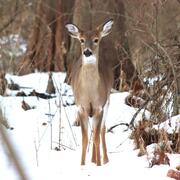
EESC Makes an Impact: Preserving our Hunting Resources

Hunting is an economic engine for the U.S. and responsible management of these resources directly supports 45.2 billion dollars spent by hunters annually. Conservation and management of hunting resources also contributes substantially to the 394.8 billion dollars spent on all wildlife-related recreation. Hunting traditions are an integral component of our American heritage, with 14.4 million...
EESC Makes an Impact: Preserving our Hunting Resources

EESC Makes an Impact: Preserving our Hunting Resources

Hunting is an economic engine for the U.S. and responsible management of these resources directly supports 45.2 billion dollars spent by hunters annually. Conservation and management of hunting resources also contributes substantially to the 394.8 billion dollars spent on all wildlife-related recreation. Hunting traditions are an integral component of our American heritage, with 14.4 million...
Learn More

EESC Makes an Impact: Reducing Management Costs and Increasing Efficiency

Decision analysis is widely used in business applications to improve cost saving and increase efficiency under uncertainty. Scientists at the U.S. Geological Survey Eastern Ecological Science Center (EESC) include world-renowned experts who use data, mathematics, statistics, and computer science to help frame and solve decision problems to support U.S. national security, public health, wildlife...
EESC Makes an Impact: Reducing Management Costs and Increasing Efficiency

EESC Makes an Impact: Reducing Management Costs and Increasing Efficiency

Decision analysis is widely used in business applications to improve cost saving and increase efficiency under uncertainty. Scientists at the U.S. Geological Survey Eastern Ecological Science Center (EESC) include world-renowned experts who use data, mathematics, statistics, and computer science to help frame and solve decision problems to support U.S. national security, public health, wildlife...
Learn More

Genomics to Aid Conservation and restoration of the Yellow Lampmussel (Lampsilis cariosa) and Tidewater Mucket (Atlanticoncha ochracea)

Due to the rapid decline in abundance of Yellow Lampmussel ( Lampsilis cariosa) and Tidewater Mucket ( Atlanticoncha ochracea), USGS and partners at the U.S. Fish and Wildlife Service (USFWS) and Central Michigan University (CMU) are conducting an assessment of genetic diversity and population structure to inform appropriate recommendations for conservation and management of each species. These...
Genomics to Aid Conservation and restoration of the Yellow Lampmussel (Lampsilis cariosa) and Tidewater Mucket (Atlanticoncha ochracea)

Genomics to Aid Conservation and restoration of the Yellow Lampmussel (Lampsilis cariosa) and Tidewater Mucket (Atlanticoncha ochracea)

Due to the rapid decline in abundance of Yellow Lampmussel ( Lampsilis cariosa) and Tidewater Mucket ( Atlanticoncha ochracea), USGS and partners at the U.S. Fish and Wildlife Service (USFWS) and Central Michigan University (CMU) are conducting an assessment of genetic diversity and population structure to inform appropriate recommendations for conservation and management of each species. These...
Learn More

Sturgeon Occurrence and Behavior in the Outer Continental Shelf

A new study aims to collect information on sturgeon temporal and spatial distribution to inform offshore wind energy and sand leasing operations.
Sturgeon Occurrence and Behavior in the Outer Continental Shelf

Sturgeon Occurrence and Behavior in the Outer Continental Shelf

A new study aims to collect information on sturgeon temporal and spatial distribution to inform offshore wind energy and sand leasing operations.
Learn More

Supporting Interstate Conservation of Atlantic Sturgeon (Acipenser o. oxyrinchus) Using Genetics, Telemetry, and Side-scan Sonar

USGS scientists are using innovative combinations of telemetry, genetics, and side-scan Sonar to support conservation of endangered Atlantic sturgeon ( Acipenser o. oxyrinchus).
Supporting Interstate Conservation of Atlantic Sturgeon (Acipenser o. oxyrinchus) Using Genetics, Telemetry, and Side-scan Sonar

Supporting Interstate Conservation of Atlantic Sturgeon (Acipenser o. oxyrinchus) Using Genetics, Telemetry, and Side-scan Sonar

USGS scientists are using innovative combinations of telemetry, genetics, and side-scan Sonar to support conservation of endangered Atlantic sturgeon ( Acipenser o. oxyrinchus).
Learn More

Using Multiple Indicators to Assess Stream Condition in the Chesapeake Bay

USGS is working with federal, state and local partners to develop multiple assessments of stream and river conditions in non-tidal areas of the Chesapeake Bay watershed. These assessments will help managers preserve stream health and improve biological conditions in impaired streams as the human population and climate continue to change in this region.
Using Multiple Indicators to Assess Stream Condition in the Chesapeake Bay

Using Multiple Indicators to Assess Stream Condition in the Chesapeake Bay

USGS is working with federal, state and local partners to develop multiple assessments of stream and river conditions in non-tidal areas of the Chesapeake Bay watershed. These assessments will help managers preserve stream health and improve biological conditions in impaired streams as the human population and climate continue to change in this region.
Learn More

New studies reveal ecological importance of fine-scale groundwater connectivity for streams during drought

Stream ecosystems support vital resources that may be jeopardized by climate change and climate stressors such as drought.
New studies reveal ecological importance of fine-scale groundwater connectivity for streams during drought

New studies reveal ecological importance of fine-scale groundwater connectivity for streams during drought

Stream ecosystems support vital resources that may be jeopardized by climate change and climate stressors such as drought.
Learn More

Fish Passage Design and Analysis at the S.O. Conte Research Laboratory

There are more than 92,000 dams in the United States, of which at least 3% of these produce hydropower. Hydropower projects create renewable energy but also can alter habitats, restrict upstream and downstream movements of fishes and other aquatic organisms, and may stress, injure or kill migrant fishes and other aquatic organisms. In addition, there are more than 5 million culverts and other road...
Fish Passage Design and Analysis at the S.O. Conte Research Laboratory

Fish Passage Design and Analysis at the S.O. Conte Research Laboratory

There are more than 92,000 dams in the United States, of which at least 3% of these produce hydropower. Hydropower projects create renewable energy but also can alter habitats, restrict upstream and downstream movements of fishes and other aquatic organisms, and may stress, injure or kill migrant fishes and other aquatic organisms. In addition, there are more than 5 million culverts and other road...
Learn More

Northeast Amphibian Research and Monitoring Initiative

The U.S. Geological Survey’s Eastern Ecological Science Center is home to the Northeast Amphibian Research and Monitoring Initiative (NEARMI), one of 7 ARMI regions across the United States. NEARMI works on public lands in thirteen states from Maine to Virginia, including many National Parks and National Wildlife Refuges.
Northeast Amphibian Research and Monitoring Initiative

Northeast Amphibian Research and Monitoring Initiative

The U.S. Geological Survey’s Eastern Ecological Science Center is home to the Northeast Amphibian Research and Monitoring Initiative (NEARMI), one of 7 ARMI regions across the United States. NEARMI works on public lands in thirteen states from Maine to Virginia, including many National Parks and National Wildlife Refuges.
Learn More

Genetic connectivity among regional populations of red tree corals (Primnoa pacifica) in the North Pacific Ocean

Knowledge of the degree to which populations are connected through larval dispersal is imperative to effective management, yet little is known about larval dispersal capability or population connectivity in Primnoa pacifica, an important habitat forming octocoral on the outer continental shelf and upper slope in the Gulf of Alaska.
Genetic connectivity among regional populations of red tree corals (Primnoa pacifica) in the North Pacific Ocean

Genetic connectivity among regional populations of red tree corals (Primnoa pacifica) in the North Pacific Ocean

Knowledge of the degree to which populations are connected through larval dispersal is imperative to effective management, yet little is known about larval dispersal capability or population connectivity in Primnoa pacifica, an important habitat forming octocoral on the outer continental shelf and upper slope in the Gulf of Alaska.
Learn More

Conservation Genetics and Genomics of the Narrowly Endemic Island Marble Butterfly Euchloe ausonides insulanus

The island marble butterfly ( Euchloe ausonides insulanus) was first discovered on Vancouver Island, Canada in 1861. Based on morphological characteristics, it has been described as a subspecies of Euchloe ausonides. After a collection was made in 1908 on Gabriola Island, Canada, the island marble was not seen again until 1998 on San Juan Island, Washington, USA. Recent surveys have determined...
Conservation Genetics and Genomics of the Narrowly Endemic Island Marble Butterfly Euchloe ausonides insulanus

Conservation Genetics and Genomics of the Narrowly Endemic Island Marble Butterfly Euchloe ausonides insulanus

The island marble butterfly ( Euchloe ausonides insulanus) was first discovered on Vancouver Island, Canada in 1861. Based on morphological characteristics, it has been described as a subspecies of Euchloe ausonides. After a collection was made in 1908 on Gabriola Island, Canada, the island marble was not seen again until 1998 on San Juan Island, Washington, USA. Recent surveys have determined...
Learn More
Was this page helpful?