



Data
The Mineral Resources Online Spatial Data web portal is our primary resource for interactive maps and downloadable data for regional and global geology, geochemistry, geophysics, and mineral resources.
Geophysical Data
Geophysical Data

Find geophysical data from airborne surveys and geophysical data compilations (magnetic, gravity, aeroradiometric).
Geochemical Data
Geochemical Data

Find data from the National Geochemical Database, focused geochemical surveys, and the NURE-HSSR collection.
Mineral Resources Data
Mineral Resources Data
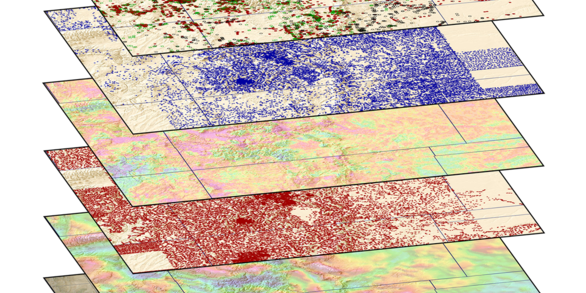
Interactive maps and downloadable data for regional and global analysis.
Filter Total Items: 415
Magnetotelluric sounding data, stations 1 to 25, north eastern Nevada, 2003 Magnetotelluric sounding data, stations 1 to 25, north eastern Nevada, 2003
This dataset includes the magnetotelluric (MT) sounding data collected in 2003 along a north-south profile west of Wendover, Nevada. It is important to know whether major mining districts in the Northern Nevada Gold Province are underlain by rocks of the Archean Wyoming craton, which are known to contain orogenic gold deposits, or by accreted rocks of the Paleoproterozoic Mojave province...
Database of significant deposits of gold, silver, copper, lead, and zinc in Alaska Database of significant deposits of gold, silver, copper, lead, and zinc in Alaska
This data release provides descriptions and locations of 134 significant deposits in Alaska. Approximately 99 percent of past production and remaining identified resources of gold, silver, copper, lead, and zinc in the United States are accounted for by deposits that originally contained at least 2 metric tons (t) of gold, 85 t silver, 50,000 t copper, 30,000 t lead, and 50,000 t zinc...
Imaging spectrometer reflectance data, mineral predominance map, and white mica wavelength position map, Nabesna Quadrangle, Alaska Imaging spectrometer reflectance data, mineral predominance map, and white mica wavelength position map, Nabesna Quadrangle, Alaska
Approximately 1,900 square kilometers of imagery were collected from July 14 to July 21, 2014 using a HyMap sensor (Cocks and others, 1998) mounted on a modified Piper Navajo aircraft. The survey area covered parts of the Wrangell and Nutzotin Mountains in the eastern Alaska Range near Nabesna, Alaska. The aircraft was flown at an altitude of approximately 5,050 meters (m) (3,480 m above...
Mines, Mineral Occurrences, and Mining Districts in the Carlin Area, Nevada Mines, Mineral Occurrences, and Mining Districts in the Carlin Area, Nevada
Sediment hosted gold deposits in Nevada were first mined in the 1960s from open pit mines with large tonnage and low grade resources. Since that time, continuing exploration and discovery have identified extraordinary resources, and together these deposits now form the second-largest gold endowment on Earth, surpassed only by the Witwatersrand Gold Fields of South Africa. The data herein...
Magnetotelluric sounding data, stations 26 to 36, north of Wells, Nevada, 2005 Magnetotelluric sounding data, stations 26 to 36, north of Wells, Nevada, 2005
This dataset includes the magnetotelluric (MT) sounding data collected in 2005 along an east-west profile north of Wells, Nevada. It is important to know whether major mining districts in the Northern Nevada Gold Province are underlain by rocks of the Archean Wyoming craton, which are known to contain orogenic gold deposits, or by accreted rocks of the Paleoproterozoic Mojave province...
High resolution helicopter-borne magnetic and electromagnetic survey Eureka Graben area, Colorado September 1999 High resolution helicopter-borne magnetic and electromagnetic survey Eureka Graben area, Colorado September 1999
On September 25, 1998, SIAL Gosciences Inc. (SIAL) was awarded Department of Interior, contract 98CRCN1018, by the U.S. Geological Survey. This contract required SIAL to carry out a high-sensitivity magnetic and electromagnetic helicopter survey over one block located in the Eureka Graben Area near Silverton, Colorado. The primary goal of this project was to provide digitally recorded...
Electron microprobe data for monazite and xenotime used in consideration of gold deposit formation models (ver. 2.0, May 2023) Electron microprobe data for monazite and xenotime used in consideration of gold deposit formation models (ver. 2.0, May 2023)
The genetic origin of many gold deposits, including Pogo in Alaska, remains controversial with questions as to whether they formed due to magmatic-hydrothermal or metamorphic-hydrothermal fluids. Gaining a better understanding of the formation mechanisms for these deposits is critical for defining proper exploration criteria in gold-bearing regions and production within these deposits...
Whole rock, soil, sediment, x-ray diffraction, and electron microprobe analyses of samples from the Orange Hill-Bond Creek area, Nabesna Quadrangle, Alaska Whole rock, soil, sediment, x-ray diffraction, and electron microprobe analyses of samples from the Orange Hill-Bond Creek area, Nabesna Quadrangle, Alaska
This data release includes geochemical, x-ray diffraction mineralogical, and electron probe microanalysis (EPMA) data on rocks, soils, and sediments collected near the Orange Hill and Bond Creek porphyry copper deposits, Nabesna quadrangle, Alaska. Geochemical analyses were completed by a laboratory under contract with the U.S. Geological Survey (USGS). Electron microprobe and x-ray...
Airborne electromagnetic and magnetic survey data, Big Sioux aquifer, October 2015, Sioux Falls, South Dakota Airborne electromagnetic and magnetic survey data, Big Sioux aquifer, October 2015, Sioux Falls, South Dakota
Airborne electromagnetic (AEM) and magnetic survey data were collected during October 2015 along 769 line-kilometers over a 160-square-kilometer area that includes the Big Sioux aquifer between Sioux Falls and Dell Rapids, South Dakota, USA. Data were acquired with the CGG Resolve frequency-domain helicopter-borne electromagnetic system along with a cesium vapor magnetometer. Files...
Electrofishing Results and Sampling of Bull Trout and Other Aquatic Vertebrates in the Vicinity of Yellow Pine, Idaho 2016 Electrofishing Results and Sampling of Bull Trout and Other Aquatic Vertebrates in the Vicinity of Yellow Pine, Idaho 2016
This data set summarizes electrofishing effort, observations, and tissue sampling of aquatic vertebrates near Yellow Pine, Idaho. Sampling was conducted using a backpack electrofishing unit at two reference sites including Cane Creek and Sugar Creek, and at three mine impact sites including Sugar Creek and Cinnabar Creek. Juvenile Bull Trout (Salvelinus confluentus) were present at all...
Sulfur isotope data for: Intermediate sulfidation type base metal mineralization at Aliabad-Khanchy, Tarom-Hashtjin metallogenic belt, NW Iran Sulfur isotope data for: Intermediate sulfidation type base metal mineralization at Aliabad-Khanchy, Tarom-Hashtjin metallogenic belt, NW Iran
These data represent sulfur isotope analyses of chalcopyrite from a base metal deposit in the Aliabad-Khanchy area in northwestern Iran. Rock samples were collected from outcrops, and chalcopyrite was separated for analysis by hand picking. The separates were analyzed for the ratio 34-S/32-S by elemental analyzer-isotope ratio monitoring mass spectrometry. Standardization was performed...
Argon data for: Elemental, isotopic, and geochronological variability in Mogollon-Datil Volcanic Province, New Mexico Argon data for: Elemental, isotopic, and geochronological variability in Mogollon-Datil Volcanic Province, New Mexico
This dataset accompanies publication 'Elemental, isotopic, and geochronological variability in Mogollon-Datil Volcanic Province archaeological obsidian, Southwestern New Mexico: Solving issues of inter-source discrimination', published in Geoarchaeology (https://dx.doi.org/10.1002/gea.21672), which studied the ability of isotopic and argon geochronologic analyses to discriminate between