



Data
The Mineral Resources Online Spatial Data web portal is our primary resource for interactive maps and downloadable data for regional and global geology, geochemistry, geophysics, and mineral resources.
Geophysical Data
Geophysical Data

Find geophysical data from airborne surveys and geophysical data compilations (magnetic, gravity, aeroradiometric).
Geochemical Data
Geochemical Data

Find data from the National Geochemical Database, focused geochemical surveys, and the NURE-HSSR collection.
Mineral Resources Data
Mineral Resources Data
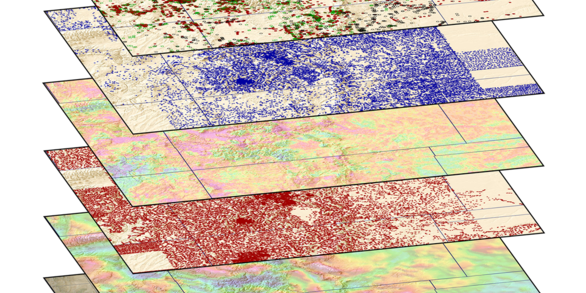
Interactive maps and downloadable data for regional and global analysis.
Filter Total Items: 415
Geochemical Database for Iron Oxide-Copper-Cobalt-Gold-Rare Earth Element Deposits of Southeast Missouri, 2016-2017 Geochemical Database for Iron Oxide-Copper-Cobalt-Gold-Rare Earth Element Deposits of Southeast Missouri, 2016-2017
The Geochemical and geologic database for Mesoproterozoic igneous rocks and iron oxide-apatite-rare earth element (IOA-REE) and iron oxide-copper-cobalt-gold (IOCG) deposits of Southeast Missouri, 2016-2017 'Geochemical Database for Iron Oxide-Copper-Cobalt-Gold-Rare Earth Element Deposits of Southeast Missouri, 2016-2017' (MO_ROCK_IOCG_REE_GX2017) contains new geochemical data...
Analytical inorganic chemistry results for samples collected for the Sediment-Bound Contaminant Resiliency and Response Strategy pilot study, northeastern United States, 2015 Analytical inorganic chemistry results for samples collected for the Sediment-Bound Contaminant Resiliency and Response Strategy pilot study, northeastern United States, 2015
Coastal communities are uniquely vulnerable to sea-level rise (SLR) and severe storms such as hurricanes. These events enhance the dispersion and concentration of natural and anthropogenic chemicals and pathogenic microorganisms that could adversely affect the health and resilience of coastal communities and ecosystems in coming years. The U.S. Geological Survey has developed the...
Selected Data from Preliminary Report on the Timmins-Kirkland Lake Area Gold Deposits File Selected Data from Preliminary Report on the Timmins-Kirkland Lake Area Gold Deposits File
Data on gold deposits are extracted from an existing publication to enable analysis. The data comprise selected portions of a data set that are published by C.J. Hodgson in "Preliminary Report on the Timmins-Kirkland Lake Area Gold Deposits File," which is available online as a digital image of a report. As an image, the data set cannot be analyzed. Consequently, selected portions of the...
Global Geochemical Database for Critical Metals in Black Shales Global Geochemical Database for Critical Metals in Black Shales
The Global Geochemical Database for Critical Metals in Black Shales (CMIBS) contains new geochemical data compilations for fine-grained sedimentary rocks in which each geologic material sample has one 'best value' determination for each analyzed species, greatly improving speed and efficiency of use (Granitto and others, 2013). The CMIBS was created and designed to compile and integrate
Shapefiles to accompany Colorado Mineral Belt revisited Shapefiles to accompany Colorado Mineral Belt revisited
Although much discussed in the literature, maps showing the detailed outline of the Colorado Mineral Belt are lacking. Lovering and Goddard (1950) show the geology and mines associated with the "Front Range mineral belt" but do not indicate an outline on plates or figures. Tweto and Sims (1963) published the outline of the Colorado mineral belt as page-size illustrations, differing on...
Geochemical analyses of rock samples collected from mineral deposits and intrusions of the Bokan Mountain peralkaline granitic complex, Prince of Wales Island, southeastern Alaska Geochemical analyses of rock samples collected from mineral deposits and intrusions of the Bokan Mountain peralkaline granitic complex, Prince of Wales Island, southeastern Alaska
This data set compiles the major and trace element chemistry of rock samples collected by the U.S. Geological Survey (USGS) at Bokan Mountain, located in the southern part of Prince of Wales Island, southeastern Alaska. Bokan Mountain was formed by an Early Jurassic peralkaline igneous complex that intruded into lower Paleozoic rocks of the Alexander terrane of southeast Alaska. The...
Argon data for Poncha Pass Geologic Map Argon data for Poncha Pass Geologic Map
This dataset was collected by Leah E. Morgan and Michael A. Cosca in the Argon Geochronology Laboratory of the USGS in Denver, Colorado in 2015. The dataset contains full raw argon isotopic data for samples presented in: Geologic Map of the Poncha Map Area, Chaffee, Fremont, and Saguache Counties, Colorado.
Magnetotelluric survey to characterize the Sunnyside Porphyry Copper System in the Patagonia Mountains, Arizona Magnetotelluric survey to characterize the Sunnyside Porphyry Copper System in the Patagonia Mountains, Arizona
This dataset includes the magnetotelluric (MT) sounding data collected in 2008 in and near the Patagonia Mountains of Arizona. The U.S. Geological Survey (USGS) conducted a series of multidisciplinary studies as part of the Assessment Techniques for Concealed Mineral Resources project funded by the USGS Minerals Resources Program in cooperation with the U.S. Forest Service.
Magnetotelluric sounding data, stations 1-9, Taos Plateau Volcanic Field, New Mexico, 2009 Magnetotelluric sounding data, stations 1-9, Taos Plateau Volcanic Field, New Mexico, 2009
This dataset includes the magnetotelluric (MT) sounding data collected in 2009 in and near the San Luis Basin, New Mexico. The U.S. Geological Survey conducted a series of multidisciplinary studies, including MT surveys, in the San Luis Basin to improve understanding of the hydrogeology of the Santa Fe Group and the nature of the sedimentary deposits comprising the principal groundwater...
Operation Basement: Missouri Precambrian Sample Database Operation Basement: Missouri Precambrian Sample Database
In 1968, the Missouri Geological Survey (MGS) established the Operation Basement program to address three objectives: a) to obtain drill hole and underground mining data relative to the structure and composition of the buried Precambrian basement; b) to expand mapping in the Precambrian outcrop area and conduct research related to Precambrian geology and mineral resources; and c) to...
Laboratory data from testing parameters of EPA Method 3060A on Soils Contaminated with Chromium Ore Processing Residue 2013-2016 Laboratory data from testing parameters of EPA Method 3060A on Soils Contaminated with Chromium Ore Processing Residue 2013-2016
It has been shown that EPA Method 3060A does not adequately extract Cr(VI) from solids containing chromium ore processing residue (COPR). We systematically tested modifications to prescribed parameters of EPA 3060A towards improving extraction efficiency of Cr(VI) from NIST SRM 2701, a standard COPR-contaminated soil from New Jersey (NJ). The alkaline extraction fluid leached Al, Si, and...
Airborne imaging spectrometer data collected for characterizing mineral resources near Nabesna, Alaska, 2014 Airborne imaging spectrometer data collected for characterizing mineral resources near Nabesna, Alaska, 2014
Imaging spectrometer (hyperspectral) data were collected using the HyMap sensor over the Nabesna Area of Interest (AOI) in the eastern Alaska Range, July 14 and July 21, 2014. The primary study area was a remote part of the eastern Alaska Range where porphyry deposits are exposed. The HyMap imaging spectrometer measured reflected sunlight in 126 narrow channels spanning the 0.4 to 2.5...