U.S. flag

An official website of the United States government

Data

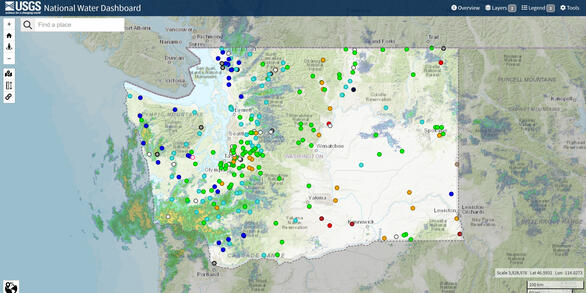
The USGS Washington Water Science Center currently operates over 380 data-collection sites in Washington.  The sites collect surface water, groundwater, water quality and meteorological data that are available in real time.  Current and historical data can be retrieved from Water Data for the Nation and the National Water Dashboard.

Separately published data releases are listed below.

Filter Total Items: 127

FLOwPER Database: StreamFLOw PERmanence field observations derived from Pacific Crest Trail (PCT) Water Report, May 2012 - September 2024 FLOwPER Database: StreamFLOw PERmanence field observations derived from Pacific Crest Trail (PCT) Water Report, May 2012 - September 2024

IMPORTANT NOTE: This dataset includes spatial locations where streamflow permanence observations (continuous flow and dry) were recorded and stored as part of the Pacific Crest Trail (PCT) water report (https://pctwater.com/) and subsequently processed to align with the FLOwPER (FLOw PERmanence) field survey available in Survey 123. Additional information to describe the field conditions...

Hydrophone data from gravel-bedded rivers in Washington and Idaho, 2019 to 2024 Hydrophone data from gravel-bedded rivers in Washington and Idaho, 2019 to 2024

Hydrophones have been proposed as a potential surrogate for bedload transport, operating on the principle that particle collisions generate sound that scales in intensity with transport rate (for example, Geay and others, 2017). To assess that potential, the U.S. Geological Survey (USGS) partnered with the Washington Department of Transportation (WSDOT) in 2019 to install hydrophones on...

Topographic Differencing Analyses on Glacier Creek, Washington, from 2005 to 2022 Topographic Differencing Analyses on Glacier Creek, Washington, from 2005 to 2022

Glacier Creek drains a 82 square kilometer watershed that includes multiple glaciers on the north flank of Mount Baker in Whatcom County, Washington. The Washington State Department of Transportation (WSDOT) maintains a bridge along Highway 542 over Glacier Creek near its confluence with the North Fork Nooksack River, where Glacier Creek has formed an alluvial fan. To assist in WSDOT...

High-resolution Thermal Infrared and True-color Imagery Mosaics, Longitudinal Stream Temperature Profiles, and Thermal Points of Interest from Airborne Surveys of the Quillayute and Bogachiel Rivers, Washington, August 15, 2023 High-resolution Thermal Infrared and True-color Imagery Mosaics, Longitudinal Stream Temperature Profiles, and Thermal Points of Interest from Airborne Surveys of the Quillayute and Bogachiel Rivers, Washington, August 15, 2023

This U.S. Geological Survey (USGS) data release provides high-resolution thermal infrared (TIR) and true-color red, green, blue (RGB) imagery mosaics, longitudinal stream-temperature profiles (LTPs), thermal points of interest (POIs), and river centerlines from airborne surveys of 47 river kilometers (29 river miles) of the Quillayute and Bogachiel Rivers, Washington. The TIR and RGB...

Streamwise Velocity, Cross-section Bathymetry, and Substrate Particle-size Distribution and Loss on Ignition at Bull Trout (Salvelinus confluentus) Spawning Habitat in the Cedar River Municipal Watershed, Washington Streamwise Velocity, Cross-section Bathymetry, and Substrate Particle-size Distribution and Loss on Ignition at Bull Trout (Salvelinus confluentus) Spawning Habitat in the Cedar River Municipal Watershed, Washington

The upper Cedar River Municipal Watershed (CRMW) is managed by Seattle Public Utilities and provides habitat that sustains an isolated adfluvial population of Endangered Species Act-listed bull trout (Salvelinus confluentus). Bull trout spawning in the CRMW begins in early fall when the water surface elevation of Chester Morse Lake and the stream discharges in its major tributaries, the...

Darcy flux and PFAS mass flux in groundwater at Yakima Training Center, Washington Darcy flux and PFAS mass flux in groundwater at Yakima Training Center, Washington

This U.S. Geological Survey (USGS) data release contains Darcy flux and mass flux of per- and polyfluoroalkyl substances (PFAS) data measured using passive flux meters (PFMs) in monitoring wells at the Yakima Training Center (YTC) in Yakima, Washington. The measurements were conducted by the USGS in cooperation with the U.S. Army Environmental Command. This data release contains PFM data...

Ground-based magnetic survey in the southwest corner of Yakima Training Center, Washington, 2025 Ground-based magnetic survey in the southwest corner of Yakima Training Center, Washington, 2025

A ground-based magnetic survey was conducted in the southwest corner of Yakima Training Center, Washington, in 2025. Magnetic surveys are passive, non-contact, surface geophysical methods that measure the total ambient magnetic field. The magnetic survey utilized a Geometrics G-864 cesium magnetometer. Survey lines were carried out to better understand the subsurface along a prominent...

Groundwater recharge estimates for the United States part of the Salish Sea Basin, northwestern Washington Groundwater recharge estimates for the United States part of the Salish Sea Basin, northwestern Washington

This data release documents estimates of groundwater recharge for the U.S. portion of the Salish Sea Basin in northwestern Washington. A U.S. Geological Survey Soil-Water-Balance (SWB) model (Westenbroek and others,2018) was developed for Hydrologic Unit Code 17110 to simulate the spatial distribution of net infiltration below the root zone on a daily time step from January 1, 1980...

Development of Western United States pluvioregions for post-wildfire assessments Development of Western United States pluvioregions for post-wildfire assessments

The U.S. Geological Survey (USGS) National Water Quality Program, through the Prototyping Modeling and Assessment of Post-wildfire Water Availability project, aims to enhance the ability to assess and predict the impacts of wildfires on water supplies. Precipitation is a key driver of flooding, debris flows, and water quality responses following wildfire. The intensity, duration, and...

Integrating long-term trends in groundwater depth and low streamflow across the United States using regional classifications Integrating long-term trends in groundwater depth and low streamflow across the United States using regional classifications

The U.S. Geological Survey (USGS) Water Resources Mission Area (WMA) is working to address a need to understand where the Nation is experiencing water shortages or surpluses relative to the demand for water need by delivering routine assessments of water supply and demand and an understanding of the natural and human factors affecting the balance between supply and demand. A key part of...

Streamflow and Surface-water Presence Data in the Conterminous United States, 1857-2023 Streamflow and Surface-water Presence Data in the Conterminous United States, 1857-2023

This data release includes information on data from 72 streamflow or surface-water presence datasets in the Conterminous United States. It includes location, dataset, parent dataset or publication, site identification (if available), start year, end year, number of years, number of days, frequency of data collection, Strahler stream order, and headwater status.

Water temperature, air temperature, sensor depth, and select flow and temperature metrics—Data from water year 2022 for the Stormwater Action Monitoring Puget Small Streams Project Water temperature, air temperature, sensor depth, and select flow and temperature metrics—Data from water year 2022 for the Stormwater Action Monitoring Puget Small Streams Project

These data were collected as part of the Stormwater Action Monitoring (SAM) program's Puget Small Streams (PSS) status and trends program. The data presented here were collected from 20 sites during water year 2022 for water temperature, air temperature, and sensor depth. Sensor depth was used as a surrogate for water depth and represents the arbitrary depth of water above the sensor...
Was this page helpful?