
U.S. flag

An official website of the United States government

Western Geographic Science Center

The WGSC is responsible for research and applications to understand coupled human-environmental systems in the face of land change and delivering pertinent information to decision makers on the vulnerability and resilience of these systems.  WGSC scientists collaborate with partners to advance the goals of the USGS Core Science Systems and Ecosystems Mission Areas and their programs. 

News

Dr. Pardhasaradhi Teluguntla receives ESRI's Award for Best Scientific Paper in GIS -1st Place

Dr. Pardhasaradhi Teluguntla receives ESRI's Award for Best Scientific Paper in GIS -1st Place

Earth Science Matters - Vol. 21 | Issue 1

Earth Science Matters - Vol. 21 | Issue 1

WGSC cloud-based tidal marsh biomass mapping tool

WGSC cloud-based tidal marsh biomass mapping tool

Publications

Regreening, restoring, and reconnecting a southwestern wetland ecosystem – the Zeedyk wetland Regreening, restoring, and reconnecting a southwestern wetland ecosystem – the Zeedyk wetland

Alluvial wetland ecosystems are vital as biodiversity hotspots but are increasingly threatened by anthropogenic stressors and drought. These pressures are especially acute in arid and semi-arid regions, where eco-hydrologic connectivity is fragile and recovery is slow. This study quantifies the efficacy of nature-based solutions, particularly the ‘Zeedyk approach,’ which employs low-tech...
Authors
Roy E. Petrakis, Laura M. Norman, Maryann McGraw, Steve Carson, Craig Sponholtz, Cameron Weber, Bill D. Zeedyk

Satellite time series analysis to quantify changing climax ciénegas using a state and transition model approach Satellite time series analysis to quantify changing climax ciénegas using a state and transition model approach

Ciénegas are rare wetlands in arid landscapes of the North American Southwest, historically providing critical ecological and hydrological functions but increasingly threatened by changing climate and land use pressures. This study quantifies changes in ciénega condition and floodplain dynamics using a state-and-transition model (STM) informed by expert knowledge and remote sensing. Key...
Authors
Laura M. Norman, Roy E. Petrakis, Natalie R. Wilson, Barry R. Middleton, Miguel L. Villarreal, Michael Pollock, Thomas A. Minckley, Dean Hendrickson

Earthquake-hazard exposure of residents with potential access and functional needs in the United States Earthquake-hazard exposure of residents with potential access and functional needs in the United States

Earthquake response plans and earthquake early warning (EEW) systems designed for general populations may not consider potential access and functional needs (AFN) of individuals with physical, sensory, cognitive, or social limitations. Previous efforts to map the distribution of these populations have focused on social-vulnerability indices that ignore or oversimply these limitations...
Authors
Nathan J. Wood, Alice Pennaz, Jeanne M. Jones

Science

New Tools for Modern Land Management Decisions
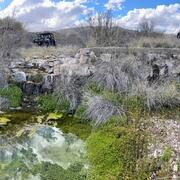
In an era of rapid land use changes, it is imperative that land managers and policymakers have actionable and current information available for decision processes. In this work, we seek to meet these needs through new data products and decision support tools built on digital soil mapping, new vegetation cover maps, agency inventory and monitoring data sets, and cutting-edge analytical frameworks...
New Tools for Modern Land Management Decisions

New Tools for Modern Land Management Decisions

In an era of rapid land use changes, it is imperative that land managers and policymakers have actionable and current information available for decision processes. In this work, we seek to meet these needs through new data products and decision support tools built on digital soil mapping, new vegetation cover maps, agency inventory and monitoring data sets, and cutting-edge analytical frameworks...
Learn More

Las Moras Wash Restoration: Integrated Geomorphic Assessment, Modeling, Monitoring, and Adaptive Management

The Las Moras Wash, within the Santa Margarita Ranch, Altar Valley, AZ, exhibits channel incision, gully expansion, head‑cut migration, vegetation loss, and reduced hydrologic connectivity between upper watershed and floodplains.
Las Moras Wash Restoration: Integrated Geomorphic Assessment, Modeling, Monitoring, and Adaptive Management

Las Moras Wash Restoration: Integrated Geomorphic Assessment, Modeling, Monitoring, and Adaptive Management

The Las Moras Wash, within the Santa Margarita Ranch, Altar Valley, AZ, exhibits channel incision, gully expansion, head‑cut migration, vegetation loss, and reduced hydrologic connectivity between upper watershed and floodplains.
Learn More

Las Moras Wash Restoration: Integrated Geomorphic Assessment, Modeling, Monitoring, and Adaptive Management

The Las Moras Wash, within the Santa Margarita Ranch, Altar Valley, AZ, exhibits channel incision, gully expansion, head‑cut migration, vegetation loss, and reduced hydrologic connectivity between upper watershed and floodplains.
Las Moras Wash Restoration: Integrated Geomorphic Assessment, Modeling, Monitoring, and Adaptive Management

Las Moras Wash Restoration: Integrated Geomorphic Assessment, Modeling, Monitoring, and Adaptive Management

The Las Moras Wash, within the Santa Margarita Ranch, Altar Valley, AZ, exhibits channel incision, gully expansion, head‑cut migration, vegetation loss, and reduced hydrologic connectivity between upper watershed and floodplains.
Learn More
Was this page helpful?