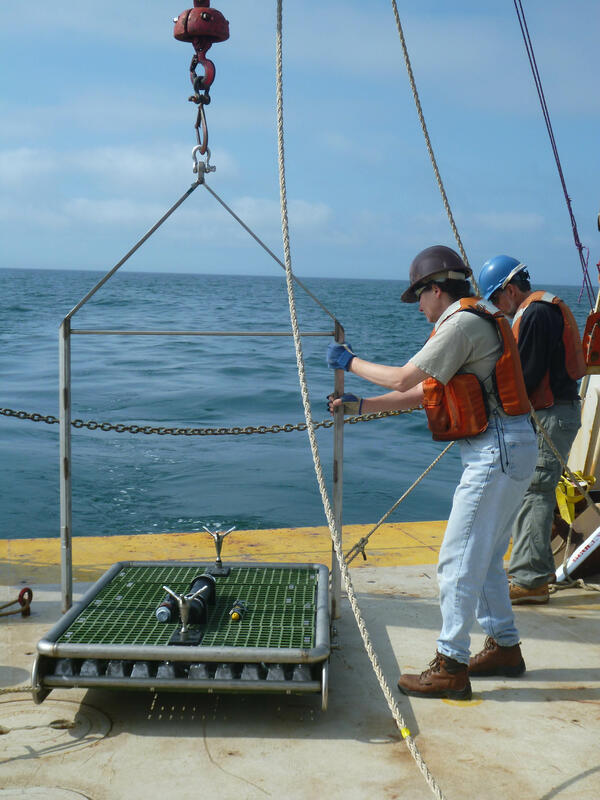
Deployment of an instrumented quadrapod off Martha’s Vineyard
Deployment of an instrumented quadrapod off Martha’s VineyardDeployment of an instrumented quadrapod off Martha’s Vineyard, November 2014.


Official websites use .gov
A .gov website belongs to an official government organization in the United States.

Secure .gov websites use HTTPS
A lock () or https:// means you’ve safely connected to the .gov website. Share sensitive information only on official, secure websites.

Woods Hole Coastal and Marine Science Center images

Deployment of an instrumented quadrapod off Martha’s Vineyard, November 2014.
Deployment of an instrumented quadrapod off Martha’s Vineyard, November 2014.

An instrumented bottom lander is deployed south of Martha's Vineyard, MA in 2014 as part of the “Bottom Stress and the Generation of Vertical Vorticity Over the Inner Shelf” project.
An instrumented bottom lander is deployed south of Martha's Vineyard, MA in 2014 as part of the “Bottom Stress and the Generation of Vertical Vorticity Over the Inner Shelf” project.

Seismic Lab aboard R/V Marcus G. Langseth
Seismic Lab aboard R/V Marcus G. Langseth

Timeline of past drilling activities conducted by countries, private sector firms, government agencies, and academe that have helped to refine global gas hydrate estimates and possible future drilling and production testing
Timeline of past drilling activities conducted by countries, private sector firms, government agencies, and academe that have helped to refine global gas hydrate estimates and possible future drilling and production testing

Airgun array aboard R/V Marcus G. Langseth
Airgun array aboard R/V Marcus G. Langseth

Schematic showing the general setting of seeps on the US Atlantic margin and related processes, such as gas hydrate degradation, groundwater seepage, leakage through fractured rocks, or emissions from the seafloor overlying salt diapirs. Pockmarks shown in white, and the nominal updip limit of gas hydrate stability is represented by the dashed black line.
Schematic showing the general setting of seeps on the US Atlantic margin and related processes, such as gas hydrate degradation, groundwater seepage, leakage through fractured rocks, or emissions from the seafloor overlying salt diapirs. Pockmarks shown in white, and the nominal updip limit of gas hydrate stability is represented by the dashed black line.

Sample preparation and processing area in the K.O. Emery Geotechnical Wing at the Woods Hole Coastal and Marine Science Center, Woods Hole, MA
Sample preparation and processing area in the K.O. Emery Geotechnical Wing at the Woods Hole Coastal and Marine Science Center, Woods Hole, MA
Marinna Martini prepares to deploy a NIMBBLE from the R/V Connecticut south of Martha's Vineyard
Marinna Martini prepares to deploy a NIMBBLE from the R/V Connecticut south of Martha's Vineyard

A Sontek IQ ADCP measures depth and velocity of a salt marsh creek (Cape Cod, MA)
A Sontek IQ ADCP measures depth and velocity of a salt marsh creek (Cape Cod, MA)

Jen Suttles collects water samples from a salt marsh tidal creek (East Falmouth, MA) for laboratory analysis of total organic carbon. These samples will be compared to data recorded by instrumentation deployed in an adjacent tidal creek as part of research efforts to quantify carbon dynamics in coastal ecosystems
Jen Suttles collects water samples from a salt marsh tidal creek (East Falmouth, MA) for laboratory analysis of total organic carbon. These samples will be compared to data recorded by instrumentation deployed in an adjacent tidal creek as part of research efforts to quantify carbon dynamics in coastal ecosystems

The Salt Marsh Observatory at Sage Lot Pond in the Waquoit Bay National Estuarine Research Reserve serves as an important platform for research in coastal salt marshes. Infrastrucutre in this marsh allows researchers to access sites while maintaining habitat and platform health.
The Salt Marsh Observatory at Sage Lot Pond in the Waquoit Bay National Estuarine Research Reserve serves as an important platform for research in coastal salt marshes. Infrastrucutre in this marsh allows researchers to access sites while maintaining habitat and platform health.

Sara Zeigler (USGS) uses the smartphone data collection app ‘iPlover’ to classify the landscape characteristics in an area immediately surrounding a piping plover nest (here, protected with a black mesh predator exclosure).
Sara Zeigler (USGS) uses the smartphone data collection app ‘iPlover’ to classify the landscape characteristics in an area immediately surrounding a piping plover nest (here, protected with a black mesh predator exclosure).


Human modifications to beaches, such as sand fencing, sea walls and rock jetties, can alter natural beach processes like overwash. This can affect how much habitat for species like piping plovers is created by storms.
Human modifications to beaches, such as sand fencing, sea walls and rock jetties, can alter natural beach processes like overwash. This can affect how much habitat for species like piping plovers is created by storms.

USGS scientists are working to model shorebird habitat availability both today and in the future, given processes like sea-level rise, in an effort to support the efficient management of beaches for both people and nesting shorebirds. This photo shows an area on the Rockaway Peninsula where high quality shorebird habitat has been closed off to beach recreation.
USGS scientists are working to model shorebird habitat availability both today and in the future, given processes like sea-level rise, in an effort to support the efficient management of beaches for both people and nesting shorebirds. This photo shows an area on the Rockaway Peninsula where high quality shorebird habitat has been closed off to beach recreation.

The beach-dependent shorebirds project at the Woods Hole Coastal and Marine Science Center models current and future habitat availability for nesting shorebirds in an effort to map current and likely future habitat availability on a range of sites along the U.S. Atlantic coast.
The beach-dependent shorebirds project at the Woods Hole Coastal and Marine Science Center models current and future habitat availability for nesting shorebirds in an effort to map current and likely future habitat availability on a range of sites along the U.S. Atlantic coast.

A piping plover parent and chicks.

A buoy instrumented to collect meteorological observations is recovered off Fire Island, NY in 2014. The data collected is part of a study of the coastal processes that mobilize and transport sediment in the region
A buoy instrumented to collect meteorological observations is recovered off Fire Island, NY in 2014. The data collected is part of a study of the coastal processes that mobilize and transport sediment in the region

A remotely operated vessel starts a survey at dawn off Fire Island, NY in 2014. The data collected is part of a study of the coastal processes that mobilize and transport sediment in the region
A remotely operated vessel starts a survey at dawn off Fire Island, NY in 2014. The data collected is part of a study of the coastal processes that mobilize and transport sediment in the region

USGS tilt current meter (white cylinder) in overwash channel in the Sandwich Town Beach flooded during a Nor'Easter in March 2014
USGS tilt current meter (white cylinder) in overwash channel in the Sandwich Town Beach flooded during a Nor'Easter in March 2014

Every inch of the deck of the R/V Connecticut is covered by instrumented platforms awaiting deployment on the seafloor south of Fire Island NY in winter 2014.
Every inch of the deck of the R/V Connecticut is covered by instrumented platforms awaiting deployment on the seafloor south of Fire Island NY in winter 2014.