



A modern 21st century-style streamgage on the Brazos River in Richmond, Texas.
Images
Images
Filter Total Items: 9448

USGS Streamgage in Richmond, Texas
A modern 21st century-style streamgage on the Brazos River in Richmond, Texas.

Sorting Samples
Ten minute samples from ichthyoplankton nets deployed near the bottom of the Missouri River. Samples are sorted and searched for paddlefish and sturgeon free embryos.
Ten minute samples from ichthyoplankton nets deployed near the bottom of the Missouri River. Samples are sorted and searched for paddlefish and sturgeon free embryos.

Euglena sanguinea Under the Microscope
The red is due to the presence of astaxanthin, a pigment in the cells.
The red is due to the presence of astaxanthin, a pigment in the cells.

USGS Tunison Laboratory of Aquatic Science
The Tunison Laboratory of Aquatic Science, located in Cortland, New York, is a field station of the USGS Great Lakes Science Center. More information about current research at the lab is available on the official Fact Sheet (PDF).
The Tunison Laboratory of Aquatic Science, located in Cortland, New York, is a field station of the USGS Great Lakes Science Center. More information about current research at the lab is available on the official Fact Sheet (PDF).

USGS Tunison Laboratory of Aquatic Science
The Tunison Laboratory of Aquatic Science, located in Cortland, New York, is a field station of the USGS Great Lakes Science Center. More information about current research at the lab is available on the official Fact Sheet (PDF).
The Tunison Laboratory of Aquatic Science, located in Cortland, New York, is a field station of the USGS Great Lakes Science Center. More information about current research at the lab is available on the official Fact Sheet (PDF).

USGS Tunison Laboratory of Aquatic Science
USGS Acting Director Suzette Kimball visits the Tunison Laboratory of Aquatic Science.
USGS Acting Director Suzette Kimball visits the Tunison Laboratory of Aquatic Science.

USGS Research Vessel Kaho
The USGS R/V Kaho was Christened and commissioned on August 6, 2014, in Oswego, NY. The vessel was designed with state-of-the-art navigation and scientific capabilities, giving the USGS modern scientific resources for research into Lake Ontario’s coastal and deep-water ecosystems.
The USGS R/V Kaho was Christened and commissioned on August 6, 2014, in Oswego, NY. The vessel was designed with state-of-the-art navigation and scientific capabilities, giving the USGS modern scientific resources for research into Lake Ontario’s coastal and deep-water ecosystems.

USGS Research Vessel Kaho
The USGS R/V Kaho was Christened and commissioned on August 6, 2014, in Oswego, NY. The vessel was designed with state-of-the-art navigation and scientific capabilities, giving the USGS modern scientific resources for research into Lake Ontario’s coastal and deep-water ecosystems.
The USGS R/V Kaho was Christened and commissioned on August 6, 2014, in Oswego, NY. The vessel was designed with state-of-the-art navigation and scientific capabilities, giving the USGS modern scientific resources for research into Lake Ontario’s coastal and deep-water ecosystems.

USGS Research Vessel Kaho
The USGS R/V Kaho was Christened and commissioned on August 6, 2014, in Oswego, NY. The vessel was designed with state-of-the-art navigation and scientific capabilities, giving the USGS modern scientific resources for research into Lake Ontario’s coastal and deep-water ecosystems.
The USGS R/V Kaho was Christened and commissioned on August 6, 2014, in Oswego, NY. The vessel was designed with state-of-the-art navigation and scientific capabilities, giving the USGS modern scientific resources for research into Lake Ontario’s coastal and deep-water ecosystems.

USGS researcher maps the geology of the 2014 SR530 landslide near Oso
USGS researcher maps the geology of the 2014 SR530 landslide near OsoUSGS civil engineer Brian Collins examines blocks of glacial till that form parts of the Oso landslide deposit.
USGS researcher maps the geology of the 2014 SR530 landslide near Oso
USGS researcher maps the geology of the 2014 SR530 landslide near OsoUSGS civil engineer Brian Collins examines blocks of glacial till that form parts of the Oso landslide deposit.

The confluence of the Suiattle River (muddy river) into the Sauk River
The confluence of the Suiattle River (muddy river) into the Sauk RiverThe confluence of the Suiattle River (muddy river) into the Sauk River.
The confluence of the Suiattle River (muddy river) into the Sauk River
The confluence of the Suiattle River (muddy river) into the Sauk RiverThe confluence of the Suiattle River (muddy river) into the Sauk River.

Running the Bee Traps
USGS technicians check bee traps from a harvested wheat field in Colorado. Credit: Mark Vandever, USGS.
USGS technicians check bee traps from a harvested wheat field in Colorado. Credit: Mark Vandever, USGS.

Running the Bee Traps
A USGS technician checks bee traps from a harvested wheat field in Colorado. Credit: Mark Vandever, USGS.
A USGS technician checks bee traps from a harvested wheat field in Colorado. Credit: Mark Vandever, USGS.

A Beekeeper's Toolbox
The USGS Northern Prairie Wildlife Research Center partners with professional beekeepers in North Dakota to evaluate what plant species honey bees forage on and when.
The USGS Northern Prairie Wildlife Research Center partners with professional beekeepers in North Dakota to evaluate what plant species honey bees forage on and when.

Honey Straight from the Hive
Bees must tap two million flowers and travel the equivalent of the distance between Washington, D.C., and Boston, to make just one pound of honey.
Bees must tap two million flowers and travel the equivalent of the distance between Washington, D.C., and Boston, to make just one pound of honey.
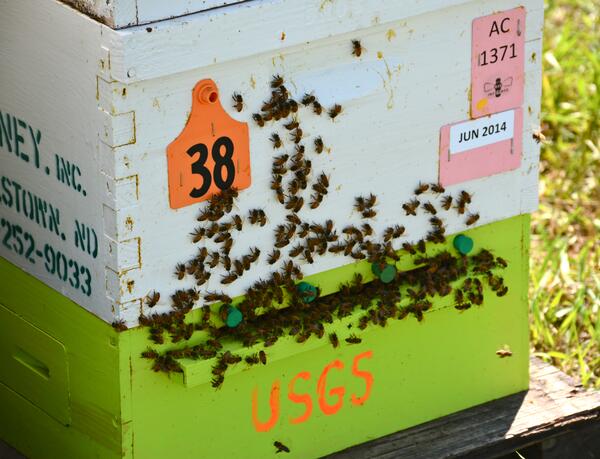
USGS Bee Research in North Dakota
The USGS Northern Prairie Wildlife Research Center partners with professional beekeepers in North Dakota to evaluate what plant species honey bees forage on and when.
The USGS Northern Prairie Wildlife Research Center partners with professional beekeepers in North Dakota to evaluate what plant species honey bees forage on and when.

The USGS Partners with Professional Beekeepers
Clint Otto, a research ecologist at the USGS Northern Prairie Wildlife Research Center, partners with professional beekeepers in North Dakota to evaluate what plant species honey bees forage on and when.
Clint Otto, a research ecologist at the USGS Northern Prairie Wildlife Research Center, partners with professional beekeepers in North Dakota to evaluate what plant species honey bees forage on and when.

Queen Bee
The bee marked in yellow is this hive's queen. There is usually only one queen in a hive, which the worker honeybees feed, follow, and protect.
The bee marked in yellow is this hive's queen. There is usually only one queen in a hive, which the worker honeybees feed, follow, and protect.
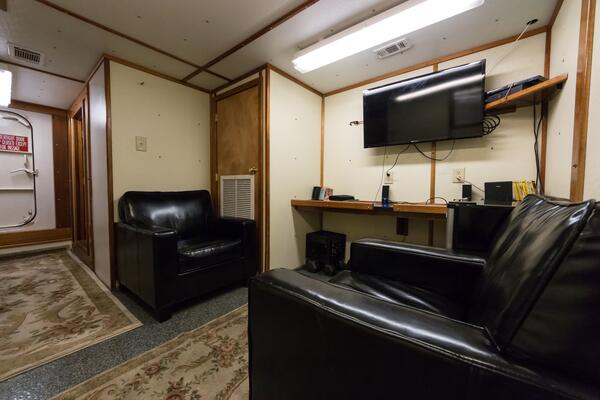
Downtime Aboard the Scarlett Isabella
The crew of the Scarlett Isabella need to have some downtime from time to time. Here is the entertainment room aboard the ship.
The crew of the Scarlett Isabella need to have some downtime from time to time. Here is the entertainment room aboard the ship.
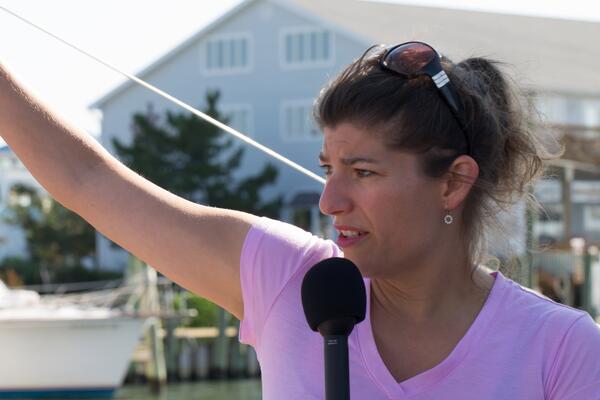
Science Explained
Laura Brothers, USGS, explaining what the crew of the Scarlett Isabella were doing on their month long journey.
Laura Brothers, USGS, explaining what the crew of the Scarlett Isabella were doing on their month long journey.
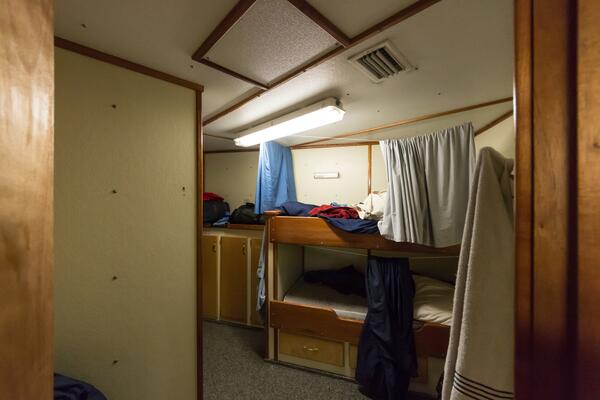
Scarlett Isabella Bedroom
A view of one of the bedrooms aboard the Scarlett Isabella.
A view of one of the bedrooms aboard the Scarlett Isabella.