

An official website of the United States government
Here's how you know
Official websites use .gov
A .gov website belongs to an official government organization in the United States.
Secure .gov websites use HTTPS
A lock () or https:// means you’ve safely connected to the .gov website. Share sensitive information only on official, secure websites.
Using Landsat’s thermal imagery, researchers at Gallo Winery have been able to better understand vineyard water needs, optimize irrigation and support long-term sustainability across thousands of acres. This work also helped shape broader tools now supporting water management across the western United States.
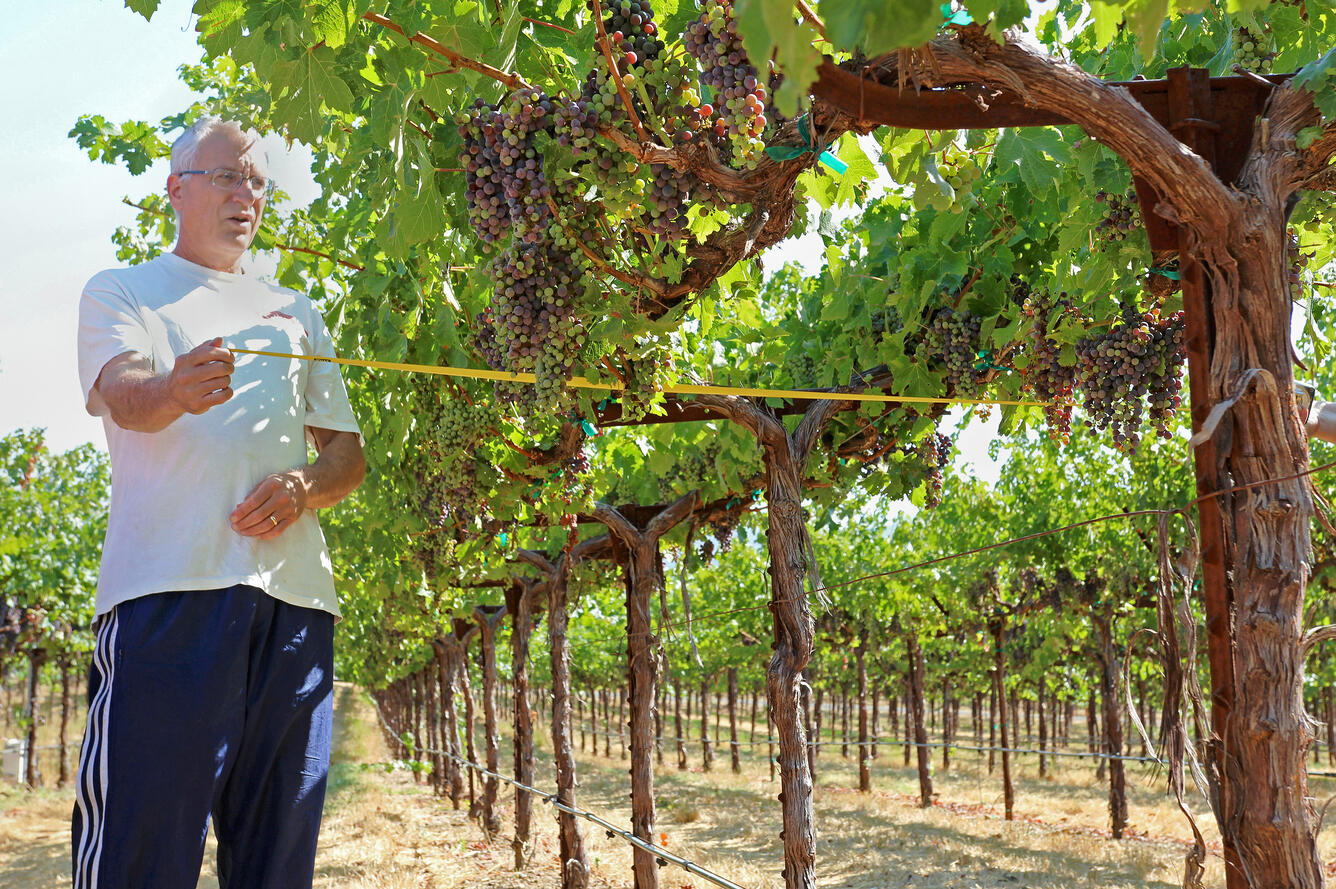
Leading that effort is Nick Dokoozlian, who has spent his career studying grapevines—from working on his family’s vineyard to teaching at the University of California, Davis, and now leading a research group at Gallo, the largest winery in the world. His extensive knowledge of growing grapes, paired with a commitment to preserving Central Valley water, led him to explore new tools for managing irrigation.
That openness to experimentation brought him to remote sensing, and to Landsat, helping the company reduce water use while continuing to grow high-quality grapes for generations to come.
After years of innovation and collaboration, the company has made it halfway to its long-term goal of reducing water usage by 50% while maintaining or improving yield and fruit quality. “Now we’re going after the next 25%. That goal will outlive me, probably, but we will continue to refine our irrigation practices to improve water use efficiency,” Dokoozlian said.
“None of that would have been possible without Landsat.”
And this work didn’t just benefit one vineyard—it helped set the stage for agricultural water management efforts now used across the western United States.
Saving Water for Centuries
Dokoozlian received the company’s sense of environmental responsibility from Bob Gallo, son of co-founder Julio Gallo. Around the time of the company’s 75th anniversary in 2008, Bob Gallo shared his concern: They needed to ensure that they would have enough groundwater to grow grapes for future generations and help area grape growers save water, too.
This image is an example of evapotranspiration mapping, centered on Modesto, California, which contains the Gallo Winery headquarters. The area's fields are known for growing a wide variety of crops, including almonds, walnuts, tomatoes and hay. This particular image of 2020 annual actual evapotranspiration (ETa) is provided by the Landsat-based SSEBop (Operational Simplified Surface Energy Balance) ET model, which is one of the models used in the OpenET ensemble.
The vineyards were generally well positioned with two water sources, groundwater and rivers, with the potential for recharging groundwater. But achieving a 50% reduction in water use was a very steep goal, especially across thousands of acres. They needed a way to accurately measure the amount of water the grapevines were using, and how much water the vines actually needed.
At that time, Dokoozlian had been reading about the use of satellites in irrigation management and knew of a U.S Department of Agriculture (USDA) hydrology group in Maryland working with Landsat data for a similar use.
Landsat sensors have two key capabilities for monitoring water use: the necessary scale for monitoring large areas and land surface temperature measurements. Those temperatures are used to calculate the plants’ water usage, also called evapotranspiration (evaporation plus transpiration, or ET).
Grapevines can vary in water needs, even within the same vineyard, so the research team used Landsat’s 30-meter resolution to understand this variability by examining water use across their vineyards. This helped them identify where irrigation could be adjusted to match the plants’ needs.
“Landsat is the single most valuable tool that we have used.” – Nick Dokoozlian
A Broader Collaboration
To build on that insight, the team worked with USDA researchers Bill Kustas (background photo) and Martha Anderson as they set up GRAPEX (Grape Remote sensing Atmospheric Profile & Evapotranspiration eXperiment) with Landsat and other imagery, developing a toolkit to improve irrigation schedules and water management in vineyards and potentially other tree crops. Gallo was an ideal partner to help with ground data and testing the usefulness of the tools in a real-world situation.
“GRAPEX was really the foundation of understanding how much water the vines are actually using,” Dokoozlian said. He began to spread the word about its usefulness beyond the wine industry to other water users in the area, such as almond growers.
That effort helped contribute to the foundation for OpenET, a broader scale initiative developed in collaboration with agencies including the USGS, USDA and NASA, universities and other partners. OpenET delivers evapotranspiration estimates based on Landsat data to growers and other water managers across the western United States, with plans to soon expand east.
“OpenET wouldn’t exist without Landsat. Most everything related to the use of remote sensing in irrigation management generally funnels back to Landsat,” Dokoozlian said.
The winery also works with its contract growers on water management and developed an irrigation dashboard with OpenET data and their own ground data. “We can adjust and validate the amounts of water that we’re applying and constantly look at it and have a continual feedback loop,” Dokoozlian said. “Did we apply enough? Did we apply too little? How do the vines look?”
He predicts that automating data flows like this will unlock additional water savings. But Dokoozlian wishes he had even more Landsat data—particularly high-resolution thermal imagery.
He’ll get his wish as plans for the next generation of Landsat include land surface temperature gathered more frequently and at a higher resolution than current Landsat satellites. Landsat Next is expected to launch in the early 2030s and will offer significant improvements, particularly for applications like GRAPEX and OpenET that rely on thermal data to support water management and agricultural decision-making.
The mission will also extend Landsat’s historic 50-plus year record, providing long-term records needed to monitor environmental change and support resource management.
“If you had one dime to call from a phone booth and you needed imagery, Landsat’s the imagery source to call,” Dokoozlian said. “Landsat provides the longest-running, well-calibrated and trusted source of information.”
Landsat 9 takes off from Vandenberg Space Flight Center
Landsat 9 - An Artist Rendition in Orbit
Landsat: Celebrating 50 Years
Left: Landsat 9 launched from Vandenberg Space Flight Center in California on September 27, 2021, onboard an Atlas V 401 rocket. Among those in attendance were Nick Dokoozlian and his son, who took a road trip to view the launch. Center: An artist’s illustration of Landsat 9 orbiting Earth. Right: The Landsat program has collected Earth observation data for more than 50 years. Watch an overview of its history and capabilities.
Note:Landsat data are available from the U.S. Geological Survey at no cost to users.
Disclaimer: This web page contains hypertext links to information created and maintained by other organizations. USGS is not responsible for the content of any off-site pages. Reference herein to any specific commercial products, processes, or services by trade name, trademark, manufacturer, or otherwise, does not constitute or imply its endorsement or recommendation by the United States Government.
Eyes on Earth Episode 35 – Watching the Water Supply with OpenET
Evapotranspiration is the process by which water transpires from the leaves and stems of plants and evaporates from the Earth’s surface. ET is an important metric for managing water use, but data availability has long been an issue.
It’s easy enough to measure rainfall, and nearly as easy to measure streamflow. Calculating the efficiency of water use through the metric of evapotranspiration (ET) – evaporation off the Earth’s surface and transpiration from the leaves of plants – is a far trickier proposal.
Landsat in Action - Water Use with Molly Maupin and Gabriel Senay
USGS Hydrologist Molly Maupin and USGS Research Physical Scientist Gabriel Senay discuss how Landsat imagery has been used by the National Water Census and in studying water use trends.
Landsat at Work: Helping Farmers Keep Soil Healthy
For farmers, uncertainty is a constant. Much is beyond their control, and the weather is just one example. What looks like a bumper crop of soybeans...
Landsat at Work: Satellites Help Extinguish Wildfire Risk
“How much money did that save our community by making these investments?” said Keith Brooks, general manager of the Douglas Electric Cooperative. “It...
Landsat’s Economic Value increases to $25.6 Billion in 2023
A new report about the Landsat satellite program – a partnership between the U.S. Geological Survey and National Aeronautics and Space Administration...
Eyes on Earth Episode 35 – Watching the Water Supply with OpenET
Evapotranspiration is the process by which water transpires from the leaves and stems of plants and evaporates from the Earth’s surface. ET is an important metric for managing water use, but data availability has long been an issue.
It’s easy enough to measure rainfall, and nearly as easy to measure streamflow. Calculating the efficiency of water use through the metric of evapotranspiration (ET) – evaporation off the Earth’s surface and transpiration from the leaves of plants – is a far trickier proposal.
Landsat in Action - Water Use with Molly Maupin and Gabriel Senay
USGS Hydrologist Molly Maupin and USGS Research Physical Scientist Gabriel Senay discuss how Landsat imagery has been used by the National Water Census and in studying water use trends.
Landsat at Work: Helping Farmers Keep Soil Healthy
For farmers, uncertainty is a constant. Much is beyond their control, and the weather is just one example. What looks like a bumper crop of soybeans...
Landsat at Work: Satellites Help Extinguish Wildfire Risk
“How much money did that save our community by making these investments?” said Keith Brooks, general manager of the Douglas Electric Cooperative. “It...
Landsat’s Economic Value increases to $25.6 Billion in 2023
A new report about the Landsat satellite program – a partnership between the U.S. Geological Survey and National Aeronautics and Space Administration...