U.S. flag

An official website of the United States government

Eastern Ecological Science Center

The USGS Eastern Ecological Science Center (EESC) strives to provide world-class science to inform natural resource decisions that preserve and enhance our quality of life. 

The land and water we live on and around shapes our lives. We share responsibility for the heathy fish, wildlife and landscapes that are assets to current and future generations.

EESC works directly with managers of our shared natural resources to provide the unbiased scientific tools, research and innovations needed to make informed decisions in today’s complex and rapidly changing conditions.

EESC’s broad expertise spans from mountain streams to deep oceans and the lands in between, supporting stewardship of a wide range of species and habitats.

Unique facilities in Maryland, Massachusetts and West Virginia help EESC deliver the reliable, actionable science that partners need to effectively conserve our treasured natural resources.

News

AquaDePTH: Merging Aquatic Disease Surveillance Data into One Useful Tool

AquaDePTH: Merging Aquatic Disease Surveillance Data into One Useful Tool

EESC in the News: PFAS Found in Cape Cod Bass May Help Inform Public Health Decisions

EESC in the News: PFAS Found in Cape Cod Bass May Help Inform Public Health Decisions

Massive new study says ospreys are thriving in some parts of the Chesapeake Bay – but not enough

Massive new study says ospreys are thriving in some parts of the Chesapeake Bay – but not enough

Publications

Cryptic life history diversity supports endangered species recovery in an ultra-urbanized landscape Cryptic life history diversity supports endangered species recovery in an ultra-urbanized landscape

Urban landscapes are often overlooked in conservation planning, allowing human activities to take precedence in ecosystem management. However, even heavily modified environments can support diverse species profiles, but continued expansion of the human footprint could transform these biodiversity hotspots into ecological traps that serve as hidden catalysts for demographic declines. In...
Authors
Shannon White, Amanda Higgs, Dewayne Fox

Using monitoring and partnerships to provide management-relevant information about Chesapeake Bay rivers Using monitoring and partnerships to provide management-relevant information about Chesapeake Bay rivers

The lands and waters of the Chesapeake Bay watershed provide more than $100 billion in economic benefits- an amount that is expected to increase by achieving the region’s clean-water goals. Achieving those goals requires accurate and timely information about the health of the watershed’s rivers and streams. The Chesapeake Bay nontidal monitoring network (NTN), a partnership of local...
Authors
James Webber, Kaylyn Gootman, Kenneth Hyer, Peter Tango, Douglas Moyer

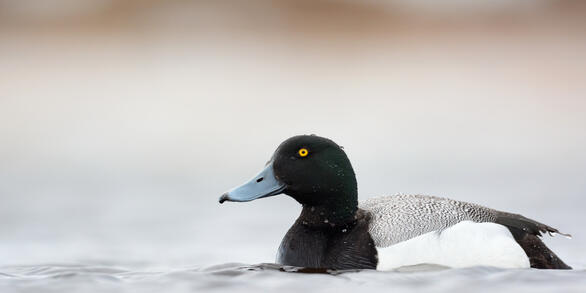
Rapid increase in antibodies to influenza A virus H5 and N1 in Lesser Scaup (Aythya affinis) following the introduction of 2.3.4.4B H5N1 into North America Rapid increase in antibodies to influenza A virus H5 and N1 in Lesser Scaup (Aythya affinis) following the introduction of 2.3.4.4B H5N1 into North America

Clade 2.3.4.4b Eurasian-origin H5N1 entered North America in late 2021 and spread across the continent. While studies have characterized the antibody response mounted by dabbling ducks following exposure, little data are available for diving ducks. This study sought to identify influenza A virus (IAV) infection and antibodies in Lesser and Greater Scaup captured in Maryland, Illinois...
Authors
Jeffery Sullivan, Rebecca L. Poulson, Glenn Olsen, Alicia Berlin, Zijing Cao, Deborah Carter, Josh Homyack, Jennifer Kilburn, Scott McWilliams, Joshua Osborn, Tori Mezebish Quinn, Hannah Schley, Matthew Weegman, Christopher A. Williams, David E. Stallknecht, Diann Prosser

Science

USGS research on coastal and nearshore ecosystems informs wildlife and fisheries management

USGS research on coastal and nearshore ecosystems informs wildlife and fisheries management

USGS coastal science plays a critical role in supporting the effective, science-based management of coastal ecosystems, where the biodiversity of land and sea meet.
Learn More

Evaluating the Risks of Tire-Derived Compounds to Fish in the Chesapeake Bay Watershed

Tires contain a chemical known as 6PPD which prevents them from quickly breaking down. Microscopic tire particles, generated mainly from the friction of tires on roads, release 6PPD-quinone (6PPDQ) when they come into contact with oxygen. During precipitation events, 6PPDQ can be washed off roads, harming fish in nearby waterways. In response to requests from fishery managers, the USGS is studying...
Evaluating the Risks of Tire-Derived Compounds to Fish in the Chesapeake Bay Watershed

Evaluating the Risks of Tire-Derived Compounds to Fish in the Chesapeake Bay Watershed

Tires contain a chemical known as 6PPD which prevents them from quickly breaking down. Microscopic tire particles, generated mainly from the friction of tires on roads, release 6PPD-quinone (6PPDQ) when they come into contact with oxygen. During precipitation events, 6PPDQ can be washed off roads, harming fish in nearby waterways. In response to requests from fishery managers, the USGS is studying...
Learn More

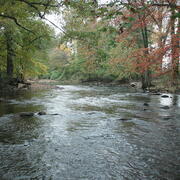
Using monitoring data to measure conditions over time in Chesapeake Bay streams

This study provides a comprehensive assessment of the health of streams throughout the Chesapeake Bay. Monitoring data were used to assess seven key indicators of stream condition, revealing consistent patterns of degradation in urban and agricultural areas. The findings offer critical insights that can inform watershed restoration efforts and improve long-term monitoring strategies.
Using monitoring data to measure conditions over time in Chesapeake Bay streams

Using monitoring data to measure conditions over time in Chesapeake Bay streams

This study provides a comprehensive assessment of the health of streams throughout the Chesapeake Bay. Monitoring data were used to assess seven key indicators of stream condition, revealing consistent patterns of degradation in urban and agricultural areas. The findings offer critical insights that can inform watershed restoration efforts and improve long-term monitoring strategies.
Learn More
Was this page helpful?