



READI-Net infographic_6 polygon


Detailed Description
The 6 components that comprise READI-Net are each represented by an interlocking hexagon, illustrating the multi-dimensional aspect of the project including: Autonomous eDNA samplers, Broad spectrum surveillance, Where & when to sample, Lab analysis standards, Information framework, and Communication.
Sources/Usage
Public Domain.
Related
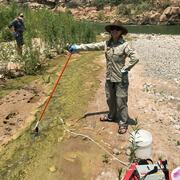
Early detection of aquatic threats: eDNA research in the Colorado River ecosystem & Lake Powell
The USGS and partners are conducting environmental DNA (eDNA) research in the Colorado River downstream from Glen Canyon Dam and in Lake Powell to detect invasive fish species and other aquatic threats before they become established. eDNA is a cutting-edge technology that makes it possible to identify invasive species before they are visible, even in vast or hard-to-survey environments like rivers...

READI-Net: Providing Tools for the Early Detection and Management of Aquatic Invasive Species
The USGS has developed the Rapid environmental (e)DNA Assessment and Deployment Initiative & Network (READI-Net) to accelerate the implementation of environmental DNA (eDNA) analysis as a best practice for the early detection of aquatic biological threats. READI-Net provides tools and a strategy to collect and deliver early detection data for natural resource managers and public health protection...
By
Ecosystems Mission Area, Biological Threats and Invasive Species Research Program, Columbia Environmental Research Center, Eastern Ecological Science Center, Forest and Rangeland Ecosystem Science Center, New York Water Science Center, Northern Rocky Mountain Science Center, Upper Midwest Environmental Sciences Center, Wetland and Aquatic Research Center , Wyoming-Montana Water Science Center, Pacific Northwest Environmental DNA Laboratory, Infrastructure Investment Jobs Act
Related
Early detection of aquatic threats: eDNA research in the Colorado River ecosystem & Lake Powell
The USGS and partners are conducting environmental DNA (eDNA) research in the Colorado River downstream from Glen Canyon Dam and in Lake Powell to detect invasive fish species and other aquatic threats before they become established. eDNA is a cutting-edge technology that makes it possible to identify invasive species before they are visible, even in vast or hard-to-survey environments like rivers...
READI-Net: Providing Tools for the Early Detection and Management of Aquatic Invasive Species
The USGS has developed the Rapid environmental (e)DNA Assessment and Deployment Initiative & Network (READI-Net) to accelerate the implementation of environmental DNA (eDNA) analysis as a best practice for the early detection of aquatic biological threats. READI-Net provides tools and a strategy to collect and deliver early detection data for natural resource managers and public health protection...
By
Ecosystems Mission Area, Biological Threats and Invasive Species Research Program, Columbia Environmental Research Center, Eastern Ecological Science Center, Forest and Rangeland Ecosystem Science Center, New York Water Science Center, Northern Rocky Mountain Science Center, Upper Midwest Environmental Sciences Center, Wetland and Aquatic Research Center , Wyoming-Montana Water Science Center, Pacific Northwest Environmental DNA Laboratory, Infrastructure Investment Jobs Act