U.S. flag

An official website of the United States government

Images

Images related to natural hazards.

Filter Total Items: 7286
This photo from June 25 shows the established lava channel at 6:49 ...
from June 25 shows the established lava channel at 6:49 pm , hours ...

This photo from June 25 shows the established lava channel at 6:49 pm HST, hours after the firehose activity. Today (June 26) HVO observers did not see any active surface breakouts on the delta and the channel has tubed over, but some narrow streams of lava were spilling into the ocean.

This photo from June 25 shows the established lava channel at 6:49 pm HST, hours after the firehose activity. Today (June 26) HVO observers did not see any active surface breakouts on the delta and the channel has tubed over, but some narrow streams of lava were spilling into the ocean.

Field-trip guides to selected volcanoes and volcanic landscapes of ...
Map of flow field...
Map of flow field
Map of flow field
Map of flow field

This map shows recent changes to Kīlauea's East Rift Zone lava flow field. The area of the active flow field as of May 31 is shown in pink, while widening and advancement of the active flow as of June 21 is shown in red. Older Pu‘u ‘Ō‘ō lava flows (1983-2016) are shown in gray. The yellow line is the trace of the active lava tube (dashed where uncertain).

This map shows recent changes to Kīlauea's East Rift Zone lava flow field. The area of the active flow field as of May 31 is shown in pink, while widening and advancement of the active flow as of June 21 is shown in red. Older Pu‘u ‘Ō‘ō lava flows (1983-2016) are shown in gray. The yellow line is the trace of the active lava tube (dashed where uncertain).

Thermal image shows crack across lava delta...
Thermal image shows crack across lava delta

Thermal images collected during the overflight on Wednesday, June 21, show a hot crack spanning much of the width of the lava delta at the Kamokuna ocean entry. These cracks are common on lava deltas, and suggest sagging and instability at the front of the delta.

Thermal images collected during the overflight on Wednesday, June 21, show a hot crack spanning much of the width of the lava delta at the Kamokuna ocean entry. These cracks are common on lava deltas, and suggest sagging and instability at the front of the delta.

HVO logs renewed seismic activity at Lō‘ihi...
HVO logs renewed seismic activity at Lō‘ihi

Left: A color-shaded bathymetry map of Lō‘ihi, a submarine volcano located southeast of the Island of Hawai‘i. The summit region is marked by pit craters formed in connection with an eruption and earthquake swarm in July-August 1996.

Left: A color-shaded bathymetry map of Lō‘ihi, a submarine volcano located southeast of the Island of Hawai‘i. The summit region is marked by pit craters formed in connection with an eruption and earthquake swarm in July-August 1996.

Active surface breakouts continue near the 61g vent...
Active surface breakouts continue near 61g vent

On June 13 at about 6:00 am, there was a new pāhoehoe breakout along the episode 61g tube system approximately 1.1 km (0.7 miles) from the vent. Today (June 21), geologists visiting the site found that the ground had been cracked and uplifted about 2 m (6.6 feet) where the breakout originated (center).

On June 13 at about 6:00 am, there was a new pāhoehoe breakout along the episode 61g tube system approximately 1.1 km (0.7 miles) from the vent. Today (June 21), geologists visiting the site found that the ground had been cracked and uplifted about 2 m (6.6 feet) where the breakout originated (center).

The ocean entry remains active and continues to increase the size o...

The ocean entry remains active and continues to increase the size of the Kamokuna lava delta. Today, activity was concentrated towards the western side of the delta (left center), and building outward in a narrow lobe. Surface flows on the delta over the past few weeks have covered most of the delta with new lava.

The ocean entry remains active and continues to increase the size of the Kamokuna lava delta. Today, activity was concentrated towards the western side of the delta (left center), and building outward in a narrow lobe. Surface flows on the delta over the past few weeks have covered most of the delta with new lava.

Distant view of sandy beach stretching from bottom left to upper right of photo.
Time-averaged image from video of beach in Madeira Beach, Florida

Time-averaged image, or “timex,” created by averaging the intensity of light recorded at each spot, or “pixel,” during a 17-minute video taken at Madeira Beach, Florida, on June 20, 2017. Blurred white bands show where waves are breaking. Offshore band shows location of a sand bar.

Time-averaged image, or “timex,” created by averaging the intensity of light recorded at each spot, or “pixel,” during a 17-minute video taken at Madeira Beach, Florida, on June 20, 2017. Blurred white bands show where waves are breaking. Offshore band shows location of a sand bar.

Image in mostly black and gray tones showing distant view of beach stretching from bottom left to upper right of photo.
Variance image from video of beach in Madeira Beach, Florida

“Variance” image produced from video shot at Madeira Beach, Florida, on June 20, 2017. The more the light intensity changes at a given spot, or “pixel,” during the video, the brighter the value assigned to that pixel. Motion tends to produce changes in light intensity. Note bright bands parallel to shore where waves were breaking.

“Variance” image produced from video shot at Madeira Beach, Florida, on June 20, 2017. The more the light intensity changes at a given spot, or “pixel,” during the video, the brighter the value assigned to that pixel. Motion tends to produce changes in light intensity. Note bright bands parallel to shore where waves were breaking.

The episode 61g flow continues to enter the ocean and build the del...

The episode 61g flow continues to enter the ocean and build the delta at the Kamokuna ocean entry. Small streams of lava along the front of the delta interact with the ocean and produce a large steam plume and occasional littoral bursts.

The episode 61g flow continues to enter the ocean and build the delta at the Kamokuna ocean entry. Small streams of lava along the front of the delta interact with the ocean and produce a large steam plume and occasional littoral bursts.

No visible breakouts on the coastal plain...
No visible breakouts on the coastal plain

The scattered breakouts that have been active on the steep part of the pali and at the base over the past few weeks were not visible this afternoon. The recent surface breakouts (pictured) were still warm, but no longer actively flowing.

The scattered breakouts that have been active on the steep part of the pali and at the base over the past few weeks were not visible this afternoon. The recent surface breakouts (pictured) were still warm, but no longer actively flowing.

HVO's masked geologist heads north to Alaska...
HVO's masked geologist heads north to AK

A masked Tim Orr, on his last day of field work as a USGS Hawaiian Volcano Observatory geologist, collected a sample from Kīlauea Volcano's active lava flow on May 31, 2017. The face mask and heavy glove on his left hand provide protection from the intense radiant heat of molten lava.

A masked Tim Orr, on his last day of field work as a USGS Hawaiian Volcano Observatory geologist, collected a sample from Kīlauea Volcano's active lava flow on May 31, 2017. The face mask and heavy glove on his left hand provide protection from the intense radiant heat of molten lava.

A series of images showing a steep cliff along the coast from two different dates and the change between them.
Mud Creek 2017 May 27-June 13 Erosion View 3

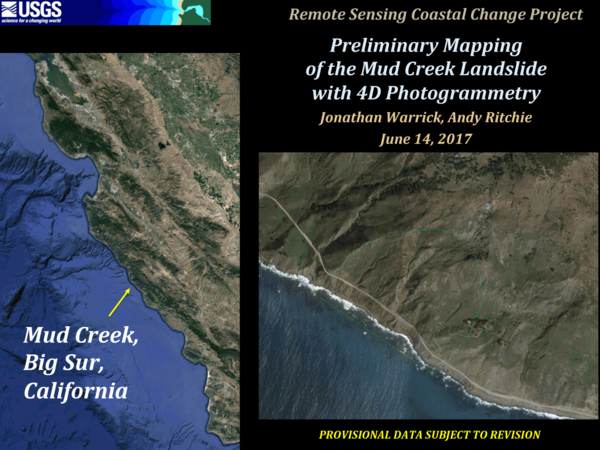
In 2017, the massive Mud Creek landslide buried a quarter-mile of the famous coastal route, California’s Highway 1, with rocks and dirt more than 65 feet deep. USGS monitors erosion along the landslide-prone cliffs of Big Sur, collecting aerial photos frequently throughout the year.

In 2017, the massive Mud Creek landslide buried a quarter-mile of the famous coastal route, California’s Highway 1, with rocks and dirt more than 65 feet deep. USGS monitors erosion along the landslide-prone cliffs of Big Sur, collecting aerial photos frequently throughout the year.

A series of images show the height of the ground and how it changes over 17 days.
Mud Creek landslide "pyramid rock" profile and shoreface erosion

In 2017, the massive Mud Creek landslide buried a quarter-mile of the famous coastal route, California’s Highway 1, with rocks and dirt more than 65 feet deep. USGS monitors erosion along the landslide-prone cliffs of Big Sur, collecting aerial photos frequently throughout the year.

In 2017, the massive Mud Creek landslide buried a quarter-mile of the famous coastal route, California’s Highway 1, with rocks and dirt more than 65 feet deep. USGS monitors erosion along the landslide-prone cliffs of Big Sur, collecting aerial photos frequently throughout the year.

A series of images showing a steep cliff along the coast from two different dates and the change between them.
Mud Creek 2017 May 27-June 13 Erosion View 1

In 2017, the massive Mud Creek landslide buried a quarter-mile of the famous coastal route, California’s Highway 1, with rocks and dirt more than 65 feet deep. USGS monitors erosion along the landslide-prone cliffs of Big Sur, collecting aerial photos frequently throughout the year.

In 2017, the massive Mud Creek landslide buried a quarter-mile of the famous coastal route, California’s Highway 1, with rocks and dirt more than 65 feet deep. USGS monitors erosion along the landslide-prone cliffs of Big Sur, collecting aerial photos frequently throughout the year.

Satellite image shows location of breakouts on flow field...
Satellite image shows location of breakouts on flow field

This satellite image was captured on Friday, June 2, by the Sentinel-2 satellite operated by the European Space Agency. Although this is a false-color image, the color map has been chosen to mimic what the human eye would expect to see. Bright red pixels depict areas of very high temperatures and show active lava. White areas are clouds.

This satellite image was captured on Friday, June 2, by the Sentinel-2 satellite operated by the European Space Agency. Although this is a false-color image, the color map has been chosen to mimic what the human eye would expect to see. Bright red pixels depict areas of very high temperatures and show active lava. White areas are clouds.

Latest upgrade of seismic stations at Kīlauea summit completed...
Latest upgrade of seismic stations at Kīlauea summit completed

USGS Hawaiian Volcano Observatory broadband-seismic stations located at the summit of Kīlauea have been significantly upgraded over the past three years. During the upgrades, HVO field engineers (inset) complete the wiring connections of the solar power and telemetry systems at each site, which are about 10 m (33 ft) from the seismometer.

USGS Hawaiian Volcano Observatory broadband-seismic stations located at the summit of Kīlauea have been significantly upgraded over the past three years. During the upgrades, HVO field engineers (inset) complete the wiring connections of the solar power and telemetry systems at each site, which are about 10 m (33 ft) from the seismometer.

Steaming Pavlof volcano and Pavlof Sister as viewed from the west s...

Steaming Pavlof volcano and Pavlof Sister as viewed from the west shore of Unga Island, Alaska. View is to the west.

Was this page helpful?