Kīlauea summit eruption - Jan. 2, 2021, at 7 a.m. HST
Kīlauea summit eruption - Jan. 2, 2021, at 7 a.m. HSTView of the west vent area and lava lake in Halema‘uma‘u, at Kīlauea Volcano's summit. USGS photo by K. Lynn.


Official websites use .gov
A .gov website belongs to an official government organization in the United States.

Secure .gov websites use HTTPS
A lock () or https:// means you’ve safely connected to the .gov website. Share sensitive information only on official, secure websites.

Hawaiian Volcano Observatory images of eruptive activity, field work, and more.

View of the west vent area and lava lake in Halema‘uma‘u, at Kīlauea Volcano's summit. USGS photo by K. Lynn.
View of the west vent area and lava lake in Halema‘uma‘u, at Kīlauea Volcano's summit. USGS photo by K. Lynn.

Telephoto photograph of the west vent area and lava lake in Halema‘uma‘u, at Kīlauea Volcano's summit. USGS photo by K. Lynn.
Telephoto photograph of the west vent area and lava lake in Halema‘uma‘u, at Kīlauea Volcano's summit. USGS photo by K. Lynn.

The KW webcam captured this image of Kīlauea's ongoing summit eruption, which continued overnight. The KW webcam looks in an east direction; north is to the left in the photo, south to the right, west to the bottom, and east to the top. This photo, taken at 6:30 a.m.
The KW webcam captured this image of Kīlauea's ongoing summit eruption, which continued overnight. The KW webcam looks in an east direction; north is to the left in the photo, south to the right, west to the bottom, and east to the top. This photo, taken at 6:30 a.m.

The margins of the lava lake in Halema‘uma‘u are showing a subtle levee around the perimeter. The levees grow from repeated small overflows, and the rafting and piling of pieces of surface crust that fuse together into a barrier that impounds the lake.
The margins of the lava lake in Halema‘uma‘u are showing a subtle levee around the perimeter. The levees grow from repeated small overflows, and the rafting and piling of pieces of surface crust that fuse together into a barrier that impounds the lake.

Telephoto view of the west vent area in Halema‘uma‘u, Kīlauea Volcano. The west vents are in the northwestern wall of Halema‘uma‘u crater; intermittent spattering at the vents has constructed a perched pointed cone on the crater wall. USGS photo by M. Patrick.
Telephoto view of the west vent area in Halema‘uma‘u, Kīlauea Volcano. The west vents are in the northwestern wall of Halema‘uma‘u crater; intermittent spattering at the vents has constructed a perched pointed cone on the crater wall. USGS photo by M. Patrick.

With the onset of the eruption at Kīlauea summit on December 20, 2020, the HVO monitoring network has been recording volcanic tremor, a signal that travels through the subsurface as magma degasses and erupts from vents to fill a lava lake at the summit.
With the onset of the eruption at Kīlauea summit on December 20, 2020, the HVO monitoring network has been recording volcanic tremor, a signal that travels through the subsurface as magma degasses and erupts from vents to fill a lava lake at the summit.

Main frame: A composite of the point clouds resulting from HVO’s terrestrial laser scanning surveys of Halemaʻumaʻu crater since January 2021, viewed from the southwest. The central region of the crater, including the lava lake, is reliably captured in all surveys.
Main frame: A composite of the point clouds resulting from HVO’s terrestrial laser scanning surveys of Halemaʻumaʻu crater since January 2021, viewed from the southwest. The central region of the crater, including the lava lake, is reliably captured in all surveys.

Kīlauea's summit lava lake in Halemaʻumaʻu continues to re-surface. This process is called crustal foundering, in which pieces of solidified lava crust on the surface of the lava lake break and sink back into the liquid portion. USGS photo by M. Patrick.
Kīlauea's summit lava lake in Halemaʻumaʻu continues to re-surface. This process is called crustal foundering, in which pieces of solidified lava crust on the surface of the lava lake break and sink back into the liquid portion. USGS photo by M. Patrick.

The western portion of the lava lake in Halema‘uma‘u, Kīlauea Volcano summit. The island has migrated closer to the west vent area, which remains active. USGS photo by M. Patrick.
The western portion of the lava lake in Halema‘uma‘u, Kīlauea Volcano summit. The island has migrated closer to the west vent area, which remains active. USGS photo by M. Patrick.

On January 1, 2021, with permission from Hawai‘i Volcanoes National Park, HVO researchers set up temporary seismic instruments around Halema‘uma‘u crater to collect data that will help them learn more about how magma travels in the shallow magmatic plumbing system beneath Kīlauea Volcano.
On January 1, 2021, with permission from Hawai‘i Volcanoes National Park, HVO researchers set up temporary seismic instruments around Halema‘uma‘u crater to collect data that will help them learn more about how magma travels in the shallow magmatic plumbing system beneath Kīlauea Volcano.

HVO field crews deployed a dense network of temporary seismic instruments at Kīlauea’s summit on January 1, 2021, and with permission from Hawai‘i Volcanoes National Park.
HVO field crews deployed a dense network of temporary seismic instruments at Kīlauea’s summit on January 1, 2021, and with permission from Hawai‘i Volcanoes National Park.

Kass Ulmer, Research Corporation of the University of Hawaiʻi seismologist at the Hawaiian Volcano Observatory, deploys a temporary seismometer at Kīlauea summit on 1/1/2021. USGS image by P. Dotray.
Kass Ulmer, Research Corporation of the University of Hawaiʻi seismologist at the Hawaiian Volcano Observatory, deploys a temporary seismometer at Kīlauea summit on 1/1/2021. USGS image by P. Dotray.

Kīlauea eruption in Halema‘uma‘u on Jan. 1, 2021. The channel-like feature remains visible on the lava lake surface within Halemaʻumaʻu crater at Kīlauea Volcano's summit. This feature originates from the influx of lava from the western fissure. USGS photo by M. Patrick.
Kīlauea eruption in Halema‘uma‘u on Jan. 1, 2021. The channel-like feature remains visible on the lava lake surface within Halemaʻumaʻu crater at Kīlauea Volcano's summit. This feature originates from the influx of lava from the western fissure. USGS photo by M. Patrick.

Another telephoto view of the west vent area in Halema‘uma‘u, Kīlauea Volcano. The west vents are in the northwestern wall of Halema‘uma‘u crater; intermittent spattering at the vents has constructed a perched pointed cone on the crater wall. USGS photo by M. Patrick.
Another telephoto view of the west vent area in Halema‘uma‘u, Kīlauea Volcano. The west vents are in the northwestern wall of Halema‘uma‘u crater; intermittent spattering at the vents has constructed a perched pointed cone on the crater wall. USGS photo by M. Patrick.

Within an hour of the Kīlauea summit eruption starting on December 20, 2020, HVO's permanent seismic network detected a signal called volcanic tremor.
Within an hour of the Kīlauea summit eruption starting on December 20, 2020, HVO's permanent seismic network detected a signal called volcanic tremor.

Over the past week, the lava lake in Halema‘uma‘u has developed a subtle levee around its perimeter that allows the lake to be slightly perched above its base, like a mesa. The levees grow from repeated small overflows, and the rafting and piling of pieces of surface crust that fuse together into a barrier that impounds the fluid lake.
Over the past week, the lava lake in Halema‘uma‘u has developed a subtle levee around its perimeter that allows the lake to be slightly perched above its base, like a mesa. The levees grow from repeated small overflows, and the rafting and piling of pieces of surface crust that fuse together into a barrier that impounds the fluid lake.

Kīlauea's summit lava lake in Halemaʻumaʻu is continually re-surfacing. Like the 2008-2018 lava lake, the current lava lake is exhibiting crustal foundering, when fragments of solidified lava crust on the surface break and sink back into the liquid portion. USGS photo by M. Patrick.
Kīlauea's summit lava lake in Halemaʻumaʻu is continually re-surfacing. Like the 2008-2018 lava lake, the current lava lake is exhibiting crustal foundering, when fragments of solidified lava crust on the surface break and sink back into the liquid portion. USGS photo by M. Patrick.

The former gas monitoring station in Moku‘āweoweo, Mauna Loa's summit caldera. Power and telemetry components of the station are to the right in the image, with solar panels. The gas sensors themselves were housed in the black box toward the lower left of the image.
The former gas monitoring station in Moku‘āweoweo, Mauna Loa's summit caldera. Power and telemetry components of the station are to the right in the image, with solar panels. The gas sensors themselves were housed in the black box toward the lower left of the image.
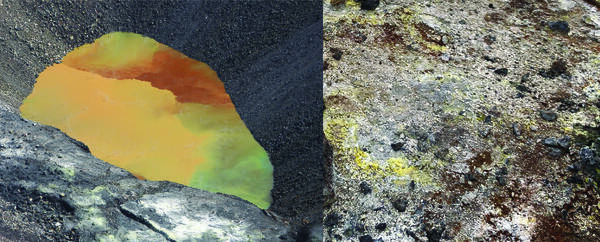
Left: Kīlauea’s water lake on November 17, 2020 (photo by M. Patrick). The orange and brown colors are caused by the presence of various oxygen- and sulfur-bearing iron minerals in the water. The green at the edges is caused by an influx of iron-bearing groundwater that has not yet had time to react with oxygen in the atmosphere.
Left: Kīlauea’s water lake on November 17, 2020 (photo by M. Patrick). The orange and brown colors are caused by the presence of various oxygen- and sulfur-bearing iron minerals in the water. The green at the edges is caused by an influx of iron-bearing groundwater that has not yet had time to react with oxygen in the atmosphere.

The western fissure in Halemaʻumaʻu wall remains active. Glowing vents and a prominent spatter cone are visible in this photo, which shows some spattering at the vent. This view looks steeply down from Kīlauea's west caldera rim, and the lava lake surface is visible in the background. USGS photo by B. Carr on 12/31/2020.
The western fissure in Halemaʻumaʻu wall remains active. Glowing vents and a prominent spatter cone are visible in this photo, which shows some spattering at the vent. This view looks steeply down from Kīlauea's west caldera rim, and the lava lake surface is visible in the background. USGS photo by B. Carr on 12/31/2020.

Kīlauea's summit lava lake in Halemaʻumaʻu is continually re-surfacing. HVO geologists monitoring the activity in the field have observed crustal foundering, in which pieces of solidified lava crust on the surface of the lava lake break and sink back into the liquid portion. USGS photo by M. Patrick on 12/31/2020.
Kīlauea's summit lava lake in Halemaʻumaʻu is continually re-surfacing. HVO geologists monitoring the activity in the field have observed crustal foundering, in which pieces of solidified lava crust on the surface of the lava lake break and sink back into the liquid portion. USGS photo by M. Patrick on 12/31/2020.