



Fissure 8 (lower right) and open lava channel leading to the northeast.
Images
Hawaiian Volcano Observatory images of eruptive activity, field work, and more.
Filter Total Items: 4171

Kīlauea Volcano — Fissure 8 Overflight
Fissure 8 (lower right) and open lava channel leading to the northeast.

Kīlauea Volcano — Fissure 8
View of Fissure 8 and channel during the morning overflight on July 7.
View of Fissure 8 and channel during the morning overflight on July 7.

Kīlauea Volcano — SO2 Camera
For several years, a special ultraviolet camera has been located near Keanakākoʻi Crater at Kīlauea's summit. The camera was capable of detecting SO2 gas coming from Halema‘uma‘u crater. This morning, the camera was removed because there is very little SO2 to measure these days at the summit.
For several years, a special ultraviolet camera has been located near Keanakākoʻi Crater at Kīlauea's summit. The camera was capable of detecting SO2 gas coming from Halema‘uma‘u crater. This morning, the camera was removed because there is very little SO2 to measure these days at the summit.

Kīlauea Volcano — Fissure 8
Dawn at Fissure 8

Kīlauea Volcano — Kapoho Bay
Ocean entry in Kapoho as viewed from morning helicopter overflight.
Ocean entry in Kapoho as viewed from morning helicopter overflight.

Kīlauea Volcano — Satellite View of Kīlauea Summit
Kīlauea Volcano — Satellite View of Kīlauea SummitThe WorldView-3 satellite acquired this view of Kīlauea's summit on July 3. Despite a few clouds, the area of heaviest fractures in the caldera is clear. Views into the expanding Halema‘uma‘u crater reveal a pit floored by rubble. HVO, on the northwest caldera rim, is labeled.
Kīlauea Volcano — Satellite View of Kīlauea Summit
Kīlauea Volcano — Satellite View of Kīlauea SummitThe WorldView-3 satellite acquired this view of Kīlauea's summit on July 3. Despite a few clouds, the area of heaviest fractures in the caldera is clear. Views into the expanding Halema‘uma‘u crater reveal a pit floored by rubble. HVO, on the northwest caldera rim, is labeled.

Kīlauea Volcano — Ocean Entry at Kapoho
Having crusted over about 0.8 km (0.5 mi) upchannel from the ocean entry, lava oozes from the flow's molten interior to enter the sea along a broad flow front on the northern (Kapoho) side of the flow.
Having crusted over about 0.8 km (0.5 mi) upchannel from the ocean entry, lava oozes from the flow's molten interior to enter the sea along a broad flow front on the northern (Kapoho) side of the flow.

Kīlauea Volcano — Lavafall Near Kapoho Crater
Near the Kapoho Crater, in the area called Four Corners, the lava channel makes a 90-degree bend. After lava exits the bend, it makes a short drop to form a lavafall. A side channel makes a short surface diversion before rejoining the existing channel.
Near the Kapoho Crater, in the area called Four Corners, the lava channel makes a 90-degree bend. After lava exits the bend, it makes a short drop to form a lavafall. A side channel makes a short surface diversion before rejoining the existing channel.

Kīlauea Volcano — Aerial of Kapoho Area
Aerial view of the lava channel and active margins between Kapoho Crater (upper right) and the coast (lower left). The northern margin of the flow field is advancing at several points in the area of Kapoho Ag and Beach Lots (vegetated areas in center of image). Image courtesy of Hawaii County Fire Department.
Aerial view of the lava channel and active margins between Kapoho Crater (upper right) and the coast (lower left). The northern margin of the flow field is advancing at several points in the area of Kapoho Ag and Beach Lots (vegetated areas in center of image). Image courtesy of Hawaii County Fire Department.

Kīlauea Volcano — Collapse and Dust Rising at Halema`uma`u Crater
Kīlauea Volcano — Collapse and Dust Rising at Halema`uma`u CraterAt 1:20 PM HST on July 5, a collapse explosion event occurred at Kīlauea's summit. The energy released by the event was equivalent to a M5.2 earthquake.
Kīlauea Volcano — Collapse and Dust Rising at Halema`uma`u Crater
Kīlauea Volcano — Collapse and Dust Rising at Halema`uma`u CraterAt 1:20 PM HST on July 5, a collapse explosion event occurred at Kīlauea's summit. The energy released by the event was equivalent to a M5.2 earthquake.

Kīlauea Volcano — Kapoho Coastline Delta
Lava enters the sea along the Kapoho coastline, building a delta that is now over 555 acres in size.
Lava enters the sea along the Kapoho coastline, building a delta that is now over 555 acres in size.

Kīlauea Volcano — Dust from Summit Explosion
Rocks generate brown dust as they tumble down the western caldera wall during the collapse explosion event on July 5, 2018.
Rocks generate brown dust as they tumble down the western caldera wall during the collapse explosion event on July 5, 2018.

Kīlauea Volcano — Lava Levees
Lava, from small overflows, cools and congeals along the banks of the lava channel to build lava levees. The levees also build up as moving lava pushes cooled crust over the edge.
Lava, from small overflows, cools and congeals along the banks of the lava channel to build lava levees. The levees also build up as moving lava pushes cooled crust over the edge.

Black streak of water on Kīlauea caldera wall
Black streak on caldera wall (center) is about 50 m (yards) long, and white steam plume (lower right) rises from northwestern part of Halema‘uma‘u. Photo from Volcano House Hotel on July 4, 2018. The configuration of this area changed considerably after the photo was taken, as collapse continued into early August.
Black streak on caldera wall (center) is about 50 m (yards) long, and white steam plume (lower right) rises from northwestern part of Halema‘uma‘u. Photo from Volcano House Hotel on July 4, 2018. The configuration of this area changed considerably after the photo was taken, as collapse continued into early August.

Kīlauea Volcano — Flows Near Kapoho Ag. and Beach Lots
Kīlauea Volcano — Flows Near Kapoho Ag. and Beach LotsNear the coast, the northern margin of the flow field is still oozing pasty lava at several points in the area of Kapoho Agricultural and Beach Lots.
Kīlauea Volcano — Flows Near Kapoho Ag. and Beach Lots
Kīlauea Volcano — Flows Near Kapoho Ag. and Beach LotsNear the coast, the northern margin of the flow field is still oozing pasty lava at several points in the area of Kapoho Agricultural and Beach Lots.

Kīlauea Volcano — Fissure 8 at Night
USGS Unmanned Aircraft Systems image of fissure 8 looking east.
USGS Unmanned Aircraft Systems image of fissure 8 looking east.

Kīlauea Volcano — Lava Channel Bend
The lava channel from fissure 8 jumped its banks near Kapoho Crater where the channel makes a 90 degree bend. The flow within the channel was diverted around a constricted area and joined the channel again "downstream" to the south (left).
The lava channel from fissure 8 jumped its banks near Kapoho Crater where the channel makes a 90 degree bend. The flow within the channel was diverted around a constricted area and joined the channel again "downstream" to the south (left).

Kīlauea Volcano — Sunrise at Haleam`uma`u Crater
Sunrise view of Halema‘uma‘u crater as seen from the USGS observation point from Volcano House in Hawai‘i Volcanoes National Park.
Sunrise view of Halema‘uma‘u crater as seen from the USGS observation point from Volcano House in Hawai‘i Volcanoes National Park.

Kīlauea Volcano — Scientist Observing Fissure 8
USGS scientist observes the glow of fissure 8 fountain and channel within Leilani Estates. Steam rises from cracks and hot spots within the tephra deposit surrounding the cone.
USGS scientist observes the glow of fissure 8 fountain and channel within Leilani Estates. Steam rises from cracks and hot spots within the tephra deposit surrounding the cone.
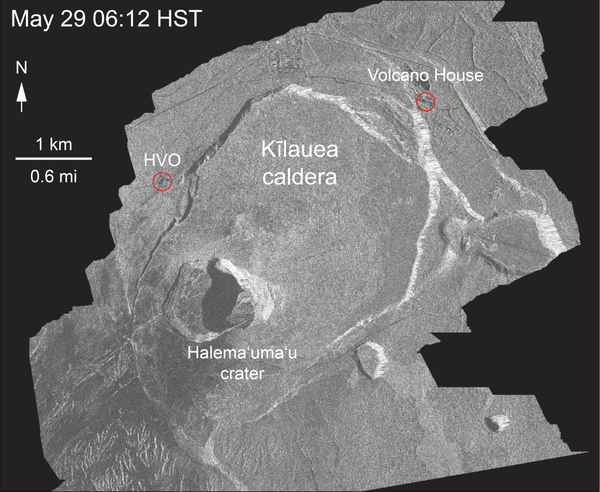
Kīlauea Volcano — Animation of Summit Subsidence
This animated GIF shows a sequence of radar amplitude images that were acquired by the Agenzia Spaziale Italiana CosmoSkyMed satellite system. The images illustrate changes to the caldera area of Kīlauea Volcano that occurred between May 5 and July 4 at about 6:00 a.m. HST.
This animated GIF shows a sequence of radar amplitude images that were acquired by the Agenzia Spaziale Italiana CosmoSkyMed satellite system. The images illustrate changes to the caldera area of Kīlauea Volcano that occurred between May 5 and July 4 at about 6:00 a.m. HST.

Kīlauea Volcano — Lava Flowing from Fissure 8
Lava within the fissure 8 cone roils and churns where it eupts from the vent and flows rapidly down the well-established channel. This image was captured via a Mavic Pro drone courtesy of the DOI/USGS Unmanned Aircraft Systems team.
Lava within the fissure 8 cone roils and churns where it eupts from the vent and flows rapidly down the well-established channel. This image was captured via a Mavic Pro drone courtesy of the DOI/USGS Unmanned Aircraft Systems team.