U.S. flag

An official website of the United States government

Images

Hawaiian Volcano Observatory images of eruptive activity, field work, and more.

Filter Total Items: 3867
Color photograph of lava fountain
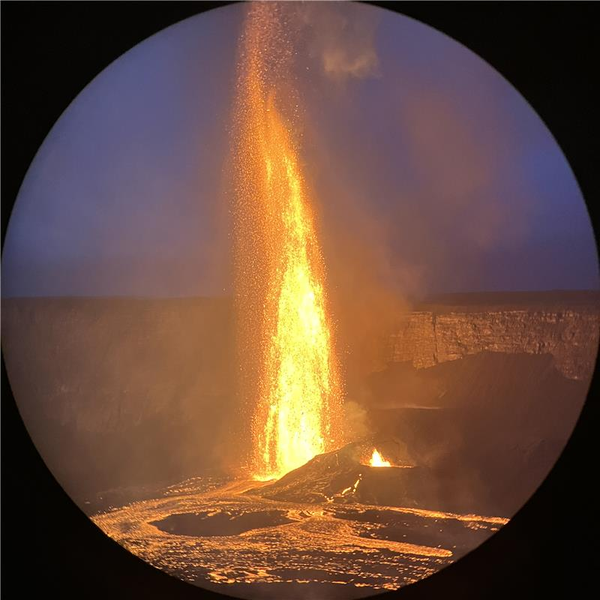
December 24, 2024 - Kīlauea summit lava fountain

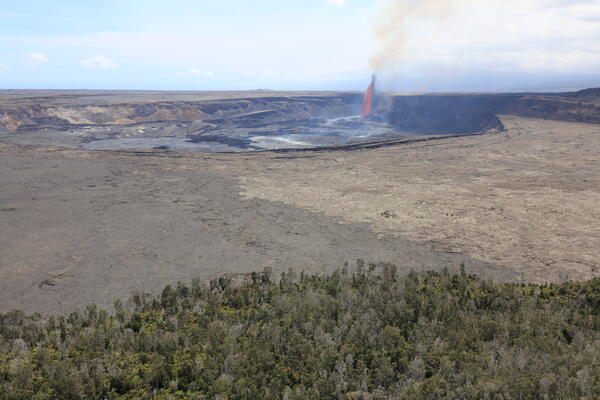
A telephoto view of lava fountains erupting within Kaluapele (Kīlauea summit caldera) the afternoon of December 24. This eruption began on December 23 with vigorous lava and volcanic gas effusion, which decreased throughout the day until the eruption paused around 4:00 p.m. HST. Renewed, low-level eruption of sluggish lava began around 8 a.m.

A telephoto view of lava fountains erupting within Kaluapele (Kīlauea summit caldera) the afternoon of December 24. This eruption began on December 23 with vigorous lava and volcanic gas effusion, which decreased throughout the day until the eruption paused around 4:00 p.m. HST. Renewed, low-level eruption of sluggish lava began around 8 a.m.

color graphic map of recent lava flow coverage within summit caldera
December 23, 2024—Kīlauea summit eruption reference map

This reference map depicts the new Kīlauea summit eruption within Halema‘uma‘u crater on December 23, 2024, constructed using data captured during a USGS Hawaiian Volcano Observatory helicopter overflight at 9:30 a.m.

This reference map depicts the new Kīlauea summit eruption within Halema‘uma‘u crater on December 23, 2024, constructed using data captured during a USGS Hawaiian Volcano Observatory helicopter overflight at 9:30 a.m.

Color photograph of active lava fountains
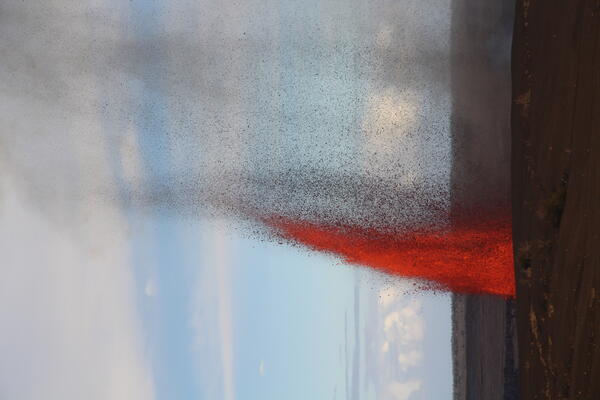
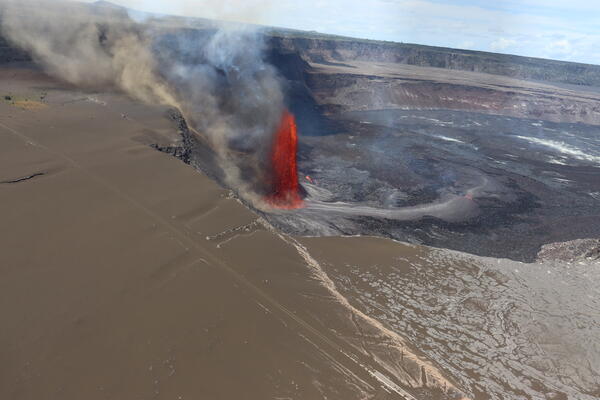
December 23, 2024 - Lava fountains in the west part of Kīlauea caldera

This aerial view, captured during a USGS Hawaiian Volcano Observatory monitoring overflight, shows the lava fountains active in the west part of Kīlauea caldera. The eruption began this morning at 2:20 a.m. HST, December 23, and fountains reached up to 90 meters (290 feet) overnight.

This aerial view, captured during a USGS Hawaiian Volcano Observatory monitoring overflight, shows the lava fountains active in the west part of Kīlauea caldera. The eruption began this morning at 2:20 a.m. HST, December 23, and fountains reached up to 90 meters (290 feet) overnight.

Color photograph of active lava flowing
December 23, 2024 - Lava flowing on the floor of Kīlauea summit caldera

A lobe of molten pāhoehoe lava on the floor of Kaluapele (Kīlauea caldera) on December 23, 2024. USGS photo by M. Patrick. 

Color photograph of two people loading a machine with geologic samples for analysis
December 23, 2024 - Analyzing Kīlauea's recent eruption samples

After sample preparation, University of Hawai‘i at Hilo faculty and an undergraduate research student load the most recent Kīlauea eruption sample into the ED-XRF (energy dispersive x-ray fluorescence) for chemical analysis. Within 6 hours of sample collection, the chemical analysis of the lava was completed. USGS photo by K. Lynn.

After sample preparation, University of Hawai‘i at Hilo faculty and an undergraduate research student load the most recent Kīlauea eruption sample into the ED-XRF (energy dispersive x-ray fluorescence) for chemical analysis. Within 6 hours of sample collection, the chemical analysis of the lava was completed. USGS photo by K. Lynn.

Color photograph of vents erupting lava
December 23, 2024 - View of the new eruption at the summit of Kīlauea

This photograph, taken at approximately 4:00 a.m. HST from the Volcano House overlook in Hawaiʻi Volcanoes National Park, shows the new eruption within Kaluapele (the summit caldera).

This photograph, taken at approximately 4:00 a.m. HST from the Volcano House overlook in Hawaiʻi Volcanoes National Park, shows the new eruption within Kaluapele (the summit caldera).

Color map of temperature of crater floor with recent lava flows
December 23, 2024 — Thermal map of eruption at Kīlauea summit

This thermal map shows lava flows covering the floor of Halemaʻumaʻu crater at the summit of Kīlauea.  Fountaining was active in the southwest portion of the caldera, with flows extending east onto the downdropped block. Cooler colors (purple, black) show lower temperatures while hotter colors (orange, yellow) show higher temperatures. USGS map by M.

This thermal map shows lava flows covering the floor of Halemaʻumaʻu crater at the summit of Kīlauea.  Fountaining was active in the southwest portion of the caldera, with flows extending east onto the downdropped block. Cooler colors (purple, black) show lower temperatures while hotter colors (orange, yellow) show higher temperatures. USGS map by M.

Color photograph of volcanic plume illuminated
December 23, 2024 - Kīlauea summit eruption plume

The new Kīlauea summit eruption is occurring within a closed area of Hawai'i Volcanoes National Park. High levels of volcanic gas—primarily water vapor (H2O), carbon dioxide (CO2), and sulfur dioxide (SO2)—are the primary hazard of concern, as this hazard can have far-reaching effects down-wind.

The new Kīlauea summit eruption is occurring within a closed area of Hawai'i Volcanoes National Park. High levels of volcanic gas—primarily water vapor (H2O), carbon dioxide (CO2), and sulfur dioxide (SO2)—are the primary hazard of concern, as this hazard can have far-reaching effects down-wind.

Color photograph of molten lava lake glowing
December 23, 2024 - Kīlauea summit eruption sunrise

The lake of active lava in the summit caldera of Kīlauea glows as the sun rises. Lava has covered more than 400 acres since the eruption began at 2:20 a.m. HST this morning. USGS image by N. Deligne. 

The lake of active lava in the summit caldera of Kīlauea glows as the sun rises. Lava has covered more than 400 acres since the eruption began at 2:20 a.m. HST this morning. USGS image by N. Deligne. 

Color photograph of volcanic plume
December 23, 2024 — Kīlauea summit eruption plume

The volcanic plume from the December 23, 2024, Kīlauea summit eruption taken from Uēkahuna overlook within Hawai‘i Volcanoes National Park and looking south. As of 9:30 a.m. HST, the plume (which is periodic in intensity) is still active and ejecting spatter and bombs onto the west rim of the caldera in the closed area along Crater Rim Drive Road. USGS photo by H.

The volcanic plume from the December 23, 2024, Kīlauea summit eruption taken from Uēkahuna overlook within Hawai‘i Volcanoes National Park and looking south. As of 9:30 a.m. HST, the plume (which is periodic in intensity) is still active and ejecting spatter and bombs onto the west rim of the caldera in the closed area along Crater Rim Drive Road. USGS photo by H.

Color photograph of caldera with fresh lava flows and active eruption
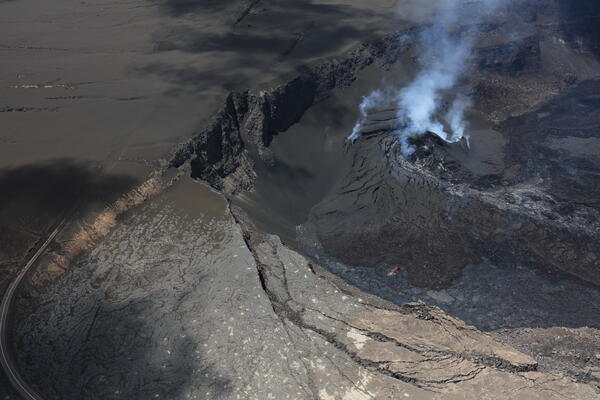
December 23, 2024 - Kīlauea summit eruption overflight

USGS Hawaiian Volcano Observatory geologists conducted a monitoring overflight of the new eruption in Kīlauea summit caldera. During the overflight, which occurred at 9:30 a.m. HST, they observed lava the active lava fountains and active lava flows at the base of the caldera, which have paved more than 500 acres with new rock.

USGS Hawaiian Volcano Observatory geologists conducted a monitoring overflight of the new eruption in Kīlauea summit caldera. During the overflight, which occurred at 9:30 a.m. HST, they observed lava the active lava fountains and active lava flows at the base of the caldera, which have paved more than 500 acres with new rock.

Colro photograph of erupting vents across crater floor
December 23, 2024 - A view across new lava flows in Kīlauea summit caldera

A view across new lava flows paving the floor of Kīlauea caldera, taken during the USGS Hawaiian Volcano Observatory monitoring overflight at approximately 9:30 a.m. HST this morning. USGS photo by M. Zoeller. 

A view across new lava flows paving the floor of Kīlauea caldera, taken during the USGS Hawaiian Volcano Observatory monitoring overflight at approximately 9:30 a.m. HST this morning. USGS photo by M. Zoeller. 

Color photograph of scientist monitoring eruption
December 23, 2024 - HVO field geologists monitor eruption

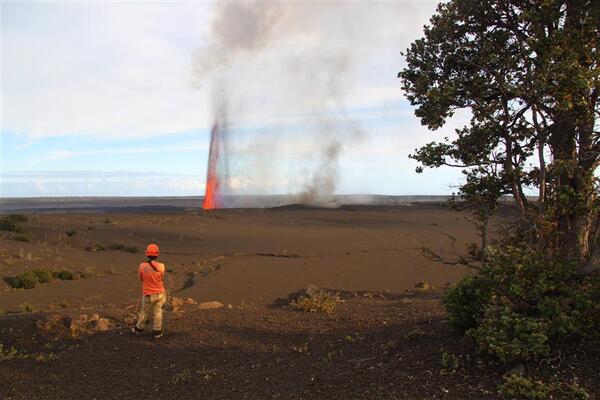
USGS Hawaiian Volcano Observatory geologists observe and document the new eruption within Kīlauea summit caldera. Using a laser rangefinder, the geologists measure the distance to various points associated with the new eruption. USGS photo by M. Patrick. 

USGS Hawaiian Volcano Observatory geologists observe and document the new eruption within Kīlauea summit caldera. Using a laser rangefinder, the geologists measure the distance to various points associated with the new eruption. USGS photo by M. Patrick. 

Color photograph showing crystals under magnification
December 23, 2024 - Preparing Kīlauea's newest eruption samples

Kīlauea's newest eruption samples contain olivine - a common green mineral in Hawaiian lavas. USGS Hawaiian Volcano Observatory and University of Hawai‘i at Hilo staff are picking out the olivine crystals like this one, shown using a microscope to magnify it (the crystal is 1 mm in size, or about 0.04 inches across), to analyze their chemistry.

Kīlauea's newest eruption samples contain olivine - a common green mineral in Hawaiian lavas. USGS Hawaiian Volcano Observatory and University of Hawai‘i at Hilo staff are picking out the olivine crystals like this one, shown using a microscope to magnify it (the crystal is 1 mm in size, or about 0.04 inches across), to analyze their chemistry.

Color photograph of active lava flows
December 23, 2024 - New eruption in Kīlauea summit caldera

Kīlauea volcano began erupting within the summit caldera at approximately 2:20 a.m. HST this morning, December 23, 2024, following an increase in seismicity that began beneath the summit just a half hour earlier, at approximately 2:00 a.m. HST.

Kīlauea volcano began erupting within the summit caldera at approximately 2:20 a.m. HST this morning, December 23, 2024, following an increase in seismicity that began beneath the summit just a half hour earlier, at approximately 2:00 a.m. HST.

Color photograph of eruptive vents
December 23, 2024 - View from the west rim of Kaluapele

From the closed area of Hawaiʻi Volcanoes National Park, USGS Hawaiian Volcano Observatory geologists documented the new eruption within Kalupele that started this morning at 2:20 a.m. HST.

From the closed area of Hawaiʻi Volcanoes National Park, USGS Hawaiian Volcano Observatory geologists documented the new eruption within Kalupele that started this morning at 2:20 a.m. HST.

Color photograph of lava eruptive and feeding lava flows on crater floor
December 23, 2024 - Kīlauea summit eruption

Another view of the new eruption within the summit caldera of Kīlauea, Kaluapele, that began this morning, December 23, 2024, at approximately 2:20 a.m. HST. Lava is erupting from vents on the west part of the caldera wall, feeding lava flows that cover the area of Halemaʻumaʻu crater (with an approximate diameter of 1 kilometer or 0.75 miles). USGS photo by M.

Another view of the new eruption within the summit caldera of Kīlauea, Kaluapele, that began this morning, December 23, 2024, at approximately 2:20 a.m. HST. Lava is erupting from vents on the west part of the caldera wall, feeding lava flows that cover the area of Halemaʻumaʻu crater (with an approximate diameter of 1 kilometer or 0.75 miles). USGS photo by M.

Color image of webcam capturing eruption start
December 23, 2024 - B2cam captures eruption start

The B2cam captures a live view of Halemaʻumaʻu crater from the east rim and down-dropped block, looking west across Kīlauea summit caldera. On December 23, 2024, it captured the start of another Kīlauea summit eruption. USGS webcam image. 

The B2cam captures a live view of Halemaʻumaʻu crater from the east rim and down-dropped block, looking west across Kīlauea summit caldera. On December 23, 2024, it captured the start of another Kīlauea summit eruption. USGS webcam image. 

Color photograph of lava samples being prepped in a lab next to a laptop
December 23, 2024 — Young rock, new lava samples from Kīlauea eruption

Around 2:20 a.m. HST on December 23, 2024, Kīlauea's newest summit eruption began in Halema‘uma‘u. Lava fountains overnight reached up to 90 meters (295 feet) high and threw molten lava up and onto portions of the old Crater Rim Drive in a closed area of Hawai‘i Volcanoes National Park.

Around 2:20 a.m. HST on December 23, 2024, Kīlauea's newest summit eruption began in Halema‘uma‘u. Lava fountains overnight reached up to 90 meters (295 feet) high and threw molten lava up and onto portions of the old Crater Rim Drive in a closed area of Hawai‘i Volcanoes National Park.

Color photograph of lava spatter samples next to measuring ruler
December 23, 2024 — Kīlauea newest lava samples

Around 2:20 a.m. HST on December 23, 2024, Kīlauea's newest summit eruption began in Halema‘uma‘u. Lava fountains overnight reached up to 90 meters (295 feet) high and threw molten lava up and onto portions of the old Crater Rim Drive in a closed area of Hawai‘i Volcanoes National Park.

Around 2:20 a.m. HST on December 23, 2024, Kīlauea's newest summit eruption began in Halema‘uma‘u. Lava fountains overnight reached up to 90 meters (295 feet) high and threw molten lava up and onto portions of the old Crater Rim Drive in a closed area of Hawai‘i Volcanoes National Park.

Color photograph of eruption
December 23, 2024 - Kīlauea summit eruption overflight

During an overflight at approximately 9:30 a.m. HST, USGS Hawaiian Volcano Observatory geologists captured this view of the eruption that began this morning at 2:20 a.m. HST in Kaluapele (Kīlauea summit caldera).

During an overflight at approximately 9:30 a.m. HST, USGS Hawaiian Volcano Observatory geologists captured this view of the eruption that began this morning at 2:20 a.m. HST in Kaluapele (Kīlauea summit caldera).

Was this page helpful?