U.S. flag

An official website of the United States government

Images

Hawaiian Volcano Observatory images of eruptive activity, field work, and more.

Filter Total Items: 3867
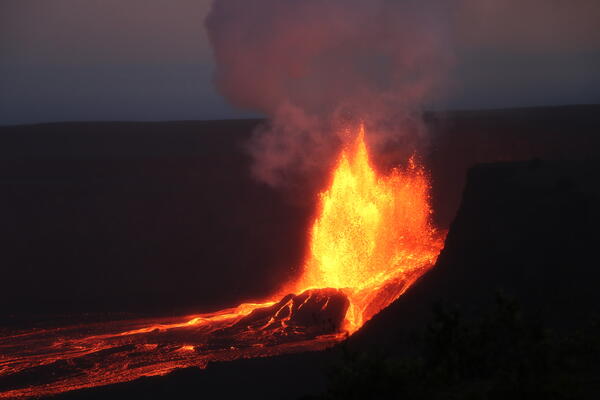
Color photograph of lava fountain
January 2, 2025 — Kīlauea lava fountains

Lava fountaining in the southwest portion of Kaluapele (Kīlauea caldera) has producing tephra cone perched along the caldera wall. USGS photo by M. Patrick on January 2, 2025. 

Lava fountaining in the southwest portion of Kaluapele (Kīlauea caldera) has producing tephra cone perched along the caldera wall. USGS photo by M. Patrick on January 2, 2025. 

Color photograph of erupting vents
January 2, 2025 — Kīlauea eruptive vents

On January 2, USGS-Hawaiian Volcano Observatory geologists measured lava fountains at Kīlauea summit reaching heights of 262-295 feet (80-90 meters). USGS photo by M. Patrick. 

On January 2, USGS-Hawaiian Volcano Observatory geologists measured lava fountains at Kīlauea summit reaching heights of 262-295 feet (80-90 meters). USGS photo by M. Patrick. 

Color photograph of lava fountain
January 2, 2025 — Vigorous lava fountaining continues at Kīlauea summit

Vigorous lava fountaining continued this morning with the dominant vent producing fountain heights of about 80 m (260 feet). USGS photo by M. Patrick.


Color photograph of vent erupting lava
January 2, 2025 — Vigorous lava fountaining continues at Kīlauea summit

Two vents were active today at Kīlauea summit. The southern vent was producing the dominant fountain (left side of image) and had built a large pyroclastic cone abutting the western caldera wall. The northern vent had a lower fountain (right side of image) and a smaller cone. USGS photo by M. Patrick.

Two vents were active today at Kīlauea summit. The southern vent was producing the dominant fountain (left side of image) and had built a large pyroclastic cone abutting the western caldera wall. The northern vent had a lower fountain (right side of image) and a smaller cone. USGS photo by M. Patrick.

Color photograph of vent erupting
January 2, 2025 — Kīlauea eruption observations

A view from the west rim of Kaluapele (Kīlauea summit caldera) of the vents erupting at Kīlauea summit. USGS photo by M. Patrick. 

A view from the west rim of Kaluapele (Kīlauea summit caldera) of the vents erupting at Kīlauea summit. USGS photo by M. Patrick. 

Color photograph of vent erupting on side of crater
January 2, 2025 — Kīlauea eruption observations

A broader view of the activity at Kīlauea summit. The lava fountaining has produced a large pyroclastic cone against the western wall, with deposits draped on the walls. Lava pours out of the vents into a large ponded area in the southwest portion of Halema‘uma‘u crater.

A broader view of the activity at Kīlauea summit. The lava fountaining has produced a large pyroclastic cone against the western wall, with deposits draped on the walls. Lava pours out of the vents into a large ponded area in the southwest portion of Halema‘uma‘u crater.

Color photograph of erupting vent
January 2, 2025 — Kīlauea summit eruption

Over the past day, vents in the southwest portion of Kaluapele (Kīlauea caldera) have continued producing a fan of lava flows covering the western portion of the crater floor during sustained lava fountaining. USGS photo by M. Patrick on January 2, 2025. 

Over the past day, vents in the southwest portion of Kaluapele (Kīlauea caldera) have continued producing a fan of lava flows covering the western portion of the crater floor during sustained lava fountaining. USGS photo by M. Patrick on January 2, 2025. 

Color plot showing ground tilt
Graph of recent ground tilting at the summit of Kīlauea

Graph of tilting at the summit of Kīlauea recorded by the UWD tiltmeter, located near Uēkahuna bluff on the north side of the caldera and the SDH tiltmeter located south of the caldera.

Graph of tilting at the summit of Kīlauea recorded by the UWD tiltmeter, located near Uēkahuna bluff on the north side of the caldera and the SDH tiltmeter located south of the caldera.

Color photograph of lava fountains
January 2, 2025 — Vigorous lava fountaining continues at Kīlauea summit

Koaʻe kea (white-tailed tropicbirds) continuously fly around the lava fountain and above the lava pond at Kīlauea summit. USGS photo by M. Patrick.

Color map showing eruption area
January 2, 2025—Kīlauea summit eruption reference map

This reference map depicts the Kīlauea summit eruption within Halema‘uma‘u as of January 2, 2025. Since the onset of the eruption on December 23, 2024, it has covered a total of 673 acres (272 hectares) with new lava (pink area), and approximately half that area still hosts active flows (red area).

This reference map depicts the Kīlauea summit eruption within Halema‘uma‘u as of January 2, 2025. Since the onset of the eruption on December 23, 2024, it has covered a total of 673 acres (272 hectares) with new lava (pink area), and approximately half that area still hosts active flows (red area).

Color photograph of erupting vent
January 2, 2025 — Kīlauea eruptive vents

Another telephoto view of the vents erupting at Kīlauea summit on January 2, 2025. View is from the closed west rim area of Hawaiʻi Volcanoes National Park. USGS photo by M. Patrick. 

Another telephoto view of the vents erupting at Kīlauea summit on January 2, 2025. View is from the closed west rim area of Hawaiʻi Volcanoes National Park. USGS photo by M. Patrick. 

Color photograph of male with aloha shirt on and greenery in the background
Dr. Thomas Lee, University of Hawaiʻi at Hilo Geology Professor

Dr. Thomas Lee, University of Hawaiʻi at Hilo Geology Professor who specializes in seismology. 

Color photograph of geologist and erupting vents in background
Sunrise shift for HVO geologists at Kīlauea on December 31, 2024

Here, a Hawaiian Volcano Observatory geologist takes images and measurements of lava fountain heights during the ongoing Kīlauea summit eruption on December 31, 2024; the eruption began on December 23 and has continued in episodic pulses. Geologists conduct shifts throughout the week to monitor the eruption and note any changes.

Here, a Hawaiian Volcano Observatory geologist takes images and measurements of lava fountain heights during the ongoing Kīlauea summit eruption on December 31, 2024; the eruption began on December 23 and has continued in episodic pulses. Geologists conduct shifts throughout the week to monitor the eruption and note any changes.

Color photograph of erupting vent
Lava fountain in Halemaʻumaʻu on New Year's Eve

Shortly after sunrise on December 31, 2024, the eruption at Kīlauea's summit continued with 50–80 foot (15–25 meter) lava fountains continuously feeding flows across the floor of Halemaʻumaʻu crater. USGS photo by K. Lynn.

Shortly after sunrise on December 31, 2024, the eruption at Kīlauea's summit continued with 50–80 foot (15–25 meter) lava fountains continuously feeding flows across the floor of Halemaʻumaʻu crater. USGS photo by K. Lynn.

Color photograph of volcanic gas plume
Volcanic gas plume from Kīlauea's summit at dawn on New Year's Eve

At dawn on December 31, 2024 the eruption in Kaluapele (Kīlauea caldera) continued. The plume of volcanic gas seen here was blown to the southwest of Kaluapele across the closed Crater Rim Drive in Hawai‘i Volcanoes National Park. USGS photo by K. Lynn.

At dawn on December 31, 2024 the eruption in Kaluapele (Kīlauea caldera) continued. The plume of volcanic gas seen here was blown to the southwest of Kaluapele across the closed Crater Rim Drive in Hawai‘i Volcanoes National Park. USGS photo by K. Lynn.

Color photograph of erupting vents
Early morning view of Kīlauea summit eruptive vents on New Year's Eve

At 6:30 a.m. on December 31, 2024, the eruption continued in Kaluapele (Kīlauea caldera) with 50–80 foot (15–25 meter) lava fountains from two vents. A Hawaiian Volcano Observatory field crew observed continuous fountaining that fed an expanding lava fan across the floor of Halemaʻumaʻu crater. USGS photo by K. Lynn.

At 6:30 a.m. on December 31, 2024, the eruption continued in Kaluapele (Kīlauea caldera) with 50–80 foot (15–25 meter) lava fountains from two vents. A Hawaiian Volcano Observatory field crew observed continuous fountaining that fed an expanding lava fan across the floor of Halemaʻumaʻu crater. USGS photo by K. Lynn.

Color photograph of panorama of erupting vents, lava flows, and volcanic gas plume
Panorama of Kīlauea summit eruption on New Year's Eve

This panorama, stitched from eight photos taken at different angles, shows the eruption within Halemaʻumaʻu crater and its volcanic gas plume in the dawn light on December 31, 2024. USGS photo by K. Lynn.

This panorama, stitched from eight photos taken at different angles, shows the eruption within Halemaʻumaʻu crater and its volcanic gas plume in the dawn light on December 31, 2024. USGS photo by K. Lynn.

Color photograph of lava flows
Zoom view of lava flows in Halemaʻumaʻu on December 31, 2024

Zoom view of the lava flow field from the ongoing Kīlauea summit eruption on December 31, 2024. The eruption continues to feed lava throughout Halemaʻumaʻu crater, where lava channels and outbreak lobes like these are forming. USGS photo by H. Winslow.

Zoom view of the lava flow field from the ongoing Kīlauea summit eruption on December 31, 2024. The eruption continues to feed lava throughout Halemaʻumaʻu crater, where lava channels and outbreak lobes like these are forming. USGS photo by H. Winslow.

Low-light zoomed in view of lava flow with incandescent orange cracks between plates black lava crust
Close-up view of lava flows within Halema‘uma‘u crater

Photo of the lava flows in the western part of Halema‘uma‘u crater just before dawn on December 30, 2024. These lava flows are reaching about 2,300 ft (or 700 m) from their source at the lava fountains and covering the pre-existing topography. The flows currently cover about a quarter of the western part of the crater floor. Photo by U.S.

Photo of the lava flows in the western part of Halema‘uma‘u crater just before dawn on December 30, 2024. These lava flows are reaching about 2,300 ft (or 700 m) from their source at the lava fountains and covering the pre-existing topography. The flows currently cover about a quarter of the western part of the crater floor. Photo by U.S.

orange lava fountains erupting from the base of a crater wall
Active lava fountains and flows on December 30, 2024

Aerial view looking to the southwest of the active eruption in Halema‘uma‘u crater on December 30, 2024. The lava fountains are reaching up to 30 m (100 ft) high and feeding the incandescent lava in the foreground. The current activity is concentrated in the western quarter of the crater floor. Photo by U.S. Geological Survey geologist D. Downs.

Aerial view looking to the southwest of the active eruption in Halema‘uma‘u crater on December 30, 2024. The lava fountains are reaching up to 30 m (100 ft) high and feeding the incandescent lava in the foreground. The current activity is concentrated in the western quarter of the crater floor. Photo by U.S. Geological Survey geologist D. Downs.

Orange incandescent lava fountains erupting from black lava on crater floor
Aerial view of lava fountains within Halema‘uma‘u, Kīlauea, December 30, 2024

This oblique aerial photo was captured during a USGS Hawaiian Volcano Observatory overflight on the morning of Monday, December 30, 2024, providing a southwest-looking view of the active fountains of the ongoing eruption within Halema‘uma‘u at Kīlauea's summit. USGS photo by N. Deligne.

This oblique aerial photo was captured during a USGS Hawaiian Volcano Observatory overflight on the morning of Monday, December 30, 2024, providing a southwest-looking view of the active fountains of the ongoing eruption within Halema‘uma‘u at Kīlauea's summit. USGS photo by N. Deligne.

Was this page helpful?