Crinoid fossil from northern Yellowstone National Park
Crinoid fossil from northern Yellowstone National ParkCrinoid fossil from a Paleozoic rock unit found in northern Yellowstone National Park.


Official websites use .gov
A .gov website belongs to an official government organization in the United States.

Secure .gov websites use HTTPS
A lock () or https:// means you’ve safely connected to the .gov website. Share sensitive information only on official, secure websites.

Images related to Yellowstone Volcano Observatory.

Crinoid fossil from a Paleozoic rock unit found in northern Yellowstone National Park.
Crinoid fossil from a Paleozoic rock unit found in northern Yellowstone National Park.

Example of some of the new layers available in the Geology of Yellowstone Map as of early 2021. Shown here are the locations of various monitoring instruments and water sample sites overlain on a thermal infrared satellite image. Lighter colors on the infrared image show more radiant (warmer) areas, whereas dark areas are less radiant (cooler).
Example of some of the new layers available in the Geology of Yellowstone Map as of early 2021. Shown here are the locations of various monitoring instruments and water sample sites overlain on a thermal infrared satellite image. Lighter colors on the infrared image show more radiant (warmer) areas, whereas dark areas are less radiant (cooler).

Seismic stations (white triangles) around Yellowstone Lake as seen on the online Geology of Yellowstone Map. Inset shows a seismogram for station YLA that can be accessed by clicking on the feature and following the “Seismogram” link in the popup box.
Seismic stations (white triangles) around Yellowstone Lake as seen on the online Geology of Yellowstone Map. Inset shows a seismogram for station YLA that can be accessed by clicking on the feature and following the “Seismogram” link in the popup box.

Photos from a Scanning Electron Microscope (SEM) showing reacted rhyolite fragments at the end of the laboratory experiments. (a) Image magnified by 500 times showing the rhyolite after it reacted with water at 250 degrees Celsius (482 F). The reacted rhyolite fragments show very little change compared with the unreacted fragments.
Photos from a Scanning Electron Microscope (SEM) showing reacted rhyolite fragments at the end of the laboratory experiments. (a) Image magnified by 500 times showing the rhyolite after it reacted with water at 250 degrees Celsius (482 F). The reacted rhyolite fragments show very little change compared with the unreacted fragments.

Mudpot located in the Mud Volcano thermal area of Yellowstone National Park. This type of thermal feature indicates an acid-sulfate system.
Mudpot located in the Mud Volcano thermal area of Yellowstone National Park. This type of thermal feature indicates an acid-sulfate system.

Steam vents along the Yellowstone River near Mud Volcano thermal area, Yellowstone National Park.
Steam vents along the Yellowstone River near Mud Volcano thermal area, Yellowstone National Park.

Looking southwest from the Steens Mountain summit area into the Alvord desert of eastern Oregon. This fault-block escarpment reveals the oldest lava flows of the Columbia River Flood Basalts, which erupted about 17 million years ago. Three or four vertical dikes that feed these flows are evident in the midground ridge where they stand as rock walls cutti
Looking southwest from the Steens Mountain summit area into the Alvord desert of eastern Oregon. This fault-block escarpment reveals the oldest lava flows of the Columbia River Flood Basalts, which erupted about 17 million years ago. Three or four vertical dikes that feed these flows are evident in the midground ridge where they stand as rock walls cutti

Thermal anomaly map of Yellowstone National Park, based on a Landsat 8 nighttime thermal infrared image from 9 January 2021. The color ramp indicates the intensity of the above-background thermal anomaly for each thermal area. Lakes are blue. Yellowstone caldera and resurgent domes are outlined in black.
Thermal anomaly map of Yellowstone National Park, based on a Landsat 8 nighttime thermal infrared image from 9 January 2021. The color ramp indicates the intensity of the above-background thermal anomaly for each thermal area. Lakes are blue. Yellowstone caldera and resurgent domes are outlined in black.

Telephoto view of the lava flow and “dome fountain” activity at the west vent of the ongoing eruption in Halema‘uma‘u, Kīlauea Volcano summit, at 5:45 p.m. HST on 5 January, 2021. USGS photo by K. Lynn.
Telephoto view of the lava flow and “dome fountain” activity at the west vent of the ongoing eruption in Halema‘uma‘u, Kīlauea Volcano summit, at 5:45 p.m. HST on 5 January, 2021. USGS photo by K. Lynn.
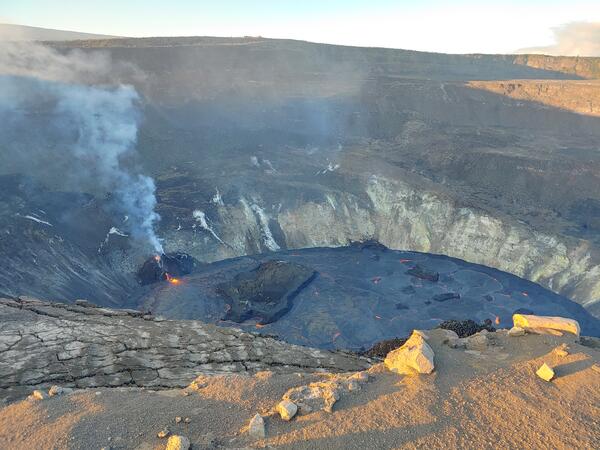
View looking north across Kīlauea caldera from the south rim of Halema‘uma‘u, showing the ongoing eruption around 5:30 p.m. HST on January 5, 2021. The west vent activity included the “dome fountain,” effusive lava flows from a mid-elevation vent, and weak strombolian spattering activity from the high-elevation vent. USGS photo by K. Lynn.
View looking north across Kīlauea caldera from the south rim of Halema‘uma‘u, showing the ongoing eruption around 5:30 p.m. HST on January 5, 2021. The west vent activity included the “dome fountain,” effusive lava flows from a mid-elevation vent, and weak strombolian spattering activity from the high-elevation vent. USGS photo by K. Lynn.

Eruptions of Steamboat Geyser over time. (A) Cumulative eruptions of Steamboat Geyser since 1960. Each dot represents an eruption. (B) Comparative plot of the cumulative eruptions in each active phase (1960s, 1980s, and 2018-). Data from GeyserTimes.
Eruptions of Steamboat Geyser over time. (A) Cumulative eruptions of Steamboat Geyser since 1960. Each dot represents an eruption. (B) Comparative plot of the cumulative eruptions in each active phase (1960s, 1980s, and 2018-). Data from GeyserTimes.

Steamboat Geyser eruption signals recorded by nearby monitoring instruments. The vertical pink lines mark when the signal first appears. (A) Seismic station YNM records a signal which slowly tapers as the eruption decreases in intensity. Spikes seen before the eruption are mostly due to human activity.
Steamboat Geyser eruption signals recorded by nearby monitoring instruments. The vertical pink lines mark when the signal first appears. (A) Seismic station YNM records a signal which slowly tapers as the eruption decreases in intensity. Spikes seen before the eruption are mostly due to human activity.

Map of seismicity (red circles) in the Yellowstone region during 2020. Gray lines are roads, red line shows the caldera boundary, Yellowstone National Park is outlined by black dashed line, and gray dashed lines denote state boundaries.
Map of seismicity (red circles) in the Yellowstone region during 2020. Gray lines are roads, red line shows the caldera boundary, Yellowstone National Park is outlined by black dashed line, and gray dashed lines denote state boundaries.

Experimental apparatus for reacting hot water and rhyolite. The photo on the left shows the inert gold bags into which the rhyolite fragments and water were inserted. After being sealed, the gold bag is then placed into a steel pressure vessel, which itself is loaded into a furnace (photo on the right).
Experimental apparatus for reacting hot water and rhyolite. The photo on the left shows the inert gold bags into which the rhyolite fragments and water were inserted. After being sealed, the gold bag is then placed into a steel pressure vessel, which itself is loaded into a furnace (photo on the right).

Ngorongoro volcano, in Tanzania, east Africa, is a caldera that formed 2-3 million years ago. The Ngorongoro Conservation Area is a UNESCO World Heritage Site and home to one of the densest concentrations of wildlife in Africa. Satellite Image from CNES/Airbus via Google Earth.
Ngorongoro volcano, in Tanzania, east Africa, is a caldera that formed 2-3 million years ago. The Ngorongoro Conservation Area is a UNESCO World Heritage Site and home to one of the densest concentrations of wildlife in Africa. Satellite Image from CNES/Airbus via Google Earth.

Section from the piston core YL92-1C, collected in south-central Yellowstone Lake. The core is viewed horizontally, with the top of core to the left. The core section shown is from 5.21–5.63 meters (17–18.4 feet) depth.
Section from the piston core YL92-1C, collected in south-central Yellowstone Lake. The core is viewed horizontally, with the top of core to the left. The core section shown is from 5.21–5.63 meters (17–18.4 feet) depth.

Beginning of Yellowstone-Snake River Plain hotspot track and resulting northeasterly path of the ancestral Missouri River starting about 16.5 million years ago. Modified from Hyndman D.W., and Thomas, R.C., 2020, Roadside Geology of Montana, Mountain Press Publishing, 464 p.
Beginning of Yellowstone-Snake River Plain hotspot track and resulting northeasterly path of the ancestral Missouri River starting about 16.5 million years ago. Modified from Hyndman D.W., and Thomas, R.C., 2020, Roadside Geology of Montana, Mountain Press Publishing, 464 p.

Absolute versus relative earthquake locations associated with 2019 Ridgecrest, California, foreshock and aftershock sequence. Animated GIF image compares the routine catalog earthquake locations with those from an enhanced catalog employing precise relative locations. Depths are color-coded as shown. Triangles indicate seismic stations.
Absolute versus relative earthquake locations associated with 2019 Ridgecrest, California, foreshock and aftershock sequence. Animated GIF image compares the routine catalog earthquake locations with those from an enhanced catalog employing precise relative locations. Depths are color-coded as shown. Triangles indicate seismic stations.

Yellowstone rangers -- and tourists, too! -- can determine the height of a geyser eruption with some simple trigonometry.
Yellowstone rangers -- and tourists, too! -- can determine the height of a geyser eruption with some simple trigonometry.

Swath bathymetric image of the Elliott’s Crater explosion crater in Yellowstone Lake. Inset shows location of the crater and the swath image (red box) within the northern part of the lake.
Swath bathymetric image of the Elliott’s Crater explosion crater in Yellowstone Lake. Inset shows location of the crater and the swath image (red box) within the northern part of the lake.

The right side of the figure is an image of a small piece of the Y-9 core from the USGS 1967-68 drilling expedition to Yellowstone National Park. The black area was analyzed using a scanning electron microscope (SEM) at the University of Wyoming to determine mineralogy and dispersion of elements.
The right side of the figure is an image of a small piece of the Y-9 core from the USGS 1967-68 drilling expedition to Yellowstone National Park. The black area was analyzed using a scanning electron microscope (SEM) at the University of Wyoming to determine mineralogy and dispersion of elements.