USGS Earth Explorer screen shot with Landsat 8 data from Yellowstone
USGS Earth Explorer screen shot with Landsat 8 data from YellowstoneUSGS Earth Explorer screen shot showing example of Landsat 8 search results over Yellowstone.


Official websites use .gov
A .gov website belongs to an official government organization in the United States.

Secure .gov websites use HTTPS
A lock () or https:// means you’ve safely connected to the .gov website. Share sensitive information only on official, secure websites.

Images related to Yellowstone Volcano Observatory.

USGS Earth Explorer screen shot showing example of Landsat 8 search results over Yellowstone.
USGS Earth Explorer screen shot showing example of Landsat 8 search results over Yellowstone.

Aerial view of the active lava lake and vents within Halema‘uma‘u crater, at the summit of Kīlauea. This view is looking to the northwest.
Aerial view of the active lava lake and vents within Halema‘uma‘u crater, at the summit of Kīlauea. This view is looking to the northwest.

Site of the former Fountain Hotel in Yellowstone National Park. Red arrows indicate the location of the pipe that ran through the meadow between Leather Pool and the site of the Fountain Hotel (yellow arrow). Yellowstone National Park photo by Annie Carlson, October 2021.
Site of the former Fountain Hotel in Yellowstone National Park. Red arrows indicate the location of the pipe that ran through the meadow between Leather Pool and the site of the Fountain Hotel (yellow arrow). Yellowstone National Park photo by Annie Carlson, October 2021.

Aerial image looking to the west of the large island that is floating within the middle of the lava lake in Halema‘uma‘u, at Kīlauea's summit. There are several vents with fountains reaching to just a few meters (yards) high. One of the vents along the eastern margin of the island has started to form spatter ramparts to enclose it. USGS photo by D. Downs.
Aerial image looking to the west of the large island that is floating within the middle of the lava lake in Halema‘uma‘u, at Kīlauea's summit. There are several vents with fountains reaching to just a few meters (yards) high. One of the vents along the eastern margin of the island has started to form spatter ramparts to enclose it. USGS photo by D. Downs.

Aerial photo taken during a morning overflight on October 1, 2021, and looking at the west end of the lava lake within Halema‘uma‘u crater, at the summit of Kīlauea. The west vent that is feeding this part of the lava lake is visible; the base of this vent was well above the lava lake when it opened on the afternoon of September 29, 2021.
Aerial photo taken during a morning overflight on October 1, 2021, and looking at the west end of the lava lake within Halema‘uma‘u crater, at the summit of Kīlauea. The west vent that is feeding this part of the lava lake is visible; the base of this vent was well above the lava lake when it opened on the afternoon of September 29, 2021.

Aerial image looking to the southwest and showing fissures within Halema‘uma‘u, at Kīlauea's summit, producing lava fountains within the southern and south-central part of the lava lake. These lava fountains are less energetic than when the eruption started on September 29, 2021, but are still spattering to heights of about 5 meters (16 ft) or less.
Aerial image looking to the southwest and showing fissures within Halema‘uma‘u, at Kīlauea's summit, producing lava fountains within the southern and south-central part of the lava lake. These lava fountains are less energetic than when the eruption started on September 29, 2021, but are still spattering to heights of about 5 meters (16 ft) or less.

Shaded relief map of Henrys Fork Caldera and vicinity. The margin of Henrys Fork Caldera is shown in blue. Note the smooth, low-relief topography within the caldera compared to the steep and dynamic topography associated with Yellowstone Caldera (at the right side of the image).
Shaded relief map of Henrys Fork Caldera and vicinity. The margin of Henrys Fork Caldera is shown in blue. Note the smooth, low-relief topography within the caldera compared to the steep and dynamic topography associated with Yellowstone Caldera (at the right side of the image).

Interferogram created from data collected on September 22, 2020, and September 17, 2021, by the Sentinel-1 satellite system. Colored fringes indicate a change in distance (called range change) between the satellite and ground surface that is caused by surface deformation.
Interferogram created from data collected on September 22, 2020, and September 17, 2021, by the Sentinel-1 satellite system. Colored fringes indicate a change in distance (called range change) between the satellite and ground surface that is caused by surface deformation.

Pore waters from Yellowstone Lake sediment cores collected in August 2021 are extracted through filtration devices into plastic syringes. Note that the second core from the left appears light in color because the plastic core liner was etched by very hot 91°C (196°F) fluids.
Pore waters from Yellowstone Lake sediment cores collected in August 2021 are extracted through filtration devices into plastic syringes. Note that the second core from the left appears light in color because the plastic core liner was etched by very hot 91°C (196°F) fluids.

Gravity coring device on the rear deck of the R/V Annie after coring the floor of Yellowstone Lake, with dark mud coating the outside of the corer. The 100-lb. green coring head is at the top, and the bottom of the barrel has a tapered stainless steel core cutter.
Gravity coring device on the rear deck of the R/V Annie after coring the floor of Yellowstone Lake, with dark mud coating the outside of the corer. The 100-lb. green coring head is at the top, and the bottom of the barrel has a tapered stainless steel core cutter.

View to the aft of the R/V Annie as it leaves Bridge Bay Marina early in the morning of August 26, 2021.
View to the aft of the R/V Annie as it leaves Bridge Bay Marina early in the morning of August 26, 2021.

A hand-sample photo of what is known to be Lava Creek Tuff “unit 2.” Small black scoria pieces are distinctive of this unit compared to the previously recognized Member A and Member B of the Lava Creek Tuff. Photo by Ray Salazar (Montana State University) on August 16, 2021.
A hand-sample photo of what is known to be Lava Creek Tuff “unit 2.” Small black scoria pieces are distinctive of this unit compared to the previously recognized Member A and Member B of the Lava Creek Tuff. Photo by Ray Salazar (Montana State University) on August 16, 2021.

Schematic displaying the general processes associated with collapse of Yellowstone Caldera. (A) Pre-caldera volcanism includes the eruption of dome complexes from the underlying magma chambers. (B) The caldera-forming eruption evacuates a significant amount of magma from the chamber, causing the overlying crustal block to subside into the void space.&nbs
Schematic displaying the general processes associated with collapse of Yellowstone Caldera. (A) Pre-caldera volcanism includes the eruption of dome complexes from the underlying magma chambers. (B) The caldera-forming eruption evacuates a significant amount of magma from the chamber, causing the overlying crustal block to subside into the void space.&nbs

“Hey Bear” volcano, Wyoming, with Raggedtop Mountain in the background. Hey Bear volcano is a small scoria cone that is about 1.3 million years old and that erupted over Eocene (~50 million-year-old) rocks (noted by yellow dotted line). Photo by Matthew Brueseke, Kansas State University, August 2021, used with permission.
“Hey Bear” volcano, Wyoming, with Raggedtop Mountain in the background. Hey Bear volcano is a small scoria cone that is about 1.3 million years old and that erupted over Eocene (~50 million-year-old) rocks (noted by yellow dotted line). Photo by Matthew Brueseke, Kansas State University, August 2021, used with permission.

Typical exposure of tabular blocks of layered ash in a matrix of cross-bedded ash. The tabular blocks were deposited, rapidly hardened, and ripped up and transported downstream along the ancestral Missouri River system with another pulse of ash and water, forming the cross-bedded matrix.
Typical exposure of tabular blocks of layered ash in a matrix of cross-bedded ash. The tabular blocks were deposited, rapidly hardened, and ripped up and transported downstream along the ancestral Missouri River system with another pulse of ash and water, forming the cross-bedded matrix.

Photograph of Twin Buttes in Lower Geyser Basin looking to the northwest, with Excelsior Geyser of Midway Geyser Basin in the foreground. Twin Buttes is a thermal kame that formed when glaciers covered the area, and hydrothermal activity below the ice led to melting and the deposition and cementation of glacial sediments.
Photograph of Twin Buttes in Lower Geyser Basin looking to the northwest, with Excelsior Geyser of Midway Geyser Basin in the foreground. Twin Buttes is a thermal kame that formed when glaciers covered the area, and hydrothermal activity below the ice led to melting and the deposition and cementation of glacial sediments.

The Yellowstone borehole geophysical network, installed by UNAVCO in 2007–2008. The placement of the boreholes is focused primarily around the caldera, and the boreholes contain a mix of instruments, including strainmeters, seismometers, tiltmeters, and pore pressure sensors.
The Yellowstone borehole geophysical network, installed by UNAVCO in 2007–2008. The placement of the boreholes is focused primarily around the caldera, and the boreholes contain a mix of instruments, including strainmeters, seismometers, tiltmeters, and pore pressure sensors.

Imperial Geyser, Lower Geyser Basin, Yellowstone National Park. USGS photo by Lauren Harrison, July 2021.
Imperial Geyser, Lower Geyser Basin, Yellowstone National Park. USGS photo by Lauren Harrison, July 2021.

Visible and thermal infrared images of Yellowstone acquired on July 17, 2021. In the visible image, Landsat 8 channels 4-3-2 are assigned red-green-blue colors (respectively) to simulate natural color. In thermal infrared image, bright pixels are warmer, and dark pixels are cooler. The full satellite images are clipped to the boundaries of Yellowst
Visible and thermal infrared images of Yellowstone acquired on July 17, 2021. In the visible image, Landsat 8 channels 4-3-2 are assigned red-green-blue colors (respectively) to simulate natural color. In thermal infrared image, bright pixels are warmer, and dark pixels are cooler. The full satellite images are clipped to the boundaries of Yellowst

Seismogram from station YTP in Yellowstone National Park showing earthquakes from the swarm beneath Yellowstone Lake that began late on July 15, 2021. Each row represents 30 minutes of seismic data.
Seismogram from station YTP in Yellowstone National Park showing earthquakes from the swarm beneath Yellowstone Lake that began late on July 15, 2021. Each row represents 30 minutes of seismic data.
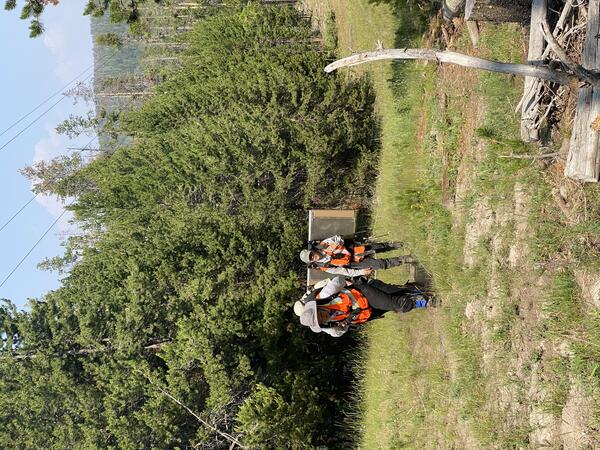
USGS scientists Laura Dobeck and Sara Peek carrying field equipment to set up a gas monitoring station in Yellowstone National Park. USGS photo by Jennifer Lewicki, July 13, 2021.
USGS scientists Laura Dobeck and Sara Peek carrying field equipment to set up a gas monitoring station in Yellowstone National Park. USGS photo by Jennifer Lewicki, July 13, 2021.