U.S. flag

An official website of the United States government

All Multimedia

Access all multimedia to include images, video, audio, webcams, before-after imagery, and more. Filter and explore with filtering options to refine search. 

Filter Total Items: 24923
Snow covered Heaven's Peak

Examples of glide avalanches on Heaven's Peak, Glacier National Park.

Giant gartersnake (Thamnophis gigas)
Threatened Giant Gartersnake (Thamnophis gigas)

Threatened giant gartersnake (Thamnophis gigas). This semi-aquatic snake lives in rice fields and the remaining wetlands of California's Central Valley.

Threatened giant gartersnake (Thamnophis gigas). This semi-aquatic snake lives in rice fields and the remaining wetlands of California's Central Valley.

USGS Status Update of Kīlauea Volcano - May 14, 2018

USGS Hawaiian Volcano Observatory status of Kilauea volcano in Hawaii on May 14, 2018 by scientist in charge Tina Neal.

employee in cable car
Cable Car
Cable Car
Cable Car

USGS staff member positioned in a cable car, ready to collect streamflow data on Pine Creek near Pinedale, Wyoming.

USGS staff member positioned in a cable car, ready to collect streamflow data on Pine Creek near Pinedale, Wyoming.

Orange spray paint on cracks in roadway
Fissure 17 — Marking cracks in roadway

At 10:31 a.m. HST. Cracks on Hwy 132 marked with orange spray paint to track changes through time.

Aerial view of a fissure erupting lava
Fissure 17 — slow sticky a'a flow emerges

At 8:00 a.m. HST. A slow sticky a'a flow emerges from a new fissure just over a half mile northeast of the end of Hinalo Street. The new fissure - fissure 17 - is about one half mile south of Hwy 132. Some reports have referred to this fissure as number 18 but that is not correct. Fissure 18 had not erupted by this time.

At 8:00 a.m. HST. A slow sticky a'a flow emerges from a new fissure just over a half mile northeast of the end of Hinalo Street. The new fissure - fissure 17 - is about one half mile south of Hwy 132. Some reports have referred to this fissure as number 18 but that is not correct. Fissure 18 had not erupted by this time.

Aerial view of a fissure in Hawaii
Fissure 18 - small outbreak

At 2:00 p.m. HST. This photo reveals a small pad of lava between Fissures 16 and 17 which did not appear in photos of the same scene taken this morning. (Red arrow points to the lava pad.) From the photo it appears that this fissure had stagnated. We have designated this small outbreak as Fissure 18.

At 2:00 p.m. HST. This photo reveals a small pad of lava between Fissures 16 and 17 which did not appear in photos of the same scene taken this morning. (Red arrow points to the lava pad.) From the photo it appears that this fissure had stagnated. We have designated this small outbreak as Fissure 18.

Kīlauea Lower East Rift Zone Fissures, May 13 at 9:00 a.m. HST...
Kīlauea LERZ Fissures, May 13 at 9:00 a.m.

Map as of 9:00 a.m. HST, May 13, shows the location of fissure 17, which opened this morning at approximately 4:30 a.m. HST. NOTE: This new fissure was initially referred to as fissure 18 in early reports, but that is incorrect (what was called fissure 17 yesterday did not erupt lava, so this morning's erupting fissure is actually 17).

Map as of 9:00 a.m. HST, May 13, shows the location of fissure 17, which opened this morning at approximately 4:30 a.m. HST. NOTE: This new fissure was initially referred to as fissure 18 in early reports, but that is incorrect (what was called fissure 17 yesterday did not erupt lava, so this morning's erupting fissure is actually 17).

Kīlauea Lower East Rift Zone Eruption (May 13, 2018)

Aerial view of fissure 17 around 4:30 p.m. HST. On the west end of the flow, intermittent percussive jetting threw spatter and lava bombs up to 500 feet above the ground. East margin of the ‘a‘ā flow was cascading into a pit or graben.

Aerial view of fissure 17 around 4:30 p.m. HST. On the west end of the flow, intermittent percussive jetting threw spatter and lava bombs up to 500 feet above the ground. East margin of the ‘a‘ā flow was cascading into a pit or graben.

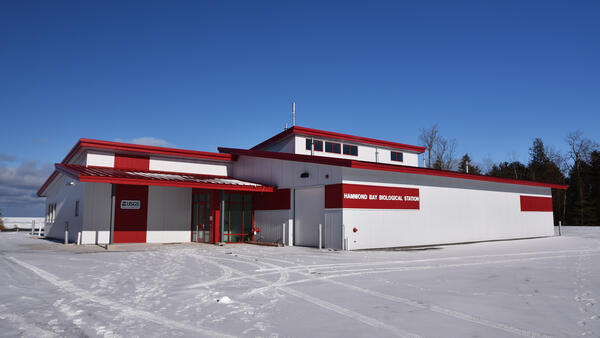
New HBBS Laboratory Building
The new Hammond Bay Biological Station laboratory building
USGS Status Update of Kīlauea Volcano - May 13, 2018
An aerial view of fissure 16, located about 1.3 km (0.8 miles) northeast of fissure 15 (top left).
An aerial view of fissure 16

5/12/18, 08:27 a.m. HST - An aerial view of fissure 16, located about 1.3 km (0.8 miles) northeast of fissure 15 (top left). The fissure is located 500 m northeast of the Puna Geothermal Venture site (top right). Photograph courtesy of Hawai`i County Fire Department.

5/12/18, 08:27 a.m. HST - An aerial view of fissure 16, located about 1.3 km (0.8 miles) northeast of fissure 15 (top left). The fissure is located 500 m northeast of the Puna Geothermal Venture site (top right). Photograph courtesy of Hawai`i County Fire Department.

Fissure 16 eruption at 12:57 p.m. HST on May 12, 2018

Fissure 16 eruption at 12:57 p.m. HST on May 12, 2018. Video by Cheryl Gansecki, University of Hawaii.

Kīlauea Lower East Rift Zone Fissures, May 12 at 12:00 p.m. HST...
Kīlauea LERZ Fissures, May 12 at 12:00 p.m.

Main map shows the location of fissure 16, as well as earlier fissures, lava flows, and steaming areas, as of 12:00 p.m. HST, May 12. Inset map shows fissures in Leilani Estates in the order they occurred since May 3. Shaded purple areas indicate lava flows erupted in 1840, 1955, 1960, and 2014-2015.

Main map shows the location of fissure 16, as well as earlier fissures, lava flows, and steaming areas, as of 12:00 p.m. HST, May 12. Inset map shows fissures in Leilani Estates in the order they occurred since May 3. Shaded purple areas indicate lava flows erupted in 1840, 1955, 1960, and 2014-2015.

USGS Status Update of Kīlauea Volcano - May 12, 2018

USGS Hawaiian Volcano Observatory status of Kilauea volcano in Hawaii on May 12, 2018 by scientist in charge Tina Neal.
 

Image of the Week - Rattlesnake Fire, AZ

Landsat and Sentinel sensors capture the Rattlesnake Fire as it burns in Arizona.

At the USGS EROS Center, we study land change, operate the Landsat satellites, and maintain the longest, continuously acquired collection of images of the Earth's land surface.

USGS EROS Center (https://eros.usgs.gov/)

Landsat and Sentinel sensors capture the Rattlesnake Fire as it burns in Arizona.

At the USGS EROS Center, we study land change, operate the Landsat satellites, and maintain the longest, continuously acquired collection of images of the Earth's land surface.

USGS EROS Center (https://eros.usgs.gov/)

It's an extraordinary time on Kīlauea Volcano! ...
It's an extraordinary time on Kīlauea!

On the morning of May 9, 2018, a large rockfall in "Overlook crater" within Halema‘uma‘u at the summit of Kīlauea triggered a gas-driven explosion that sent an ash plume several thousand feet skyward. Phreatic (steam-driven) explosions can create larger ash plumes; the 1924 explosions sent ash plumes up to 20,000 feet high. USGS photo.

On the morning of May 9, 2018, a large rockfall in "Overlook crater" within Halema‘uma‘u at the summit of Kīlauea triggered a gas-driven explosion that sent an ash plume several thousand feet skyward. Phreatic (steam-driven) explosions can create larger ash plumes; the 1924 explosions sent ash plumes up to 20,000 feet high. USGS photo.

It's an extraordinary time on Kīlauea Volcano! ...
It's an extraordinary time on Kīlauea!

To help us understand what could happen at Kīlauea Volcano's summit, we look to past similar events, but this does not mean that future events will be exactly the same. This map shows the distribution of ballistics and tephra from the 1924 phreatic (steam-driven) explosions.

To help us understand what could happen at Kīlauea Volcano's summit, we look to past similar events, but this does not mean that future events will be exactly the same. This map shows the distribution of ballistics and tephra from the 1924 phreatic (steam-driven) explosions.

Was this page helpful?