Adult Pacific salmon caught in impounded water above beaver dam
Adult Pacific salmon caught in impounded water above beaver damAdult Pacific salmon (Oncorhynchus nerka) caught in impounded water above beaver dam. >25 rKM (river KM) from coast.


Official websites use .gov
A .gov website belongs to an official government organization in the United States.

Secure .gov websites use HTTPS
A lock () or https:// means you’ve safely connected to the .gov website. Share sensitive information only on official, secure websites.

Explore our planet through photography and imagery, including climate change and water all the way back to the 1800s when the USGS was surveying the country by horse and buggy.

Adult Pacific salmon (Oncorhynchus nerka) caught in impounded water above beaver dam. >25 rKM (river KM) from coast.
Adult Pacific salmon (Oncorhynchus nerka) caught in impounded water above beaver dam. >25 rKM (river KM) from coast.

U.S. Geological Survey hydrologic technician Mike Michelotti measures streamflow on the South Fork Coeur d'Alene River at Elizabeth Park near Kellogg, Idaho, October 9, 2019. The USGS operates streamgage station 12413210 in cooperation with the U.S. Environmental Protection Agency.
U.S. Geological Survey hydrologic technician Mike Michelotti measures streamflow on the South Fork Coeur d'Alene River at Elizabeth Park near Kellogg, Idaho, October 9, 2019. The USGS operates streamgage station 12413210 in cooperation with the U.S. Environmental Protection Agency.

Mike Michelotti is making a winter stream flow measurement using a flow tracker at stream gage 12413210 South Fork Coeur D' Alene River at Elizabeth Park near Kellogg, ID.
Mike Michelotti is making a winter stream flow measurement using a flow tracker at stream gage 12413210 South Fork Coeur D' Alene River at Elizabeth Park near Kellogg, ID.

USGS staffer Matthew Jennings collecting water quality samples on the lower Niagara River for the Great Lakes Restoration Initiative (GLRI) project. Photo by John Wernly (Public domain)
USGS staffer Matthew Jennings collecting water quality samples on the lower Niagara River for the Great Lakes Restoration Initiative (GLRI) project. Photo by John Wernly (Public domain)

什么是水循环?
什么是水循环?回答这个问题非常容易 ---水循环通常也被称为"水分循环"或"水文循环",是指水在地球上、地球中以及地球上空的存在及运动情况。地球的水处于不停地运动中,并且不停地变换着存在形式,从液体变成水蒸气再变成冰,然后再循环往复。水循环已经持续了几十亿年,地球上的所有生命都依赖于水循环。如果没有水循环,地球将会是一个毫无生气的地方。
什么是水循环?
什么是水循环?回答这个问题非常容易 ---水循环通常也被称为"水分循环"或"水文循环",是指水在地球上、地球中以及地球上空的存在及运动情况。地球的水处于不停地运动中,并且不停地变换着存在形式,从液体变成水蒸气再变成冰,然后再循环往复。水循环已经持续了几十亿年,地球上的所有生命都依赖于水循环。如果没有水循环,地球将会是一个毫无生气的地方。

El Ciclo del Agua

Puhimau thermal area has the largest naturally occurring population of the endangered plant, Portulaca sclerocarpa (marked by the blue flag in the photo), and is the site of National Park Service restoration efforts for this species.
Puhimau thermal area has the largest naturally occurring population of the endangered plant, Portulaca sclerocarpa (marked by the blue flag in the photo), and is the site of National Park Service restoration efforts for this species.

This Sierra Marten was caught on wildlife camera in October. The camera was set up to study animal movement under a new road crossing structure known as the “toad road” in Sierra National Forest. The Sierra marten (Martes caurina sierra) is a mammal in the weasel family about the size of a house cat.
This Sierra Marten was caught on wildlife camera in October. The camera was set up to study animal movement under a new road crossing structure known as the “toad road” in Sierra National Forest. The Sierra marten (Martes caurina sierra) is a mammal in the weasel family about the size of a house cat.

Fall time descends on Southwest Utah. The changing fall leaves coupled with blue skies and red rock backdrop make for a beautiful morning for a discharge measurement at the Coal Creek near Cedar City, Utah stream gage 10242000.
Fall time descends on Southwest Utah. The changing fall leaves coupled with blue skies and red rock backdrop make for a beautiful morning for a discharge measurement at the Coal Creek near Cedar City, Utah stream gage 10242000.

U.S. Geological Survey hydrologist Tyler King helps a citizen volunteer test a water sample for dissolved oxygen as part of the 2019 Watershed Watch in the lower Boise River watershed of southwestern Idaho. Watershed Watch is an annual citizen science event sponsored by the City of Boise. The USGS is an event co-sponsor.
U.S. Geological Survey hydrologist Tyler King helps a citizen volunteer test a water sample for dissolved oxygen as part of the 2019 Watershed Watch in the lower Boise River watershed of southwestern Idaho. Watershed Watch is an annual citizen science event sponsored by the City of Boise. The USGS is an event co-sponsor.

USGS scientists Brandon Nasr, Jenna Hill, Nora Nieminski, and Jenny McKee removing a sediment-filled core liner from the jumbo piston core barrel with the picturesque northern California coastline in the background.
USGS scientists Brandon Nasr, Jenna Hill, Nora Nieminski, and Jenny McKee removing a sediment-filled core liner from the jumbo piston core barrel with the picturesque northern California coastline in the background.

UCSC student Travis Alonghi and USGS scientist Danny Brothers deploying the Chirp sub-bottom profiler at sunset from M/V Bold Horizon.
UCSC student Travis Alonghi and USGS scientist Danny Brothers deploying the Chirp sub-bottom profiler at sunset from M/V Bold Horizon.

The USGS Coastal and Estuarine Dynamics Group will be deploying a cross shore array at Pea Island, various intruments will be connected to the poles to measure oceanographic conditions
The USGS Coastal and Estuarine Dynamics Group will be deploying a cross shore array at Pea Island, various intruments will be connected to the poles to measure oceanographic conditions

The Field trip guide to Mount St. Helens, Washington—Recent and ancient volcaniclastic processes and deposits is available in the USGS Publications Warehouse, at https://doi.org/10.3133/sir20175022E.
The Field trip guide to Mount St. Helens, Washington—Recent and ancient volcaniclastic processes and deposits is available in the USGS Publications Warehouse, at https://doi.org/10.3133/sir20175022E.

Geophysicist Sarah Conway, a member of the USGS Hawaiian Volcano Observatory's deformation team, readies a temporary GPS station during a campaign survey of benchmarks on Kīlauea Volcano to monitor changes in the ground surface.
Geophysicist Sarah Conway, a member of the USGS Hawaiian Volcano Observatory's deformation team, readies a temporary GPS station during a campaign survey of benchmarks on Kīlauea Volcano to monitor changes in the ground surface.

Adult Sage Thrasher waiting to deliver food to its nestlings.
Adult Sage Thrasher waiting to deliver food to its nestlings.

USGS scientists Nora Nieminski, Jenna Hill, and Brandon Nasr working to cap and secure a trigger core on deck. Trigger cores can provide important information about seafloor sediments just below the seafloor
USGS scientists Nora Nieminski, Jenna Hill, and Brandon Nasr working to cap and secure a trigger core on deck. Trigger cores can provide important information about seafloor sediments just below the seafloor

The crew of research vessel Bold Horizon with USGS science crew prepare to launch the Chirp sub-bottom profiler off the west coast near northern California and southern Oregon.
The crew of research vessel Bold Horizon with USGS science crew prepare to launch the Chirp sub-bottom profiler off the west coast near northern California and southern Oregon.
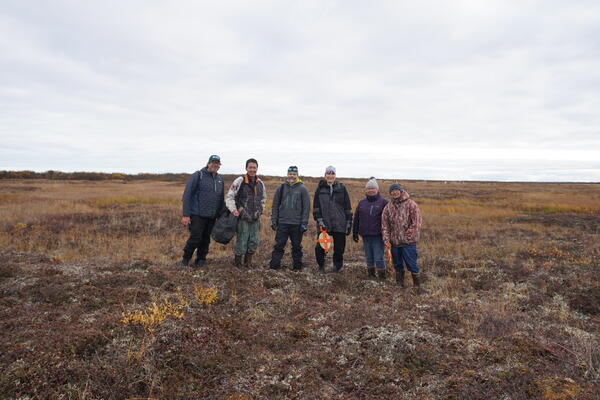
From left to right: Ryan Toohey, Bernard TKTKTK, Jeremy Littell (AK CASC Lead Scientist), Malinda Chase (AK CASC Tribal Liaison), Philomena Keyes, and Victor Tonuchuk, Jr. at the Active Layer Network site in Kotlik, Alaska.
From left to right: Ryan Toohey, Bernard TKTKTK, Jeremy Littell (AK CASC Lead Scientist), Malinda Chase (AK CASC Tribal Liaison), Philomena Keyes, and Victor Tonuchuk, Jr. at the Active Layer Network site in Kotlik, Alaska.

USGS scientists Pete Dal Ferro and Jenny McKee securing a recently collected jumbo piston core (JPC) on the back deck of M/V Bold Horizon for preliminary core processing.
USGS scientists Pete Dal Ferro and Jenny McKee securing a recently collected jumbo piston core (JPC) on the back deck of M/V Bold Horizon for preliminary core processing.
