Zombie Salmon and Ghost Moose - The Spooky Implications of Climate Change
By Laura Thompson & Abigail Lynch, USGS National Climate Adaptation Science Center


Official websites use .gov
A .gov website belongs to an official government organization in the United States.

Secure .gov websites use HTTPS
A lock () or https:// means you’ve safely connected to the .gov website. Share sensitive information only on official, secure websites.

Explore a diverse collection of engaging videos showcasing the latest research, discoveries, and educational content from the U.S. Geological Survey. Dive into the fascinating world of geology, hydrology, ecology, and natural hazards as we bring science to life. Stay informed and inspired by our visual storytelling that highlights the vital work of USGS scientists and their impact on the planet.

Zombie Salmon and Ghost Moose - The Spooky Implications of Climate Change
By Laura Thompson & Abigail Lynch, USGS National Climate Adaptation Science Center
Zombie Salmon and Ghost Moose - The Spooky Implications of Climate Change
By Laura Thompson & Abigail Lynch, USGS National Climate Adaptation Science Center

The granitic cliffs of Yosemite Valley produce frequent rockfalls, modifying the landscape but also posing risk to park visitors. Analyses of terrestrial lidar and historical structure-from-motion photogrammetry data provide relatively precise short-term (approximately 40 years) rates of rockfall and cliff retreat.
The granitic cliffs of Yosemite Valley produce frequent rockfalls, modifying the landscape but also posing risk to park visitors. Analyses of terrestrial lidar and historical structure-from-motion photogrammetry data provide relatively precise short-term (approximately 40 years) rates of rockfall and cliff retreat.

The volcanic activity of Kilauea continues on the island of Hawaii. The latest eruption began within Halema'uma'u Crater on September 29. The previous eruption just ended in May 2021. Before that, major lava flows covered the eastern tip of Hawaii's Big Island in 2018. This latest eruption included vigorous fountaining up to 50-60m high.
The volcanic activity of Kilauea continues on the island of Hawaii. The latest eruption began within Halema'uma'u Crater on September 29. The previous eruption just ended in May 2021. Before that, major lava flows covered the eastern tip of Hawaii's Big Island in 2018. This latest eruption included vigorous fountaining up to 50-60m high.

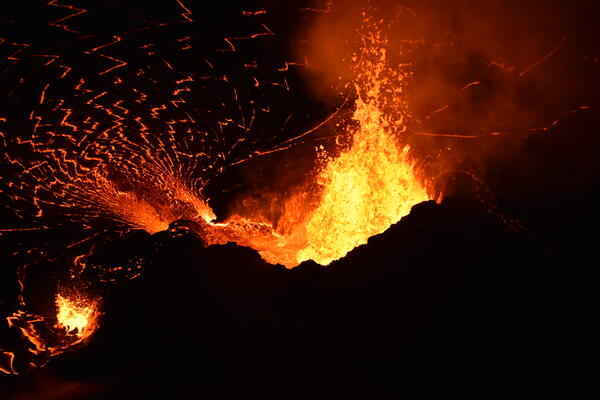
Eruptive activity continues in Halema‘uma‘u crater, at the summit of Kīlauea. The west vent remains active with low fountaining in a slightly perched pond set within the cone. Lava pours through a short spillway into the lava lake.
Eruptive activity continues in Halema‘uma‘u crater, at the summit of Kīlauea. The west vent remains active with low fountaining in a slightly perched pond set within the cone. Lava pours through a short spillway into the lava lake.

Morning views of the eruption within Halema‘uma‘u crater, at Kīlauea summit, on October 23, 2021. Variable west vent fountain heights are visible in this video, which is shown at 5 times speed.
Morning views of the eruption within Halema‘uma‘u crater, at Kīlauea summit, on October 23, 2021. Variable west vent fountain heights are visible in this video, which is shown at 5 times speed.

Morning views of the eruption within Halema‘uma‘u crater, at Kīlauea summit, on October 23, 2021. This view is from the south rim of the crater. Lava continues to erupt from a single vent on the western wall of the crater. Lava fountains within the cone and spills out of the cone opening, flowing east into the lake.
Morning views of the eruption within Halema‘uma‘u crater, at Kīlauea summit, on October 23, 2021. This view is from the south rim of the crater. Lava continues to erupt from a single vent on the western wall of the crater. Lava fountains within the cone and spills out of the cone opening, flowing east into the lake.

Understanding of rockfall frequency-magnitude relationships is important for managing rockfall hazards, but characterizing these relationships is a challenging problem due to limited data, limited access, and the difficulty of accurately dating historic rockfalls.
Understanding of rockfall frequency-magnitude relationships is important for managing rockfall hazards, but characterizing these relationships is a challenging problem due to limited data, limited access, and the difficulty of accurately dating historic rockfalls.

A morning overflight of Kīlauea summit on October 15, 2021, provided aerial views of the eruption within Halema‘uma‘u. Lava erupts from a single vent on the western wall of the crater. The vent has a spatter cone around it, with an opening to the east from which lava flows into the lava lake.
A morning overflight of Kīlauea summit on October 15, 2021, provided aerial views of the eruption within Halema‘uma‘u. Lava erupts from a single vent on the western wall of the crater. The vent has a spatter cone around it, with an opening to the east from which lava flows into the lava lake.


We had an amazing turnout for our public webinar on Wednesday, October 13th, 2021 – 450 total attendees!
We had an amazing turnout for our public webinar on Wednesday, October 13th, 2021 – 450 total attendees!

This is an animation showing the changing conditions of USGS streamgages from July 1, 2021 to September 30, 2021. The river conditions shown range from the driest condition seen at a gage (red open circles) to the wettest (blue closed circles). A purple outer ring around a gage indicates it is flooding.
This is an animation showing the changing conditions of USGS streamgages from July 1, 2021 to September 30, 2021. The river conditions shown range from the driest condition seen at a gage (red open circles) to the wettest (blue closed circles). A purple outer ring around a gage indicates it is flooding.
Eruptive activity continues at the west vent in Halema‘uma‘u crater, at the summit of Kīlauea. When this video was taken on October 12, a small subordinate vent was present on the north side of the main fountaining vent. The main fountaining source was supplying lava into the lake via a short spillway.
Eruptive activity continues at the west vent in Halema‘uma‘u crater, at the summit of Kīlauea. When this video was taken on October 12, a small subordinate vent was present on the north side of the main fountaining vent. The main fountaining source was supplying lava into the lake via a short spillway.

The eruption continues within Halema‘uma‘u crater, at the summit of Kīlauea. The western vent supplies lava into the lava lake through a short spillway. Consistent fountain heights of 10–15 meters (30–50 ft) were interrupted by frequent larger busts of spatter exceeding the height of the cone (30 m or 100 ft).
The eruption continues within Halema‘uma‘u crater, at the summit of Kīlauea. The western vent supplies lava into the lava lake through a short spillway. Consistent fountain heights of 10–15 meters (30–50 ft) were interrupted by frequent larger busts of spatter exceeding the height of the cone (30 m or 100 ft).

Lava continues to erupt from the western vent in Halema‘uma‘u. On October 12, a short-lived vent (erupting for approximately 10 hours) was present to the north of the main vent (right). Lava fountaining from the main vent was 10–15 meters (30–50 ft) above the lake surface, with larger bursts exceeding the height of the cone (30 meters or 100 ft).
Lava continues to erupt from the western vent in Halema‘uma‘u. On October 12, a short-lived vent (erupting for approximately 10 hours) was present to the north of the main vent (right). Lava fountaining from the main vent was 10–15 meters (30–50 ft) above the lake surface, with larger bursts exceeding the height of the cone (30 meters or 100 ft).

Kīlauea summit eruption lava fountain height in Halema‘uma‘u crater on October 10, 2021 was highly variable. A persistent low fountain a few meters (yards) tall was frequently interrupted by larger series of bursts throwing lava more than 15 meters (50 feet) into the air and onto the interior walls of the vent cone.
Kīlauea summit eruption lava fountain height in Halema‘uma‘u crater on October 10, 2021 was highly variable. A persistent low fountain a few meters (yards) tall was frequently interrupted by larger series of bursts throwing lava more than 15 meters (50 feet) into the air and onto the interior walls of the vent cone.

An HVO geologist makes observations, collects data, and maintains instruments during the ongoing eruption within Halema'uma'u.
An HVO geologist makes observations, collects data, and maintains instruments during the ongoing eruption within Halema'uma'u.

The eruption continues in Halema‘uma‘u crater, at the summit of Kīlauea. Lava fountaining no longer emerges from the central portion of the lake, with fountaining limited to the west vent shown here. Low fountaining within the cone supplies lava into the lake via a short spillway.
The eruption continues in Halema‘uma‘u crater, at the summit of Kīlauea. Lava fountaining no longer emerges from the central portion of the lake, with fountaining limited to the west vent shown here. Low fountaining within the cone supplies lava into the lake via a short spillway.

Fissures opened on the Cumbre Vieja volcano on September 19. It's the first time it has erupted since 1971.
Fissures opened on the Cumbre Vieja volcano on September 19. It's the first time it has erupted since 1971.

Lava fountains from the western fissure vent in the Halema‘uma‘u crater wall, at Kīlauea's summit during the ongoing eruption. The shaking at the end of the video is due to strong wind gusts moving the tripod. This video clip was recorded on October 5, 2021, from the southern crater rim.
Lava fountains from the western fissure vent in the Halema‘uma‘u crater wall, at Kīlauea's summit during the ongoing eruption. The shaking at the end of the video is due to strong wind gusts moving the tripod. This video clip was recorded on October 5, 2021, from the southern crater rim.

The eruption continues in Halema‘uma‘u crater, at the summit of Kīlauea. This video shows the dominant fountain at the west vent, from two different angles, as well as the smaller fountaining source emerging through the lava lake.
The eruption continues in Halema‘uma‘u crater, at the summit of Kīlauea. This video shows the dominant fountain at the west vent, from two different angles, as well as the smaller fountaining source emerging through the lava lake.