U.S. flag

An official website of the United States government

Images

Volcano Hazard Program images.

Filter Total Items: 6262
Rising summit lava lake level improves views of spattering...
Rising summit lava lake level improves views of spattering

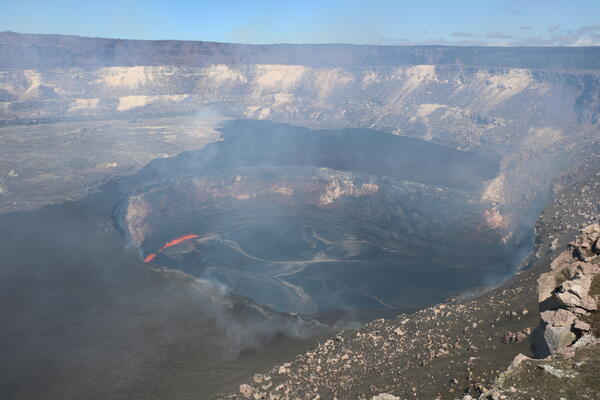
Kīlauea Volcano's summit lava lake level rose over the past day with steep summit inflation, providing improved views of spattering from visitor overlooks in Hawai‘i Volcanoes National Park.

Kīlauea Volcano's summit lava lake level rose over the past day with steep summit inflation, providing improved views of spattering from visitor overlooks in Hawai‘i Volcanoes National Park.

Exploring USGS volcano observatories—Part 3: California...
Exploring USGS volcano observatories—Part 3: CA

Mount Shasta, a steep-sided Cascade Range stratovolcano in Northern California, looms above Little Glass Mountain, a thick obsidian flow erupted from the Medicine Lake shield volcano about 1,000 years ago. These are just two of the 19 young volcanic areas monitored by the USGS California Volcano Observatory (CalVO).

Mount Shasta, a steep-sided Cascade Range stratovolcano in Northern California, looms above Little Glass Mountain, a thick obsidian flow erupted from the Medicine Lake shield volcano about 1,000 years ago. These are just two of the 19 young volcanic areas monitored by the USGS California Volcano Observatory (CalVO).

pattering along a down-welling section of Kīlauea Volcano's summit lava lake
Spattering along a down-welling section of Kīlauea Volcano's summit

This telephoto image from January 19, 2017, shows spattering along a down-welling section of Kīlauea Volcano's summit lava lake. The main area of spattering was about 10 m (32 ft) high, but some lava fragments were thrown even higher.

This telephoto image from January 19, 2017, shows spattering along a down-welling section of Kīlauea Volcano's summit lava lake. The main area of spattering was about 10 m (32 ft) high, but some lava fragments were thrown even higher.

Lower level of Kīlauea's summit lava lake exposes vent wall...
Lower level of Kīlauea's summit lava lake exposes vent wall

The summit lava lake within Halema‘uma‘u Crater today (Jan. 15, 2017) was about 50.5 m (166 ft) below the crater floor (vent rim). One of the most interesting things exposed by the lower lake level was the clear view of the thick, dark veneer of lava on the eastern vent wall (close-up shown below).

The summit lava lake within Halema‘uma‘u Crater today (Jan. 15, 2017) was about 50.5 m (166 ft) below the crater floor (vent rim). One of the most interesting things exposed by the lower lake level was the clear view of the thick, dark veneer of lava on the eastern vent wall (close-up shown below).

In places, the dark-colored veneer of lava, or bathtub rings, have ...

In places, the dark-colored veneer of lava, or bathtub rings, have already collapsed into the lava lake, exposing older, light- or rusty-colored rocks in the vent wall. The lava lake surface is visible in the foreground. The distance from the vent rim to the lake surface is 50.5 m (166 ft).

In places, the dark-colored veneer of lava, or bathtub rings, have already collapsed into the lava lake, exposing older, light- or rusty-colored rocks in the vent wall. The lava lake surface is visible in the foreground. The distance from the vent rim to the lake surface is 50.5 m (166 ft).

Telephoto image of the lava veneer on the 50.5 m (166 ft) tall east...

Telephoto image of the lava veneer on the 50.5 m (166 ft) tall eastern vent wall; the lava lake surface is visible at lower left. The solidified lava coating the vent wall is quite thick.

On the left is a normal photograph of the ocean entry, which produc...

On the left is a normal photograph of the ocean entry, which produces a robust steam plume and an area of discolored water extending out from the entry point. The thermal image on the right shows how this area of discolored water corresponds to scalding water temperatures.

On the left is a normal photograph of the ocean entry, which produces a robust steam plume and an area of discolored water extending out from the entry point. The thermal image on the right shows how this area of discolored water corresponds to scalding water temperatures.

A close up view of where approximately 4 acres of old sea cliff fel...

A close up view of where approximately 4 acres of old sea cliff fell into the ocean during the delta collapse on December 31. The far eastern end of this collapse (right), is where the old public viewing area was located prior to the collapse.

A close up view of where approximately 4 acres of old sea cliff fell into the ocean during the delta collapse on December 31. The far eastern end of this collapse (right), is where the old public viewing area was located prior to the collapse.

Another view of the ocean entry, with the plume of hot water extend...
ocean entry, with the plume of hot water extending out from the oce...
November 21 breakout remains active and Kamokuna ocean entry contin...
Nov. 21 breakout remains active and Kamokuna ocean entry continues

The November 21 breakout from the episode 61g lava flow remains active. The tip is 2.4 km (1.5 mi) straight-line from the vent, and the furthest active lava is roughly 600 m (660 yd) back from the tip. The breakout, extending to the lower right of the image, can be identified by its light silver color. Pu‘u ‘Ō‘ō is visible in the upper left of the photo.

The November 21 breakout from the episode 61g lava flow remains active. The tip is 2.4 km (1.5 mi) straight-line from the vent, and the furthest active lava is roughly 600 m (660 yd) back from the tip. The breakout, extending to the lower right of the image, can be identified by its light silver color. Pu‘u ‘Ō‘ō is visible in the upper left of the photo.

The Kamokuna ocean entry remains active. On December 31, approximat...
The Kamokuna ocean entry remains active. On Dec. 31, approximately ...

The Kamokuna ocean entry remains active. On December 31, approximately 21 acres of delta collapsed into the ocean. The remaining ~2.5 acres can be seen at the base of the sea cliff in long narrow sections. On the lower right of the photo, a scarp is visible where a portion of the old sea cliff collapsed.

The Kamokuna ocean entry remains active. On December 31, approximately 21 acres of delta collapsed into the ocean. The remaining ~2.5 acres can be seen at the base of the sea cliff in long narrow sections. On the lower right of the photo, a scarp is visible where a portion of the old sea cliff collapsed.

Map of flow field...
Map of flow field
Map of flow field
Map of flow field

This map shows recent changes to Kīlauea's East Rift Zone lava flow field. The area of the active flow field as of December 14 is shown in pink, while widening and advancement of the active flow as of January 12 is shown in red. Older Pu‘u ‘Ō‘ō lava flows (1983-2016) are shown in gray.

This map shows recent changes to Kīlauea's East Rift Zone lava flow field. The area of the active flow field as of December 14 is shown in pink, while widening and advancement of the active flow as of January 12 is shown in red. Older Pu‘u ‘Ō‘ō lava flows (1983-2016) are shown in gray.

Exploring USGS volcano observatories—Part 2: Alaska...
Exploring USGS volcano observatories—Part 2: AK

Redoubt Volcano, shown here on April 4, 2009, is just one of the more than 50 historically active volcanoes monitored by the Alaska Volcano Observatory (AVO). Gray ash draping the flanks of the volcano creates a stark contrast to the surrounding snow-covered landscape and white steam rising from Redoubt's summit crater.

Redoubt Volcano, shown here on April 4, 2009, is just one of the more than 50 historically active volcanoes monitored by the Alaska Volcano Observatory (AVO). Gray ash draping the flanks of the volcano creates a stark contrast to the surrounding snow-covered landscape and white steam rising from Redoubt's summit crater.

Annotated aerial photo of crescent shaped island surrounded by open ocean.
Annotated photo of Bogoslof Island showing effects of eruption

Annotated photograph of Bogoslof Island showing the cumulative effects of 2016-17 eruptive activity. A layer of fine muddy appearing ash drapes most of the landscape and covers pre-existing vegetation. The dashed line indicates the area excavated by explosive eruptive activity so far.

Annotated photograph of Bogoslof Island showing the cumulative effects of 2016-17 eruptive activity. A layer of fine muddy appearing ash drapes most of the landscape and covers pre-existing vegetation. The dashed line indicates the area excavated by explosive eruptive activity so far.

How well do you know USGS volcano observatories? Part 1: Cascades...
How well do you know USGS volcano observatories? Part 1: Cascades

Mount St. Helens in December 2004, a few months after the start of the volcano's most recent eruption, as seen from the Johnston Ridge Observatory in Mount St. Helens National Volcanic Monument in Washington. Inset: The USGS Cascades Volcano Observatory in Vancouver, WA, monitors volcanoes in Washington, Oregon, and Idaho. USGS photos.

Mount St. Helens in December 2004, a few months after the start of the volcano's most recent eruption, as seen from the Johnston Ridge Observatory in Mount St. Helens National Volcanic Monument in Washington. Inset: The USGS Cascades Volcano Observatory in Vancouver, WA, monitors volcanoes in Washington, Oregon, and Idaho. USGS photos.

A glove provides scale for spatter (lighter gray, shiny fragments) ...

A glove provides scale for spatter (lighter gray, shiny fragments) that landed on the sea cliff above the Kamokuna ocean entry.

Pele's hair, filaments of volcanic glass, formed from the explosive...

Pele's hair, filaments of volcanic glass, formed from the explosive interaction of hot lava entering the ocean, accumulates on the lava surface above the ocean entry. Some is also blown far downwind of the ocean entry.

Pele's hair, filaments of volcanic glass, formed from the explosive interaction of hot lava entering the ocean, accumulates on the lava surface above the ocean entry. Some is also blown far downwind of the ocean entry.

A telephoto lens captured the cascade of lava streaming from the la...

A telephoto lens captured the cascade of lava streaming from the lava tube. Hot lava mixing with cool seawater produces an explosive interaction that results in fragmented lava—spatter, Pele's hair, and black sand—flying upward, landing on the sea cliff above the ocean entry and being thrown seaward.

A telephoto lens captured the cascade of lava streaming from the lava tube. Hot lava mixing with cool seawater produces an explosive interaction that results in fragmented lava—spatter, Pele's hair, and black sand—flying upward, landing on the sea cliff above the ocean entry and being thrown seaward.

Ongoing activity at Kamokuna ocean entry...
Ongoing activity at Kamokuna ocean entry

Part of what's left of the eastern Kamokuna lava delta following the New Year's Eve collapse can be seen in the center foreground of this image. Visible cracks on the surface of this rocky shelf indicate potential instability and serve as reminders for visitors to the lava viewing area to heed all warning signs.

Part of what's left of the eastern Kamokuna lava delta following the New Year's Eve collapse can be seen in the center foreground of this image. Visible cracks on the surface of this rocky shelf indicate potential instability and serve as reminders for visitors to the lava viewing area to heed all warning signs.

A closer view of lava cascading from the lava tube at the Kamokuna ...

A closer view of lava cascading from the lava tube at the Kamokuna ocean entry, with spatter (fragments of molten lava) and black sand (volcanic glass) being thrown skyward.

Was this page helpful?