



Other Landscapes
Other Landscapes
Featured News
New Toolkit Helps Managers Create Connected Landscapes Robust to Climate Change
New Toolkit Helps Managers Create Connected Landscapes Robust to Climate Change
Featured Project
Developing a Cave Conservation Management Toolbox by Exploring Cave Microclimates and Biodiversity Patterns
Developing a Cave Conservation Management Toolbox by Exploring Cave Microclimates and Biodiversity Patterns
Landscapes such as drylands, sagebrush, and even underground networks of caves are impacted by climate change. CASC scientists use a variety of research tools to understand how these unique landscapes are altered by factors such as drought or sea level rise. Learn more about their work below.
Filter Total Items: 195
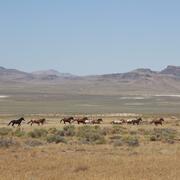
Science for management of America’s iconic wild horses and burros
Wild horses and burros are iconic wildlife of the western USA as well as a complicated management issue on tribal, state, and federal lands. Due to their history as domesticated animals, these wild equids – also called “free-roaming” or “feral” equids – can reproduce quickly, and have few natural predators, allowing their populations to grow rapidly if not managed. When populations are too large...

Future of Species Range Shifts: Quantifying and Projecting the Effects of Climate Change on the Summer Behavior and Distribution of the Porcupine Caribou Herd in Arctic Alaska
Declines in many barren-ground caribou herds across North America have coincided with the ‘greening of the Arctic’, raising concerns about the influence of changing summer habitat conditions on caribou, and the subsequent effects on Indigenous communities that rely on caribou for subsistence. These cocerns have been compounded by plans and proposals to expand energy development into...

Effects of global change on alpine and subalpine ecosystems
Atmospheric nitrogen deposition, changing environmental patterns, and recreation are rapidly altering high elevation ecosystems. This project will evaluate long-term biogeochemical, hydrological, and ecological trends in Rocky Mountain National Park to understand the causes and rates of change in alpine and subalpine waters, soils, and vegetation. Resource managers of high-elevation, protected...

After the Dams: Fire Impacts and Restoration Opportunities for a Culturally Important Klamath River Willow
Project Overview The sandbar willow of the Klamath River is used within the Karuk Tribe’s ongoing cultural practices of basketweaving. The willow has been threatened by intensifying fire and dams, but restoration and the recent historical dam removals provide an opportunity to increase the quantity, quality, and access to this important resource. Researchers supported by this Southwest...
Building Climate-Resilient Rangelands Amidst Fire, Grazing, and Ecological Invasion in California
Rangelands in California face significant challenges from climate change, wildfires, and invasive species, threatening their productivity and the benefits they provide to local communities. Researchers supported by this Southwest CASC project will develop a management framework for restoring climate-resilient rangelands in California by examining interactions between fire, grazing, and...

Forecasting Changes in Avian Biodiversity Under Changing Climate
Infrastructure development and climate change pose significant threats to migratory bird populations by altering their distributions and habitat. This Northeast CASC-supported research team will use citizen-science and structured monitoring data to identify current and future areas that are important for migratory bird species across the Northeastern US. Researchers will produce high...
Monitoring of the ʻEkupuʻu (Laysan finch) on Eastern Island, Midway Atoll National Wildlife Refuge
Project Overview Hawaiian honeycreepers face numerous threats related to sea level rise, increasing storm frequency, erosion and invasive species. These impacts can alter their habitat, making it unsuitable and detrimental to their already small populations. Researchers supported by this Pacific Islands CASC project will create additional populations of a Hawaiian honeycreeper species by
Restoring Hawai‘i’s Wetlands and Investigating Potential Impacts from Climate Change
Project Overview The James Campbell National Wildlife Refuge in Hawai’i provides important wetland habitats for four species of endangered waterbirds. However, due to invasive species and climate change impacts, these habitats are becoming unsuitable for the fledging and longevity of these birds. Researchers supported by this Pacific Islands CASC project will examine the effectiveness of
Using Historical Data to Track Long Term Climate Impacted Trends and Resilience in Atoll Landscapes and Biodiversity
Project Overview Atolls in the tropical Pacific and Indian Oceans are experiencing significant changes to their landscapes and biodiversity due to climate change. Researchers supported by this Pacific Islands CASC will use historical data to study a 50+ year window of change in both islet size and the occurrence of lizard species. This work will better inform lizard distribution in light...

Soil-climate for Managing Sagebrush Ecosystems
Soil-climate describes the temperature and moisture conditions important for plant growth and function. Soil condition patterns determine which vegetation is most abundant, thus controlling which habitats, invasive species, fuels, and economic activities are present in a region. Here, we use a model to simulate the vertical movement of water in a soil profile to provide insights into landscape...

Advancing Climate Change Adaptation Strategies for High Elevation and Endangered Lowland Coquí Frogs in the U.S. Caribbean
Amphibians in the US Caribbean, like the well-known coquí frog, are particularly vulnerable to climate change. Coquí frogs are represented by 17 species across Puerto Rico and US Virgin Islands and include several mountainous and coastal species that are threatened by extreme heat and drying, loss of coastal freshwater marshes through saltwater intrusion, or both. Over the past decade...

Climate Adaptation in North Central Mountain Ecosystems
Mountain ecosystems are prioritized by the North Central CASC due to the provided water resources, recreation opportunities, and endemic biodiversity. Mountain ecosystems are vulnerable to climate change due to elevation-dependent warming, loss of snowpack, reduction in physical area at higher elevations, and general sensitivity of alpine species to climate. Current climate adaptation...