



Typhoon Merbok Disaster Recovery Project: Accomplishments
Typhoon Merbok storm waves in Nome
Typhoon Merbok storm surge damage
The Typhoon Merbok Disaster Emergency Recovery Efforts project addresses critical data and capacity gaps in coastal Alaska by generating high resolution environmental datasets, hazard analyses, and monitoring tools needed to quantify erosion, flooding, and permafrost-related risks at the community scale.
Supported by Title VII of Division N of the Consolidated Appropriations Act, 2023, and in collaboration with state, federal, nonprofit, and local partners, we produced information on future flood and erosion hazards, real-time storm impacts, long-term shoreline change, and other foundational indicators that strengthen the scientific basis for risk assessments and infrastructure planning. These science products are designed to improve decision-relevant understanding of coastal hazards and to support engineers, planners, and community leadership in developing durable, evidence-based risk-reduction strategies.
Planning for future coastal hazards and risk
Preparing for an approaching storm
Foundational data
Coastal erosion from extreme storms
End-user engagement
Links to all products and resources
What we did and why it matters
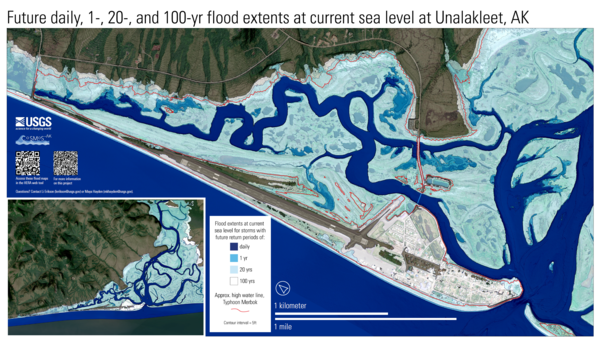
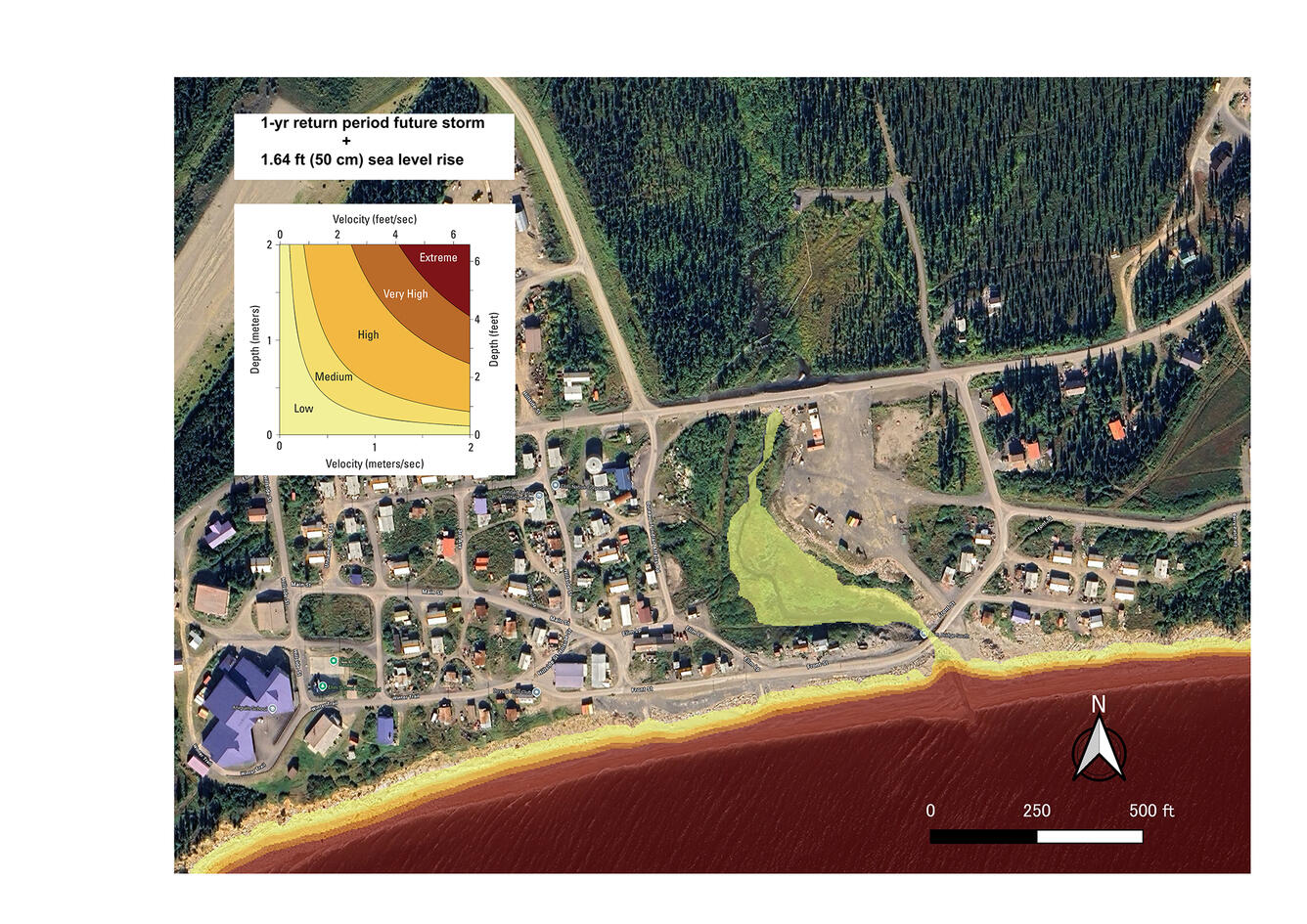
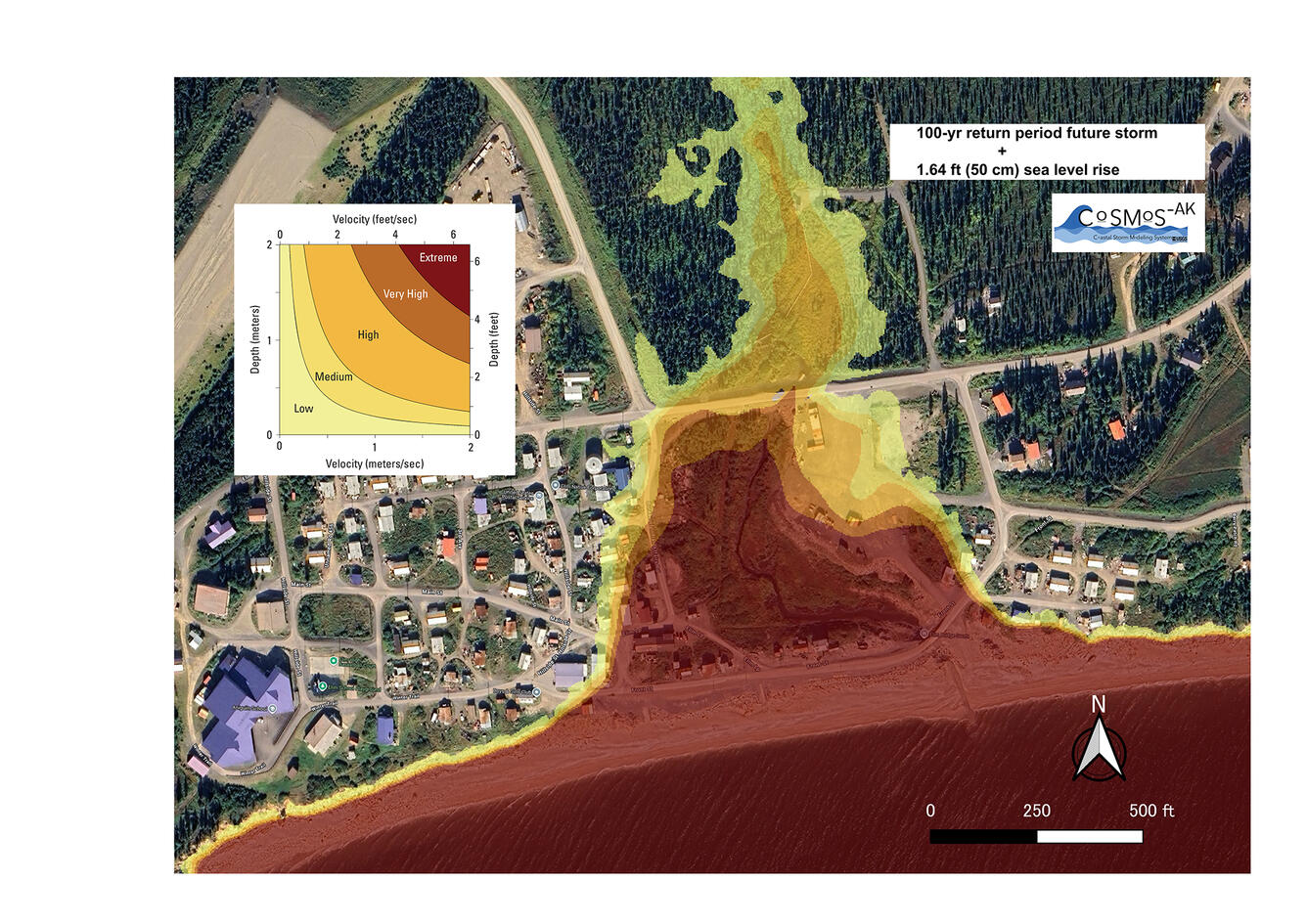
The U.S. Geological Survey’s Coastal Storm Modeling System (CoSMoS) was adapted for use in Alaska, incorporating the influence of sea ice on storm frequency and intensity, to map and quantify long-term coastal flood hazard exposure. We generated flood hazard maps for combinations of six sea-level rise scenarios and five extreme storm return intervals, along with a no-storm baseline. Results are integrated into the Hazard Exposure Reporting and Analytics (HERA) web tool, including analytics summarizing potential hazard exposure of critical infrastructure such as schools, clinics, transportation networks, and housing.
These products represent the first standardized, cross-community coastal flood hazard datasets of their kind in Alaska. Produced with consistent methods and forcing data, including the impact of waves, they enable both rapid screening and detailed, decision relevant analyses for community scale risk assessment and long-range planning.
We produced flood hazard maps using historical and projected winds, atmospheric pressures, and sea ice from the latest sixth generation global climate models, which drove a suite of numerical models that downscale waves and water levels to the community scale. Timeseries representing past and future storms were evaluated for extreme water levels and applied to overland flood modeling using new, high-resolution elevation surfaces assembled from the latest bathymetric and topographic datasets
Highlights & Status
Community-scale flood hazard maps of flood extent, depth, water surface elevations, velocity hazards, wave heights, and storm-driven erosion/deposition provided as GIS layers, with a subset visualized in the HERA Multi-hazard Viewer:
- 8 communities published
- 2 communities near completion or in review
- 6 additional communities scheduled for completion by end of 2026
- Exposure metrics generated by combining flood extent maps with census derived data on population, housing, and infrastructure
- Joint occurrence statistics for extreme water levels and waves at 26 communities, both hindcast and anticipated future values (journal article in review)
- Comprehensive storm event catalog (1979–2022) for Alaska’s north and west coasts (journal article in review)
- Projected changes in extreme water levels and waves at 700+ nearshore sites (in preparation)
- Hourly nearshore wave timeseries from the Canadian border through Norton Sound
Who's using it/How is it used?
Our future flood hazard maps are helping community leaders in Elim to relocate vulnerable utility poles so that they will be outside of both current and future flood hazard zones, improving stability of community power and communications.
The Native Village of Unalakleet, in partnership with the Alaska Climate Adaptation Science Center, has integrated our future flood hazard information into a climate impacts synthesis document, to be referenced as they develop proposals for hazard risk-reduction projects.
Alaska Native Tribal Health Consortium and engineering consultants are using our regional water level and wave data in infrastructure planning and risk assessments following Typhoon Halong, helping coastal Yukon-Kuskokwim Delta communities withstand future flood risks.
"We believe these ratios that take into account projected changes in water levels due to climactic factors combined with our estimate of relative sea-level rise would be incredibly helpful." -Northwest Hydraulic Consultants
"Seeing the flood maps [from USGS] is already helping us think about where to move our power pole." -Elim Community Leader
What we did and why it matters
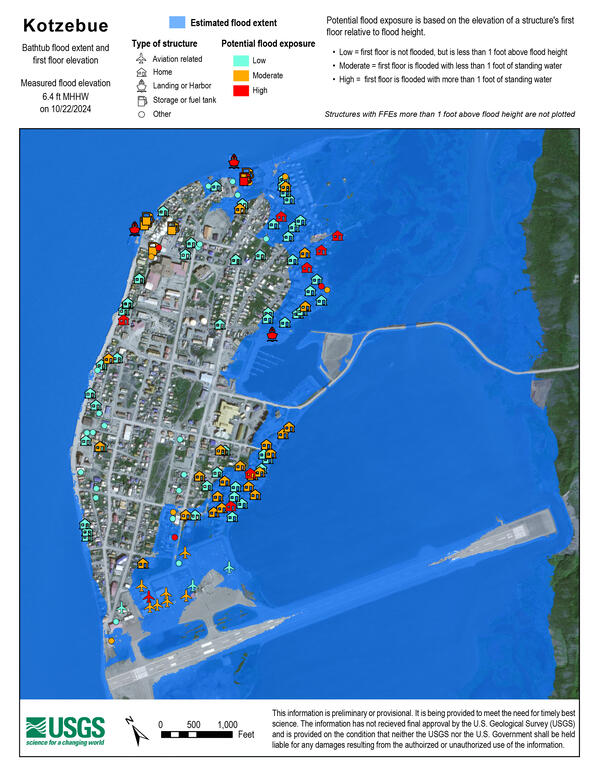
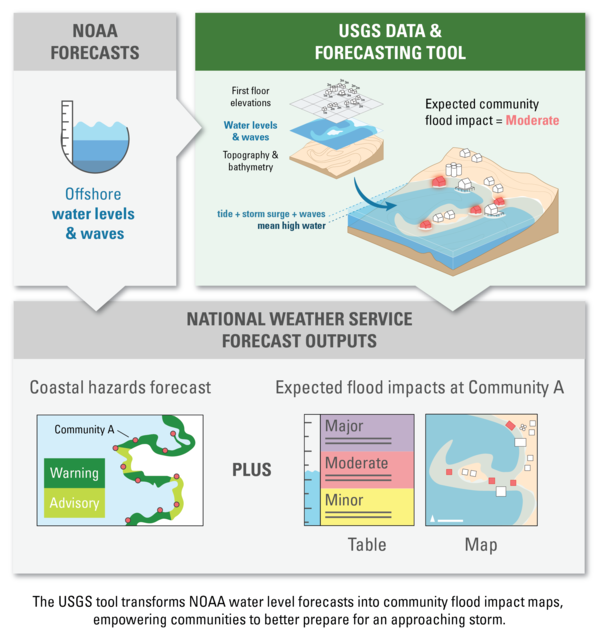
In partnership with the State of Alaska Division of Geological & Geophysical Surveys (DGGS), we developed rapid flood estimation tools that use 2- to 5-day forecasts of extreme water levels and waves to translate nearshore storm conditions into community scale flood impact maps. These tools enhance National Weather Service (NWS) coastal flood warnings by providing clear visuals and impact estimates that improve actionability of forecasts for emergency preparedness.
Highlights & Status
- Supported NWS Fairbanks during mid-August 2024 storms by directing them to DGGS bathtub maps (AKFIT demo) for Kipnuk and Kwigilingok; model outputs also indicated no major flooding concerns in Unalakleet and Elim.
- Delivered flood hazard and exposure maps ahead of the October 2024 Kotzebue storm, aiding NWS forecasting and helping local and state responders identify vulnerable structures and prioritize recovery.
- Provided DGGS with five priority digital terrain models for integration into the AKFIT flood hazard viewer.
- Developed easy-to-use software for generating bathtub flood maps using only high- resolution elevation data.
Who's using it/How is it used?
- We supported the National Weather Service Fairbanks Weather Forecast Office during approaching storms in August 2024 by running our CoSMoS model to assess real-time flood potential in Unalakleet, Elim, and Nome. Modeling indicated no major flooding concerns, guiding the Forecast Office to continue maintaining lower-level advisories. No flooding was reported in the communities following the event.
- Flood hazard and exposure forecast maps provided to the National Weather Service, Alaska State Department of Transportation, and other emergency management partners ahead of the October 2024 and 2025 storms, aided in forecasting impacts and helping local and state responders identify vulnerable structures and prioritize recovery.
- Close collaboration with the Alaska Division of Geological & Geophysical Surveys has helped to improve and expand their Alaska Flood Inundation Tool (AK-FIT), providing even more Alaskan communities with flood impact information to support coastal hazard preparedness and planning.
"Participants appreciated the work of NWS and USGS to provide rapid flood inundation maps and asked for flood maps moving forward." -NWS Rapid Case Study Assessment of the Coastal Storm in Kotzebue, AK, in October 2024
"[The team] produced, in real-time, community-specific tables showing how many structures, and which type of structures, would be impacted at different forecast water levels. These tables were explicitly tied to NWS minor, moderate, and major flood thresholds and used consistent visual language familiar to forecasters. This information was unprecedented for NWS operations in Alaska and proved invaluable in determining how to message the event, what level of threat to communicate, and how to support emergency managers and community leaders facing imminent impacts." -Former Coastal Flood Program Manager, NWS Alaska Region
What we did and why it matters
We collected high-quality elevation data and installed near real time coastal monitoring equipment in coastal communities throughout the region to improve hazard forecasts and support local emergency preparation and recovery decision making. These datasets help communities document and quantify flood impacts, improve hazard models, and provide residents and emergency managers with better information before, during, and after storms. We continue to work with partners and residents to maintain these tools, keep the data accessible, and ensure the information remains useful for decisions at the local and regional scale.
Highlights & Status
Community-scale elevation data
Recent, accurate elevation data improve models for how flood waters will move across the landscape and impact infrastructure. Towards that end, we collected key elevation information, including:
Satellite-derived vertical land motion data across the Norton Sound region
First-floor elevation measurements for all buildings in 7 communities has been published, and the remaining 6 are in review
Nearshore bathymetry (seabed elevation) in three communities and topography (land surface elevation) of beaches in seven communities
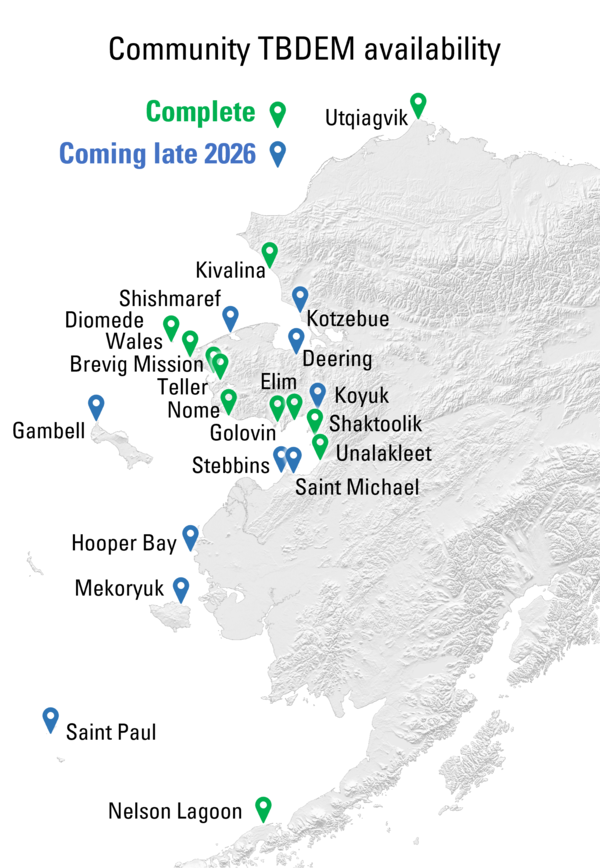
Using these data, we developed new high-resolution (1 meter) seamless topo-bathymetric digital elevation models for 12 communities, with 9 additional communities anticipated in late 2026. The digital elevation models form the foundation for accurate, real-time flood forecasting and modeling of future flood risk
Near-real-time coastal monitoring
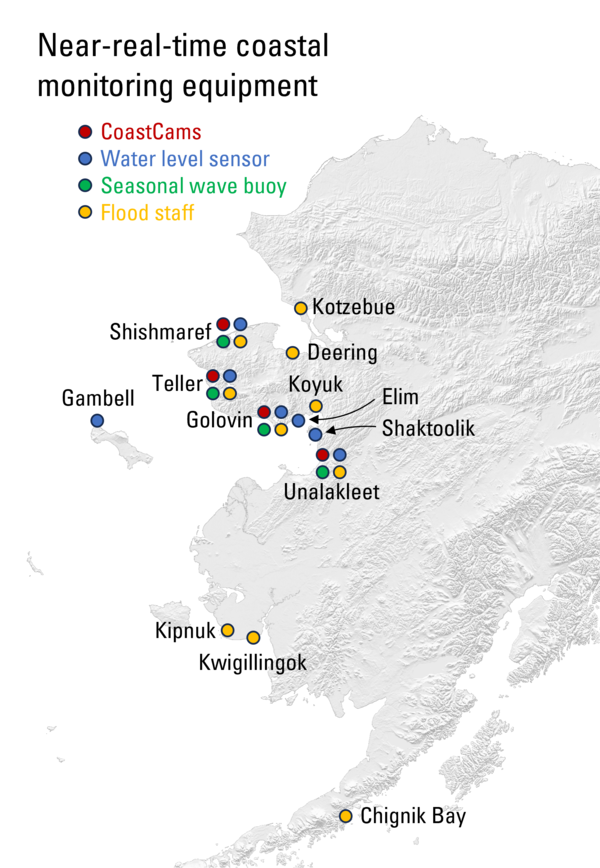
We installed a suite of monitoring tools in 13 communities to track water levels, waves, and storm conditions in real time. These include:
- Four CoastCam stations in Golovin, Shishmaref, Teller, and Unalakleet (link)
- Six water level sensors in Elim, Gambell, Golovin, Shishmaref, Teller, and Shaktoolik (link)
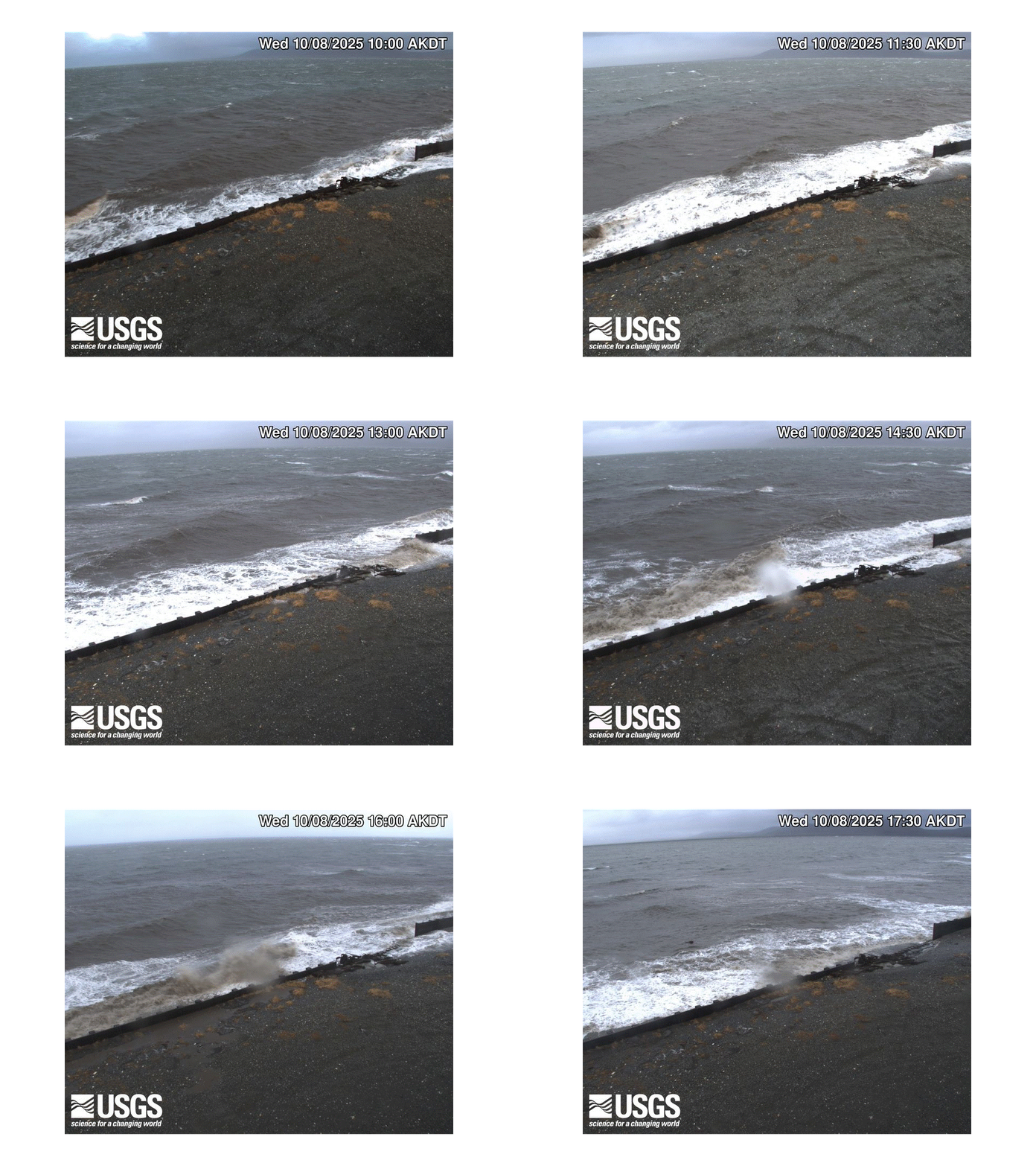
- Four seasonally operational wave buoys deployed to Golovin, Teller, Shishmaref, and Unalakleet (link)
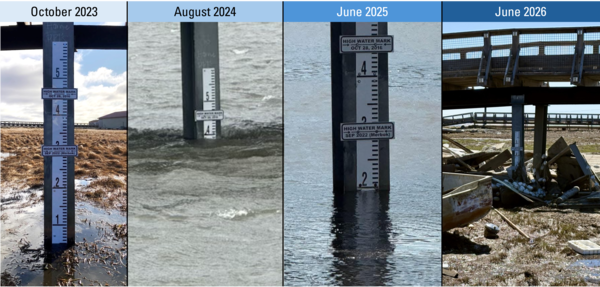
- More than ten flood staffs for community photo documentation of high-water events (link)
Who's using it/How is it used?
Elevation data were a critical input for mapping of future coastal hazards and risk and flood forecasting (detailed above).
Our topo-bathymetric digital elevation models are publicly available for other applications. For example, the Alaska Division of Geological & Geophysical Surveys used five of our digital elevation models for integration into the Alaska Flood Inundation Tool (AK-FIT) flood hazard viewer, which provides flood impact maps for community planning.
Residents have used flood staffs as a safe and effective way to document flooding in their communities, including during the most recent ex-Typhoon Halong, which caused devastating losses in communities such as Kipnuk. Photos can be shared publicly via a Facebook group and a photo database managed by the state of Alaska.
Data from CoastCams, water-level sensors, and wave buoys provide a safe, simple way to check local conditions of waves, ice, snow, and water levels. They have helped community boaters assess current conditions and supported the National Weather Service forecasters with validation information during storms. They also build an archive of past events that can support disaster declarations and strengthen applications for hazard-mitigation grants.
"What you guys have done is really important! We will be using it for risk and relocation guidance." - Richard Buzard, Climate Adaptation Project Manager, Alaska Native Tribal Health Consortium
What we did and why it matters
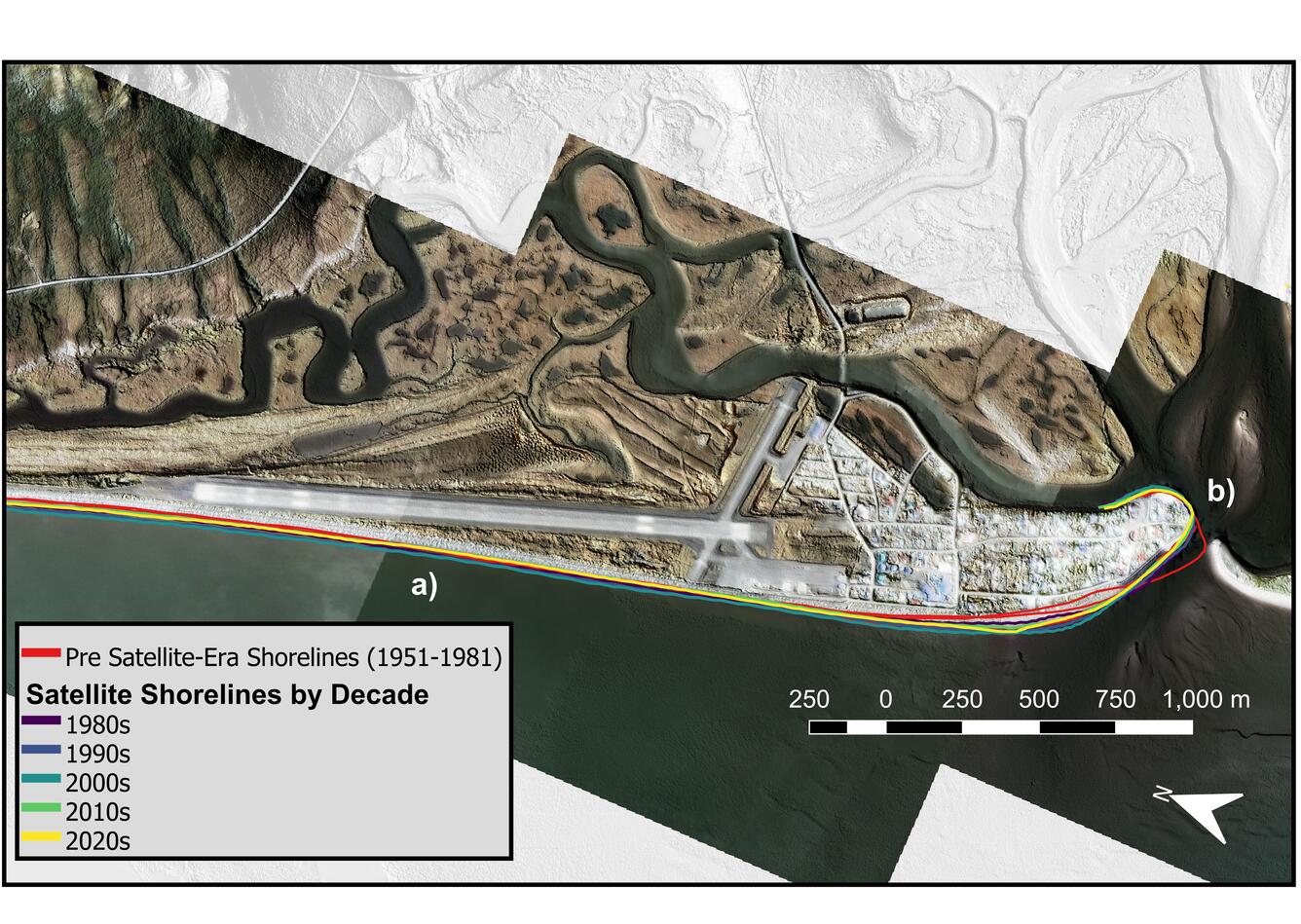
We developed a 40-year record (1984 to 2024) of shorelines across 2,500 miles of northern and western Alaska. To do this, we made significant technical advances to state of the art, automated satellite-derived shoreline mapping software known as CoastSeg, updated with new, Alaska-specific workflows and algorithms. A data service and a web visualization tool will allow users to access the data and interactively view historical shoreline positions and shoreline change rates, patterns, and trends.
Shoreline change data measure how much and how fast coastlines are moving over time, and are critical for forecasting coastal change impacts to communities, infrastructure, subsistence resources, and habitat. Accurate information regarding past and present trends and rates of shoreline movement allows communities to determine where cultural and community resources may be threatened by coastal erosion and where proactive actions such as relocating infrastructure, adjusting seasonal use areas, or planning alternative transportation routes could be most beneficial.
Alaska’s coasts have changed more rapidly over the last several decades compared to other parts of the U.S., but the remote and extremely variable environment has limited previous field- and remote-sensing-based data collection. Using satellite-based imagery and automated processing methods has significantly increased the scale and pace at which this important coastal change information can be gathered.
Highlights and Status
Using automated techniques, we processed 40-years of Landsat, Sentinel, and PlanetScope satellite imagery to build a record of shoreline change for over 2,500 miles of the Alaskan coastline from the northern U.S.-Canadian border south to the Yukon Delta.
We advanced image filtering and segmentation methods to overcome challenges of Alaska satellite imagery, including dealing with the presence of sea-ice, distorted color spaces, short open water-seasons, and narrower beach footprints.
We developed an efficient tiered system for providing a standardized suite of satellite-derived shoreline data, consisting of raw shorelines, filtered shorelines, time-averaged shorelines (annual and by decade), and statistical shorelines such as the mean, minimum, and maximum shoreline positions from the entire record.
We constructed polygons of coastal features to delineate annual and decadal landforms. Compared to typical one-dimensional transect measurements, two-dimensional characterization of landform change is especially useful for tracking the movement of very dynamic features like spits and barrier islands.
All datasets are fully generated, analyzed thoroughly for patterns and accuracy, and are undergoing improvements and finalization for public release. Additionally, we are developing a web visualization tool for interactive viewing and access to the shoreline data.
Media Sources/Usage: Public Domain. View Media Details
Landsat imagery timelapse showing coastal change from 1992-2023 near Stebbins, Alaska.
Who's using it/How is it used?
Shoreline change data are not yet available to the public, but we have begun discussions with technical support organizations (e.g., Alaska Native Tribal Health Consortium) and state partners (e.g., Alaska Division of Geological & Geophysical Surveys), who would use the data to inform erosion exposure and risk assessments for Alaska coastal communities. By leveraging shoreline change data, communities can make informed decisions that enhance resilience against coastal hazards and promote sustainable management of coastal resources.
What we did and why it matters
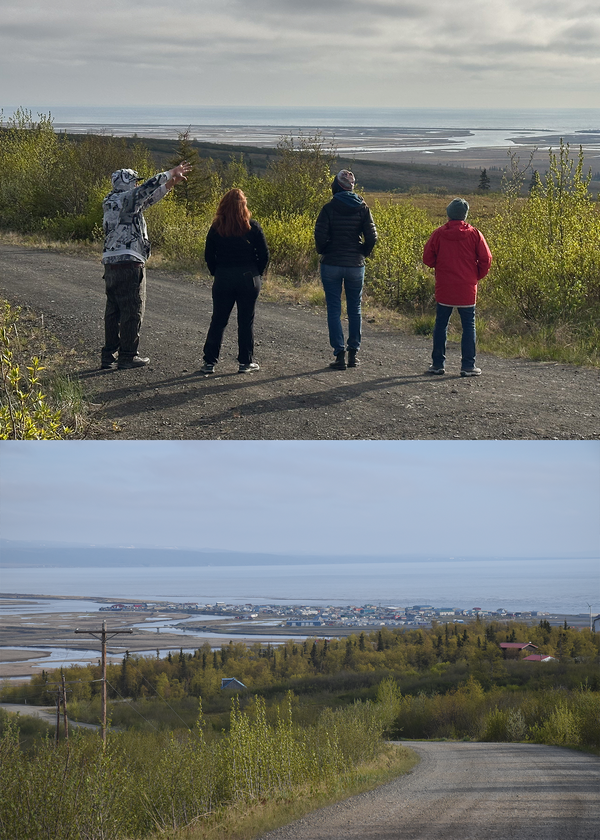
To ensure we deliver products that are both useful and useable, we are conducting outreach and engagement focused on end-user audiences specific to each type of product. Between February 2023 and June 2026, we planned and implemented or participated in 84 events reaching over 2,300 total participants. Events ranged from informal calls/meetings, to presentations, trainings, and hands-on workshops. An important component of our engagement has been developing science translation/communication materials informed by and tailored to different end-users, to facilitate the application of our science for decision making. Examples include graphics and visual aids, answers to frequently asked questions, “how to” and “quick start” guidance.
End-user audiences that we have reached include:
- Community leaders working on environmental, climate, or hazard planning issues in the community, with representation from across the tribal, city, and Alaska Native corporation governance.
- Technical support organizations that regularly provide technical services for community planning and hazard assessment. These include regional/state tribal non-profit organizations (e.g., Kawerak, Alaska Native Tribal Health Consortium), boundary organizations (e.g., Alaska Climate Adaptation Science Center), and private consulting/engineering firms. Certain federal and state agencies also fall into this category, but are called out separately below.
- State and federal agencies that provide related coastal hazards information, resources, and technical services for emergency preparedness, hazard mitigation, or long-range planning, such as the Alaska Division of Geological & Geophysical Surveys and Division of Community and Regional Affairs, NOAA National Weather Service, NOAA Office for Coastal Management, Federal Emergency Management Agency, and U.S. Army Corps of Engineers.
- Academic researchers such as University of Alaska Fairbanks and George Mason University who are working with communities to co-produce solutions that reduce the impacts of flooding from coastal storms.
Highlights & Status
- Between February 2023 and June 2026, we planned and implemented or participated in 84 events reaching over 2,300 total participants.
- Twnety-five events were primarily in-person and focused on community leaders where we have either completed future coastal hazards and risk products (Elim, Unalakleet, Golovin, Utqiagvik), and/or have installed near-real-time coastal monitoring equipment (see map above).
- We leveraged existing venues that convene relevant audiences to deliver workshops, briefings, or presentations. Examples of events included presentations at the Alaska GeoSummit, Alaska Forum, National Tribal Infrastructure Coordination Conference, and a workshop at the Alaska Tribal Conference on Environmental Management.
- Since 2023, we have led monthly flood inundation mapping coordination meetings with partners including the Alaska Native Tribal Health Consortium, Alaska Division of Geological and Geophysical Surveys, NOAA National Weather Service, and NOAA Office for Coastal Management.
- We presented and participated in annual National Weather Service pre-fall coastal storm refresher workshops (2024, 2025), for cross-agency updates, coordination, and training in preparation for fall storm forecasting and emergency response
- We continue to collaborate with partners on related projects, including the ACTION project (Alaska Coastal Cooperative for Co-Producing Transformative Ideas and Opportunities in the North), Rising Voices Changing Coasts, and the Arctic Rivers Project by leveraging data, products, and end-user engagement opportunities
- To amplify our reach, we have partnered with the Alaska Climate Adaptation Science Center and their Tribal Resilience Liaisons, leveraging their existing networks, long-standing relationships, and intimate knowledge of tribal needs. The partnership has resulted in three coastal flooding webinars delivered through the Alaska Tribal Resilience Learning Network, an interactive workshop at the 2026 Alaska Tribal Conference on Environmental Management, and a coordinated return engagement visit to Unalakleet in June 2026.
Who’s using it/How is it used?
More examples of specific product users and applications can be found in sections above. Some key highlights that have resulted from our outreach and engagement:
- Future flood hazard mapping is already being used in Elim to inform relocation of vulnerable utility infrastructure and as part of an environmental change study that will inform adaptation planning. In Unalakleet the flood hazard information has been integrated into a climate impacts synthesis completed by the Native Village of Unalakleet and the Alaska Climate Adaptation Science Center, to be used as a reference for hazard mitigation and related grant funding applications.
- Our regional water level and wave data are being used by technical support organizations for infrastructure planning and risk assessments following Typhoon Halong, helping coastal Yukon-Kuskokwim Delta communities withstand future flood risks.
- Our flood forecast mapping and exposure capabilities, foundational elevation and real-time coastal monitoring data have supported the National Weather Service and emergency management partners during Fall 2024 and 2025 storm seasons and supported improvements to agency partner flood mapping tools.
Our monthly flood inundation mapping tools coordination calls with partner agencies have successfully fostered cross-agency collaboration, including before and after storm-events (e.g., coordinated collection and dissemination of high-water marks), as well as for coordinated communication to end-users on how different agency flood mapping tools compare and complement each other.
WEBTOOLS AND RELATED WEBPAGES
Project Overview
Related USGS Disaster Supplemental web pages
Related USGS Alaska Coastal Processes and Hazards project page
Multi-hazard viewer: HERA Multi-Hazards Viewer
Impact Assessments: HERA Flood Tool
- Merbok High Water Mark data viewable in the USGS Flood Event Viewer
- Satellite-derived shorelines visualization web tool (not yet public)
DATA
Planning for future coastal hazards and risk
CoSMoS-AK Flooding and Erosion Hazards | |
| Brevig Mission | Shaktoolik |
| Golovin | Teller |
| Elim | Unalakleet |
| Nome | Utqiagvik |
- Flood staff locations and information
- Vertical land motion rates for the years 2015 to 2023
- First floor elevation data for community buildings/structures
- Field-based elevation data (beach topography and nearshore bathymetry) from 2023 to 2025
- Coastal observing camera data (CoastCams)
TECHNICAL REFERENCES (PEER-REVIEWED PAPERS AND REPORTS)
Buzard, R.M., Maio, C.V., Erikson, L.H., Overbeck, J.R., Kinsman, N.E.M., and Jones, B.M., 2024, Current and projected flood exposure for Alaska coastal communities: Scientific Reports, https://doi.org/10.1038/s41598-024-58270-w.
Engelstad, A.C., Erikson, L.H., Reguero, B.G., Gibbs, A.E., and Nederhoff, K., 2024, Database and time series of nearshore waves along the Alaskan coast from the United States-Canada border to the Bering Sea: U.S. Geological Survey Open-File Report 2023–1094, 23 p., https://doi.org/10.3133/ofr20231094.
Fitzpatrick, S., Buscombe, D., Warrick, J.A., Lundine, M.A. and Vos, K., 2024. CoastSeg: an accessible and extendable hub for satellite-derived-shoreline (SDS) detection and mapping. Journal of Open Source Software, 9(99), p.6683. https://joss.theoj.org/papers/10.21105/joss.06683
END-USER RESOURCES
Alaska Tribal Resilience Learning Network Information Sessions
Code available on Git-Hub (Coming soon…)
Back to top

Alaska Flood Staffs

Typhoon Merbok Disaster Emergency Recovery Efforts

USGS CoastCams
The Typhoon Merbok Disaster Emergency Recovery Efforts project addresses critical data and capacity gaps in coastal Alaska by generating high resolution environmental datasets, hazard analyses, and monitoring tools needed to quantify erosion, flooding, and permafrost-related risks at the community scale.
Supported by Title VII of Division N of the Consolidated Appropriations Act, 2023, and in collaboration with state, federal, nonprofit, and local partners, we produced information on future flood and erosion hazards, real-time storm impacts, long-term shoreline change, and other foundational indicators that strengthen the scientific basis for risk assessments and infrastructure planning. These science products are designed to improve decision-relevant understanding of coastal hazards and to support engineers, planners, and community leadership in developing durable, evidence-based risk-reduction strategies.
Planning for future coastal hazards and risk
Preparing for an approaching storm
Foundational data
Coastal erosion from extreme storms
End-user engagement
Links to all products and resources
What we did and why it matters
The U.S. Geological Survey’s Coastal Storm Modeling System (CoSMoS) was adapted for use in Alaska, incorporating the influence of sea ice on storm frequency and intensity, to map and quantify long-term coastal flood hazard exposure. We generated flood hazard maps for combinations of six sea-level rise scenarios and five extreme storm return intervals, along with a no-storm baseline. Results are integrated into the Hazard Exposure Reporting and Analytics (HERA) web tool, including analytics summarizing potential hazard exposure of critical infrastructure such as schools, clinics, transportation networks, and housing.
These products represent the first standardized, cross-community coastal flood hazard datasets of their kind in Alaska. Produced with consistent methods and forcing data, including the impact of waves, they enable both rapid screening and detailed, decision relevant analyses for community scale risk assessment and long-range planning.
We produced flood hazard maps using historical and projected winds, atmospheric pressures, and sea ice from the latest sixth generation global climate models, which drove a suite of numerical models that downscale waves and water levels to the community scale. Timeseries representing past and future storms were evaluated for extreme water levels and applied to overland flood modeling using new, high-resolution elevation surfaces assembled from the latest bathymetric and topographic datasets
Highlights & Status
Community-scale flood hazard maps of flood extent, depth, water surface elevations, velocity hazards, wave heights, and storm-driven erosion/deposition provided as GIS layers, with a subset visualized in the HERA Multi-hazard Viewer:
- 8 communities published
- 2 communities near completion or in review
- 6 additional communities scheduled for completion by end of 2026
- Exposure metrics generated by combining flood extent maps with census derived data on population, housing, and infrastructure
- Joint occurrence statistics for extreme water levels and waves at 26 communities, both hindcast and anticipated future values (journal article in review)
- Comprehensive storm event catalog (1979–2022) for Alaska’s north and west coasts (journal article in review)
- Projected changes in extreme water levels and waves at 700+ nearshore sites (in preparation)
- Hourly nearshore wave timeseries from the Canadian border through Norton Sound
Who's using it/How is it used?
Our future flood hazard maps are helping community leaders in Elim to relocate vulnerable utility poles so that they will be outside of both current and future flood hazard zones, improving stability of community power and communications.
The Native Village of Unalakleet, in partnership with the Alaska Climate Adaptation Science Center, has integrated our future flood hazard information into a climate impacts synthesis document, to be referenced as they develop proposals for hazard risk-reduction projects.
Alaska Native Tribal Health Consortium and engineering consultants are using our regional water level and wave data in infrastructure planning and risk assessments following Typhoon Halong, helping coastal Yukon-Kuskokwim Delta communities withstand future flood risks.
"We believe these ratios that take into account projected changes in water levels due to climactic factors combined with our estimate of relative sea-level rise would be incredibly helpful." -Northwest Hydraulic Consultants
"Seeing the flood maps [from USGS] is already helping us think about where to move our power pole." -Elim Community Leader
What we did and why it matters
In partnership with the State of Alaska Division of Geological & Geophysical Surveys (DGGS), we developed rapid flood estimation tools that use 2- to 5-day forecasts of extreme water levels and waves to translate nearshore storm conditions into community scale flood impact maps. These tools enhance National Weather Service (NWS) coastal flood warnings by providing clear visuals and impact estimates that improve actionability of forecasts for emergency preparedness.
Highlights & Status
- Supported NWS Fairbanks during mid-August 2024 storms by directing them to DGGS bathtub maps (AKFIT demo) for Kipnuk and Kwigilingok; model outputs also indicated no major flooding concerns in Unalakleet and Elim.
- Delivered flood hazard and exposure maps ahead of the October 2024 Kotzebue storm, aiding NWS forecasting and helping local and state responders identify vulnerable structures and prioritize recovery.
- Provided DGGS with five priority digital terrain models for integration into the AKFIT flood hazard viewer.
- Developed easy-to-use software for generating bathtub flood maps using only high- resolution elevation data.
Who's using it/How is it used?
- We supported the National Weather Service Fairbanks Weather Forecast Office during approaching storms in August 2024 by running our CoSMoS model to assess real-time flood potential in Unalakleet, Elim, and Nome. Modeling indicated no major flooding concerns, guiding the Forecast Office to continue maintaining lower-level advisories. No flooding was reported in the communities following the event.
- Flood hazard and exposure forecast maps provided to the National Weather Service, Alaska State Department of Transportation, and other emergency management partners ahead of the October 2024 and 2025 storms, aided in forecasting impacts and helping local and state responders identify vulnerable structures and prioritize recovery.
- Close collaboration with the Alaska Division of Geological & Geophysical Surveys has helped to improve and expand their Alaska Flood Inundation Tool (AK-FIT), providing even more Alaskan communities with flood impact information to support coastal hazard preparedness and planning.
"Participants appreciated the work of NWS and USGS to provide rapid flood inundation maps and asked for flood maps moving forward." -NWS Rapid Case Study Assessment of the Coastal Storm in Kotzebue, AK, in October 2024
"[The team] produced, in real-time, community-specific tables showing how many structures, and which type of structures, would be impacted at different forecast water levels. These tables were explicitly tied to NWS minor, moderate, and major flood thresholds and used consistent visual language familiar to forecasters. This information was unprecedented for NWS operations in Alaska and proved invaluable in determining how to message the event, what level of threat to communicate, and how to support emergency managers and community leaders facing imminent impacts." -Former Coastal Flood Program Manager, NWS Alaska Region
What we did and why it matters
We collected high-quality elevation data and installed near real time coastal monitoring equipment in coastal communities throughout the region to improve hazard forecasts and support local emergency preparation and recovery decision making. These datasets help communities document and quantify flood impacts, improve hazard models, and provide residents and emergency managers with better information before, during, and after storms. We continue to work with partners and residents to maintain these tools, keep the data accessible, and ensure the information remains useful for decisions at the local and regional scale.
Highlights & Status
Community-scale elevation data
Recent, accurate elevation data improve models for how flood waters will move across the landscape and impact infrastructure. Towards that end, we collected key elevation information, including:
Satellite-derived vertical land motion data across the Norton Sound region
First-floor elevation measurements for all buildings in 7 communities has been published, and the remaining 6 are in review
Nearshore bathymetry (seabed elevation) in three communities and topography (land surface elevation) of beaches in seven communities
Using these data, we developed new high-resolution (1 meter) seamless topo-bathymetric digital elevation models for 12 communities, with 9 additional communities anticipated in late 2026. The digital elevation models form the foundation for accurate, real-time flood forecasting and modeling of future flood risk
Near-real-time coastal monitoring
We installed a suite of monitoring tools in 13 communities to track water levels, waves, and storm conditions in real time. These include:
- Four CoastCam stations in Golovin, Shishmaref, Teller, and Unalakleet (link)
- Six water level sensors in Elim, Gambell, Golovin, Shishmaref, Teller, and Shaktoolik (link)
- Four seasonally operational wave buoys deployed to Golovin, Teller, Shishmaref, and Unalakleet (link)
- More than ten flood staffs for community photo documentation of high-water events (link)
Who's using it/How is it used?
Elevation data were a critical input for mapping of future coastal hazards and risk and flood forecasting (detailed above).
Our topo-bathymetric digital elevation models are publicly available for other applications. For example, the Alaska Division of Geological & Geophysical Surveys used five of our digital elevation models for integration into the Alaska Flood Inundation Tool (AK-FIT) flood hazard viewer, which provides flood impact maps for community planning.
Residents have used flood staffs as a safe and effective way to document flooding in their communities, including during the most recent ex-Typhoon Halong, which caused devastating losses in communities such as Kipnuk. Photos can be shared publicly via a Facebook group and a photo database managed by the state of Alaska.
Data from CoastCams, water-level sensors, and wave buoys provide a safe, simple way to check local conditions of waves, ice, snow, and water levels. They have helped community boaters assess current conditions and supported the National Weather Service forecasters with validation information during storms. They also build an archive of past events that can support disaster declarations and strengthen applications for hazard-mitigation grants.
"What you guys have done is really important! We will be using it for risk and relocation guidance." - Richard Buzard, Climate Adaptation Project Manager, Alaska Native Tribal Health Consortium
What we did and why it matters
We developed a 40-year record (1984 to 2024) of shorelines across 2,500 miles of northern and western Alaska. To do this, we made significant technical advances to state of the art, automated satellite-derived shoreline mapping software known as CoastSeg, updated with new, Alaska-specific workflows and algorithms. A data service and a web visualization tool will allow users to access the data and interactively view historical shoreline positions and shoreline change rates, patterns, and trends.
Shoreline change data measure how much and how fast coastlines are moving over time, and are critical for forecasting coastal change impacts to communities, infrastructure, subsistence resources, and habitat. Accurate information regarding past and present trends and rates of shoreline movement allows communities to determine where cultural and community resources may be threatened by coastal erosion and where proactive actions such as relocating infrastructure, adjusting seasonal use areas, or planning alternative transportation routes could be most beneficial.
Alaska’s coasts have changed more rapidly over the last several decades compared to other parts of the U.S., but the remote and extremely variable environment has limited previous field- and remote-sensing-based data collection. Using satellite-based imagery and automated processing methods has significantly increased the scale and pace at which this important coastal change information can be gathered.
Highlights and Status
Using automated techniques, we processed 40-years of Landsat, Sentinel, and PlanetScope satellite imagery to build a record of shoreline change for over 2,500 miles of the Alaskan coastline from the northern U.S.-Canadian border south to the Yukon Delta.
We advanced image filtering and segmentation methods to overcome challenges of Alaska satellite imagery, including dealing with the presence of sea-ice, distorted color spaces, short open water-seasons, and narrower beach footprints.
We developed an efficient tiered system for providing a standardized suite of satellite-derived shoreline data, consisting of raw shorelines, filtered shorelines, time-averaged shorelines (annual and by decade), and statistical shorelines such as the mean, minimum, and maximum shoreline positions from the entire record.
We constructed polygons of coastal features to delineate annual and decadal landforms. Compared to typical one-dimensional transect measurements, two-dimensional characterization of landform change is especially useful for tracking the movement of very dynamic features like spits and barrier islands.
All datasets are fully generated, analyzed thoroughly for patterns and accuracy, and are undergoing improvements and finalization for public release. Additionally, we are developing a web visualization tool for interactive viewing and access to the shoreline data.
Media
Sources/Usage: Public Domain. View Media DetailsLandsat imagery timelapse showing coastal change from 1992-2023 near Stebbins, Alaska.
Who's using it/How is it used?
Shoreline change data are not yet available to the public, but we have begun discussions with technical support organizations (e.g., Alaska Native Tribal Health Consortium) and state partners (e.g., Alaska Division of Geological & Geophysical Surveys), who would use the data to inform erosion exposure and risk assessments for Alaska coastal communities. By leveraging shoreline change data, communities can make informed decisions that enhance resilience against coastal hazards and promote sustainable management of coastal resources.
What we did and why it matters
To ensure we deliver products that are both useful and useable, we are conducting outreach and engagement focused on end-user audiences specific to each type of product. Between February 2023 and June 2026, we planned and implemented or participated in 84 events reaching over 2,300 total participants. Events ranged from informal calls/meetings, to presentations, trainings, and hands-on workshops. An important component of our engagement has been developing science translation/communication materials informed by and tailored to different end-users, to facilitate the application of our science for decision making. Examples include graphics and visual aids, answers to frequently asked questions, “how to” and “quick start” guidance.
End-user audiences that we have reached include:
- Community leaders working on environmental, climate, or hazard planning issues in the community, with representation from across the tribal, city, and Alaska Native corporation governance.
- Technical support organizations that regularly provide technical services for community planning and hazard assessment. These include regional/state tribal non-profit organizations (e.g., Kawerak, Alaska Native Tribal Health Consortium), boundary organizations (e.g., Alaska Climate Adaptation Science Center), and private consulting/engineering firms. Certain federal and state agencies also fall into this category, but are called out separately below.
- State and federal agencies that provide related coastal hazards information, resources, and technical services for emergency preparedness, hazard mitigation, or long-range planning, such as the Alaska Division of Geological & Geophysical Surveys and Division of Community and Regional Affairs, NOAA National Weather Service, NOAA Office for Coastal Management, Federal Emergency Management Agency, and U.S. Army Corps of Engineers.
- Academic researchers such as University of Alaska Fairbanks and George Mason University who are working with communities to co-produce solutions that reduce the impacts of flooding from coastal storms.
Highlights & Status
- Between February 2023 and June 2026, we planned and implemented or participated in 84 events reaching over 2,300 total participants.
- Twnety-five events were primarily in-person and focused on community leaders where we have either completed future coastal hazards and risk products (Elim, Unalakleet, Golovin, Utqiagvik), and/or have installed near-real-time coastal monitoring equipment (see map above).
- We leveraged existing venues that convene relevant audiences to deliver workshops, briefings, or presentations. Examples of events included presentations at the Alaska GeoSummit, Alaska Forum, National Tribal Infrastructure Coordination Conference, and a workshop at the Alaska Tribal Conference on Environmental Management.
- Since 2023, we have led monthly flood inundation mapping coordination meetings with partners including the Alaska Native Tribal Health Consortium, Alaska Division of Geological and Geophysical Surveys, NOAA National Weather Service, and NOAA Office for Coastal Management.
- We presented and participated in annual National Weather Service pre-fall coastal storm refresher workshops (2024, 2025), for cross-agency updates, coordination, and training in preparation for fall storm forecasting and emergency response
- We continue to collaborate with partners on related projects, including the ACTION project (Alaska Coastal Cooperative for Co-Producing Transformative Ideas and Opportunities in the North), Rising Voices Changing Coasts, and the Arctic Rivers Project by leveraging data, products, and end-user engagement opportunities
- To amplify our reach, we have partnered with the Alaska Climate Adaptation Science Center and their Tribal Resilience Liaisons, leveraging their existing networks, long-standing relationships, and intimate knowledge of tribal needs. The partnership has resulted in three coastal flooding webinars delivered through the Alaska Tribal Resilience Learning Network, an interactive workshop at the 2026 Alaska Tribal Conference on Environmental Management, and a coordinated return engagement visit to Unalakleet in June 2026.
Who’s using it/How is it used?
More examples of specific product users and applications can be found in sections above. Some key highlights that have resulted from our outreach and engagement:
- Future flood hazard mapping is already being used in Elim to inform relocation of vulnerable utility infrastructure and as part of an environmental change study that will inform adaptation planning. In Unalakleet the flood hazard information has been integrated into a climate impacts synthesis completed by the Native Village of Unalakleet and the Alaska Climate Adaptation Science Center, to be used as a reference for hazard mitigation and related grant funding applications.
- Our regional water level and wave data are being used by technical support organizations for infrastructure planning and risk assessments following Typhoon Halong, helping coastal Yukon-Kuskokwim Delta communities withstand future flood risks.
- Our flood forecast mapping and exposure capabilities, foundational elevation and real-time coastal monitoring data have supported the National Weather Service and emergency management partners during Fall 2024 and 2025 storm seasons and supported improvements to agency partner flood mapping tools.
Our monthly flood inundation mapping tools coordination calls with partner agencies have successfully fostered cross-agency collaboration, including before and after storm-events (e.g., coordinated collection and dissemination of high-water marks), as well as for coordinated communication to end-users on how different agency flood mapping tools compare and complement each other.
WEBTOOLS AND RELATED WEBPAGES
Project Overview
Related USGS Disaster Supplemental web pages
Related USGS Alaska Coastal Processes and Hazards project page
Multi-hazard viewer: HERA Multi-Hazards Viewer
Impact Assessments: HERA Flood Tool
- Merbok High Water Mark data viewable in the USGS Flood Event Viewer
- Satellite-derived shorelines visualization web tool (not yet public)
DATA
Planning for future coastal hazards and risk
CoSMoS-AK Flooding and Erosion Hazards | |
| Brevig Mission | Shaktoolik |
| Golovin | Teller |
| Elim | Unalakleet |
| Nome | Utqiagvik |
- Flood staff locations and information
- Vertical land motion rates for the years 2015 to 2023
- First floor elevation data for community buildings/structures
- Field-based elevation data (beach topography and nearshore bathymetry) from 2023 to 2025
- Coastal observing camera data (CoastCams)
TECHNICAL REFERENCES (PEER-REVIEWED PAPERS AND REPORTS)
Buzard, R.M., Maio, C.V., Erikson, L.H., Overbeck, J.R., Kinsman, N.E.M., and Jones, B.M., 2024, Current and projected flood exposure for Alaska coastal communities: Scientific Reports, https://doi.org/10.1038/s41598-024-58270-w.
Engelstad, A.C., Erikson, L.H., Reguero, B.G., Gibbs, A.E., and Nederhoff, K., 2024, Database and time series of nearshore waves along the Alaskan coast from the United States-Canada border to the Bering Sea: U.S. Geological Survey Open-File Report 2023–1094, 23 p., https://doi.org/10.3133/ofr20231094.
Fitzpatrick, S., Buscombe, D., Warrick, J.A., Lundine, M.A. and Vos, K., 2024. CoastSeg: an accessible and extendable hub for satellite-derived-shoreline (SDS) detection and mapping. Journal of Open Source Software, 9(99), p.6683. https://joss.theoj.org/papers/10.21105/joss.06683
END-USER RESOURCES
Alaska Tribal Resilience Learning Network Information Sessions
Code available on Git-Hub (Coming soon…)
Back to top
Alaska Flood Staffs
Typhoon Merbok Disaster Emergency Recovery Efforts