



Science Teams
Science Teams
The Environmental Health Program (Toxic Substances Hydrology and Contaminant Biology) assesses and differentiates environmental contaminant and pathogen exposures that cause actual health risks versus those that are only perceived. Specialized teams of hydrologists, geologists, chemists, and biologists work together in the field and laboratories across the United States. Scroll Down for Team List.
Filter Total Items: 49

Drinking Water and Wastewater Infrastructure Science Team
The team studies toxicants and pathogens in water resources from their sources, through watersheds, aquifers, and infrastructure to human and wildlife exposures. That information is used to develop decision tools that protect human and wildlife health.

Toxin Producing Algae Across U.S. Landscapes—Are They Gaining a Foothold?
There are still many unknowns related to the occurrence and potential range of various types of algae in inland waters. To fill some of these gaps, scientists at the U.S. Geological Survey (USGS) recently published a review and synthesis of toxic algae in inland waters of the conterminous United States.

USGS Scientists Develop an Interactive Mapping Tool to Visualize PFAS in Tap Water
A new interactive dashboard is available to visualize PFAS measurements for 716 tap water samples collected at select sites across the nation between 2016 and 2021 from private and public supplies.

A Farewell but not a Goodbye to a Civil Servant that Never Wavered on her Dedication to the Environment
Kathy Lee, a Deputy Program Coordinator for the Toxic Substances Hydrology Program within the Environmental Health Program, retired at the end of July. Her work with NAWQA as an ecologist, author of the GeoHealth Newsletter, archivist for the programs bibliography, mentor and resource will make a lasting impression in the Environmental Health community.

Unique Approach to Measure Per- and Polyfluoroalkyl Substances Uptake in Fish, Mussels, and Passive Samplers
Per- and polyfluoroalkyl substances (PFAS) uptake and bioconcentration by fish and mussels ─ housed in mobile laboratories at a legacy fire-training area contaminated by aqueous film-forming foams ─ varied by species, sex, and compound. PFAS in passive samplers deployed at the same time mimicked uptake by fish but not mussels indicating that passive samplers might prove useful as screening tools...

Organic Contaminants in Reuse Waters and Transport Following Land Application
Potential reuse waters contained unique mixtures of organic contaminants with the greatest number detected in treated municipal wastewater treatment plant effluent, followed by urban stormwater, and agricultural runoff. This study provided information for decisions on reuse strategies to support freshwater supplies.

Collaborative Science Provides Understanding of Contaminants in Bottled Water-an Increasingly Common Alternate Drinking Water Source
U.S. Geological Survey researchers and public health experts collaborated to determine what contaminants occur in bottled water, which is an increasingly common alternate drinking water source, to broaden their understanding of human exposure to contaminants in drinking water supply chains. Bottled water, like public-supply and private-well tap water supply chains, contained multiple organic...

Per- and Polyfluoroalkyl (PFAS) Measurements in Tampa Bay Fish and Sediments Provide an Understanding of Potential Human Exposure
Scientists provide an understanding of per- and polyfluoroalkyl substances (PFAS) levels in sediments and the edible portions of fish within Florida’s Tampa Bay in a pilot study designed to understand the potential for human exposure and health risks through fish consumption.

Coproduced Science Linking Environmental and Public-Health Data to Evaluate Drinking Water Arsenic Exposure on Birth Outcomes
U.S. Geological Survey (USGS) scientists teamed up with public-health epidemiologists to probe for associations between arsenic in drinking water and human-birth outcomes. They reported a modest inverse relation between birth weight and arsenic exposure. Findings indicate that future research efforts using individual-level exposure data such as measured arsenic concentrations in tap water could...

Per-and Polyfluoroalkyl Substances (PFAS) Integrated Science Team
Increasing scientific and public awareness of the widespread distribution of per- and poly-fluoroalkyl substances (PFAS) in U.S. drinking-water supplies, aquatic and terrestrial ecosystems, wildlife, and humans has raised many public health and resource management questions that U.S. Geological Survey's (USGS) science can inform. The USGS Environmental Health Program's PFAS Integrated Science Team...
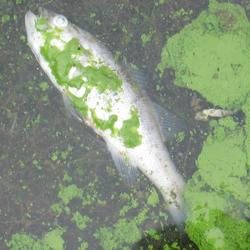
Toxins and Harmful Algal Blooms Science Team
The team develops advanced methods to study factors driving algal toxin production, how and where wildlife or humans are exposed to toxins, and ecotoxicology. That information is used to develop decision tools to understand if toxin exposure leads to adverse health effects in order to protect human and wildlife health.

Ecologically-Driven Exposure Pathways Science Team
The Ecologically-Driven Exposure Pathways Integrated Science Team identifies how ecological pathways and physiological processes within a single organism can alter exposure and toxicity of contaminants and pathogens and seek to understand outcomes at different scales from individuals to populations and ecosystems.