



Smallmouth bass research in Wisconsin may help fishery managers determine a sampling method to index recruitment before smallmouth bass enter the fishery and may address concerns regarding the effects of nest fishing on recruitment.
Images
We are cultivating and sharing the creativity, vision, and innovative perspectives that can be found among our graduate student, staff, faculty, and friends.
Filter Total Items: 391

Smallmouth bass
Smallmouth bass research in Wisconsin may help fishery managers determine a sampling method to index recruitment before smallmouth bass enter the fishery and may address concerns regarding the effects of nest fishing on recruitment.
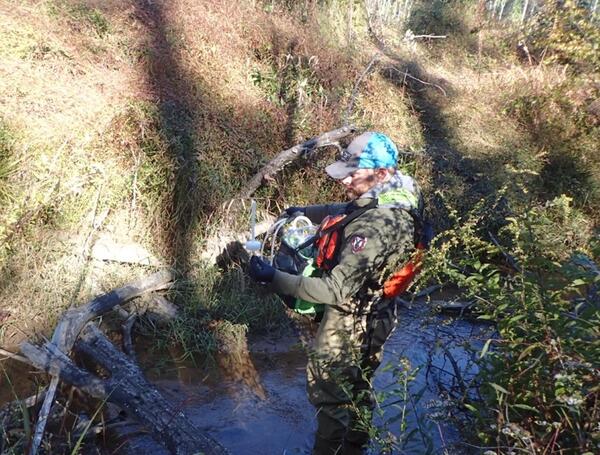
Robert Paine collecting environmental DNA from Little Chucky Creek, Tennessee
Robert Paine collecting environmental DNA from Little Chucky Creek, TennesseePostdoctoral Researcher Robert Paine is collecting environmental DNA from Little Chucky Creek, Tennessee, on a brisk morning. Personal Protective Equipment (PPE) is important for the safety of persons (e.g., life jackets), but also important for gathering robust, quality data (e.g., gloves to prevent contamination).
Robert Paine collecting environmental DNA from Little Chucky Creek, Tennessee
Robert Paine collecting environmental DNA from Little Chucky Creek, TennesseePostdoctoral Researcher Robert Paine is collecting environmental DNA from Little Chucky Creek, Tennessee, on a brisk morning. Personal Protective Equipment (PPE) is important for the safety of persons (e.g., life jackets), but also important for gathering robust, quality data (e.g., gloves to prevent contamination).

Graduate student measures hybrid striped bass
Georgia Cooperative Fish & Wildlife Research Unit graduate student Zoe Scribner measures a Hybrid Striped Bass (Morone chrysops × M. saxatilis), while staff scientist Dr. Troy Simon records data, for a project assisting the Georgia Department of Natural Resources on Carters Lake, Georgia (Nov. 2024).
Georgia Cooperative Fish & Wildlife Research Unit graduate student Zoe Scribner measures a Hybrid Striped Bass (Morone chrysops × M. saxatilis), while staff scientist Dr. Troy Simon records data, for a project assisting the Georgia Department of Natural Resources on Carters Lake, Georgia (Nov. 2024).
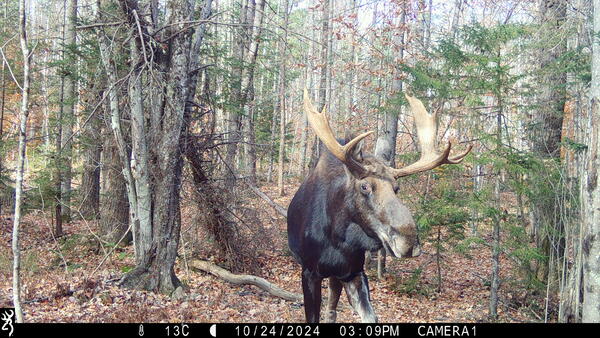
A moose is caught on camera by a trail cam deep in the forest
A moose is caught on camera by a trail cam deep in the forestUSGS researchers at the Vermont Cooperative Fish and Wildlife Research Unit have released AMMonitor 2, an R package design
A moose is caught on camera by a trail cam deep in the forest
A moose is caught on camera by a trail cam deep in the forestUSGS researchers at the Vermont Cooperative Fish and Wildlife Research Unit have released AMMonitor 2, an R package design

USGS Texas Cooperative Fish and Wildlife Research Unit Scientists and CRU Deputy pose for a picture on the dock in Rockport, Texas
USGS Texas Cooperative Fish and Wildlife Research Unit Scientists and CRU Deputy pose for a picture on the dock in Rockport, TexasA photo featuring the USGS Texas Cooperative Fish and Wildlife Research Unit (CRU) scientists and CRU Deputy standing on the dock in Rockport, Texas (from left to right), Clint Boal, Reynaldo Patino (retired), Kevin Pope, and Jane Rogosch. Photo taken by Kevin Mayes, Texas Parks and Wildlife Department) Copyright release on file.
USGS Texas Cooperative Fish and Wildlife Research Unit Scientists and CRU Deputy pose for a picture on the dock in Rockport, Texas
USGS Texas Cooperative Fish and Wildlife Research Unit Scientists and CRU Deputy pose for a picture on the dock in Rockport, TexasA photo featuring the USGS Texas Cooperative Fish and Wildlife Research Unit (CRU) scientists and CRU Deputy standing on the dock in Rockport, Texas (from left to right), Clint Boal, Reynaldo Patino (retired), Kevin Pope, and Jane Rogosch. Photo taken by Kevin Mayes, Texas Parks and Wildlife Department) Copyright release on file.

Mallard
Mallard is a large dabbling duck, length 15-16 inches, with a wingspan up to 36 inches.
Mallard is a large dabbling duck, length 15-16 inches, with a wingspan up to 36 inches.

White-tailed deer
White-tailed deer is native to North America and live in most states except Alaska, California, Nevada, and Utah (source: USFS).
White-tailed deer is native to North America and live in most states except Alaska, California, Nevada, and Utah (source: USFS).

Oak forest in Waterloo State Recreation area in southern Michigan
Oak forest in Waterloo State Recreation area in southern MichiganWaterloo State Recreation area in southern MI. Like the Huron National Forest near Cadillac, Michigan, this site had around 68% cover of northern red oak and red maple was the largest associate.
Oak forest in Waterloo State Recreation area in southern Michigan
Oak forest in Waterloo State Recreation area in southern MichiganWaterloo State Recreation area in southern MI. Like the Huron National Forest near Cadillac, Michigan, this site had around 68% cover of northern red oak and red maple was the largest associate.

Yellowstone cutthroat trout
Yellowstone cutthroat trout from the upper Yellowstone drainage south of Yellowstone National Park.
Yellowstone cutthroat trout from the upper Yellowstone drainage south of Yellowstone National Park.

White-tailed deer
A young white-tailed deer standing in the woods at 1300 feet elevation. Cervidae (the deer family; referred to as “cervids”), hooved animals.
A young white-tailed deer standing in the woods at 1300 feet elevation. Cervidae (the deer family; referred to as “cervids”), hooved animals.

Pacific Island Coral Reef and Fish
Coral reef fish assemblage in the Kealakekua Bay Marine Life Conservation District off the leeward side of Hawaiʻi Island, Hawaiʻi on 11 November 2016.
Coral reef fish assemblage in the Kealakekua Bay Marine Life Conservation District off the leeward side of Hawaiʻi Island, Hawaiʻi on 11 November 2016.
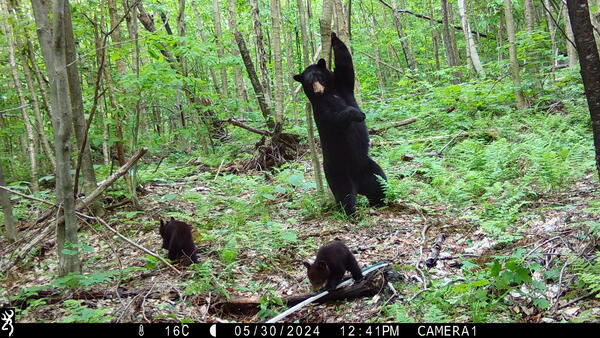
A trail camera records a bear standing in the woods with two cubs
A trail camera records a bear standing in the woods with two cubsUSGS researchers at the Vermont Cooperative Fish and Wildlife Research Unit have released AMMonitor 2, an R package design
A trail camera records a bear standing in the woods with two cubs
A trail camera records a bear standing in the woods with two cubsUSGS researchers at the Vermont Cooperative Fish and Wildlife Research Unit have released AMMonitor 2, an R package design
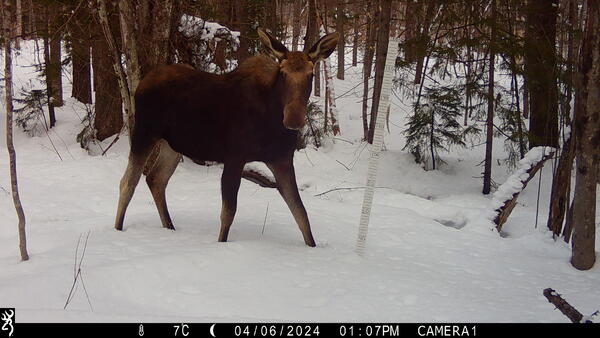
Moose sighting on a trail camera
USGS researchers at the Vermont Cooperative Fish and Wildlife Research Unit released AMMonitor 2, a fully open-source wildlife monitoring R package useful for students and users with some coding experience who desire a standardized yet flexible data management framework.
USGS researchers at the Vermont Cooperative Fish and Wildlife Research Unit released AMMonitor 2, a fully open-source wildlife monitoring R package useful for students and users with some coding experience who desire a standardized yet flexible data management framework.

Christina Murphy
Christina Murphy is the Assistant Unit Leader, Maine Cooperative Fish and Wildlife Research Unit. Originally from Oregon, Christina received her MSc from the University of Girona, Spain and her PhD from Oregon State University. She was a post-doctoral fellow at Oregon State University before joining the Maine Unit in late 2020.
Christina Murphy is the Assistant Unit Leader, Maine Cooperative Fish and Wildlife Research Unit. Originally from Oregon, Christina received her MSc from the University of Girona, Spain and her PhD from Oregon State University. She was a post-doctoral fellow at Oregon State University before joining the Maine Unit in late 2020.

Michael Quist
Mike received his BS in Fishery Resources from the University of Idaho, MS in Biology from Kansas State University, and a PhD in Biology from Kansas State University.
Mike received his BS in Fishery Resources from the University of Idaho, MS in Biology from Kansas State University, and a PhD in Biology from Kansas State University.

Kevin Pope
Kevin earned a B.S. from Texas A&M University, an M.S. from Auburn University, and a Ph.D. from South Dakota State University. Prior to joining the Nebraska Unit, he was a tenured Associate Professor at Texas Tech University.
Kevin earned a B.S. from Texas A&M University, an M.S. from Auburn University, and a Ph.D. from South Dakota State University. Prior to joining the Nebraska Unit, he was a tenured Associate Professor at Texas Tech University.
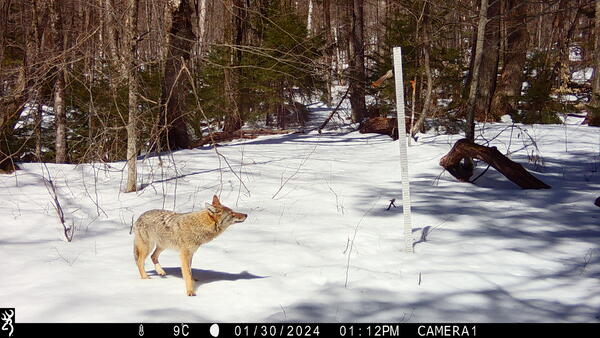
A trail camera records a coyote in the snow-covered woods
A trail camera records a coyote in the snow-covered woodsUSGS researchers at the Vermont Cooperative Fish and Wildlife Research Unit have released AMMonitor 2, an R package design
A trail camera records a coyote in the snow-covered woods
A trail camera records a coyote in the snow-covered woodsUSGS researchers at the Vermont Cooperative Fish and Wildlife Research Unit have released AMMonitor 2, an R package design

Adélie penguins
The Adélie penguin is a sea-ice obligate species so ocean habitats in the Southern Ocean surrounding Antarctica are crucial during all stages of the species annual cycle.
The Adélie penguin is a sea-ice obligate species so ocean habitats in the Southern Ocean surrounding Antarctica are crucial during all stages of the species annual cycle.
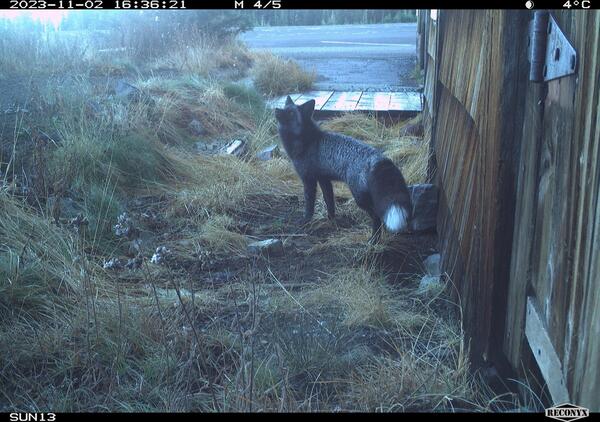
Cascade red fox
The Cascade red fox (Vulpes vulpes cascadensis) is one of the rarest and most genetically distinct carnivores in North America. Currently, Cascade red fox appear to be absent from the North Cascades and are found primarily in Washington’s South Cascades, including Mount Rainier National Park and the surrounding wilderness areas.
The Cascade red fox (Vulpes vulpes cascadensis) is one of the rarest and most genetically distinct carnivores in North America. Currently, Cascade red fox appear to be absent from the North Cascades and are found primarily in Washington’s South Cascades, including Mount Rainier National Park and the surrounding wilderness areas.

Brett Degregorio
I completed a B.S. in Wildlife and Fisheries Conservation at the University of Massachusetts in Amherst in 2004, a M.S. in Biology at Purdue at Fort Wayne in 2008, and a PhD in Natural Resources at University of Illinois in 2014.
I completed a B.S. in Wildlife and Fisheries Conservation at the University of Massachusetts in Amherst in 2004, a M.S. in Biology at Purdue at Fort Wayne in 2008, and a PhD in Natural Resources at University of Illinois in 2014.

Javan Bauder
Javan was born and raised in the Pacific Northwest (Washington and Idaho) and received his M.S. from Idaho State University where he studied the movement and habitat ecology of prairie rattlesnakes. He then worked for non-profit reptile conservation organization, The Orianne Society, conducting and directing research projects to guide reptile conservation efforts.
Javan was born and raised in the Pacific Northwest (Washington and Idaho) and received his M.S. from Idaho State University where he studied the movement and habitat ecology of prairie rattlesnakes. He then worked for non-profit reptile conservation organization, The Orianne Society, conducting and directing research projects to guide reptile conservation efforts.