



Exploring the Sensitivity of Salmonids to 6PPD-Quinone: Implications for Urban Ecosystems
The USGS is investigating the effects of 6PPD-quinone (6PPDQ), a harmful contaminant found in urban stormwater runoff, on fish and wildlife health, particularly in salmonids. Recent studies have shown that 6PPDQ poses acute toxicity risks, especially to coho salmon, with sensitivity varying by life stage. New research evaluated the lethal and sublethal impacts of 6PPDQ exposure on coastal cutthroat trout (aka sea-run cutthroat trout) whose range overlaps coho salmon, and how 6PPDQ may affect their susceptibility to disease, and swimming performance. Ultimately, the findings will enhance understanding of the risks 6PPDQ poses to salmonid populations, informing conservation and management strategies in urban-impacted aquatic ecosystems.

The USGS is conducting this research to address threats to fish and wildlife by habitat loss and pollution, especially from urban stormwater runoff, which can carry harmful substances into waterways. One contaminant of particular concern is 6PPD-quinone (6PPDQ), which is the oxidized form of the chemical compound 6PPD used to prevent tires from degrading and cracking, shed from tires during normal wear. Previous findings from USGS have highlighted the acute toxicity of 6PPDQ in coho salmon hatchlings, linked to urban runoff mortality syndrome, where juvenile coho salmon exhibit increased mortality at concentrations commonly found in urban stormwater runoff.
As cities expand, it's important to understand how different fish species respond to harmful substances like 6PPDQ. This is especially true because vehicle tires are found everywhere around the world, making 6PPDQ a global issue that affects us all. Research indicates that some salmonids (salmon and trout) are especially sensitive to 6PPDQ, and their sensitivity can vary depending on life stage. This is important in the Pacific Northwest (PNW), where many salmon and trout live in areas affected by urban development. One native species, the coastal cutthroat trout (CCT), is a popular sport fish and serves as an important food source for birds, mammals, and humans. They are very sensitive to environmental changes, making them good indicators of ecosystem health.
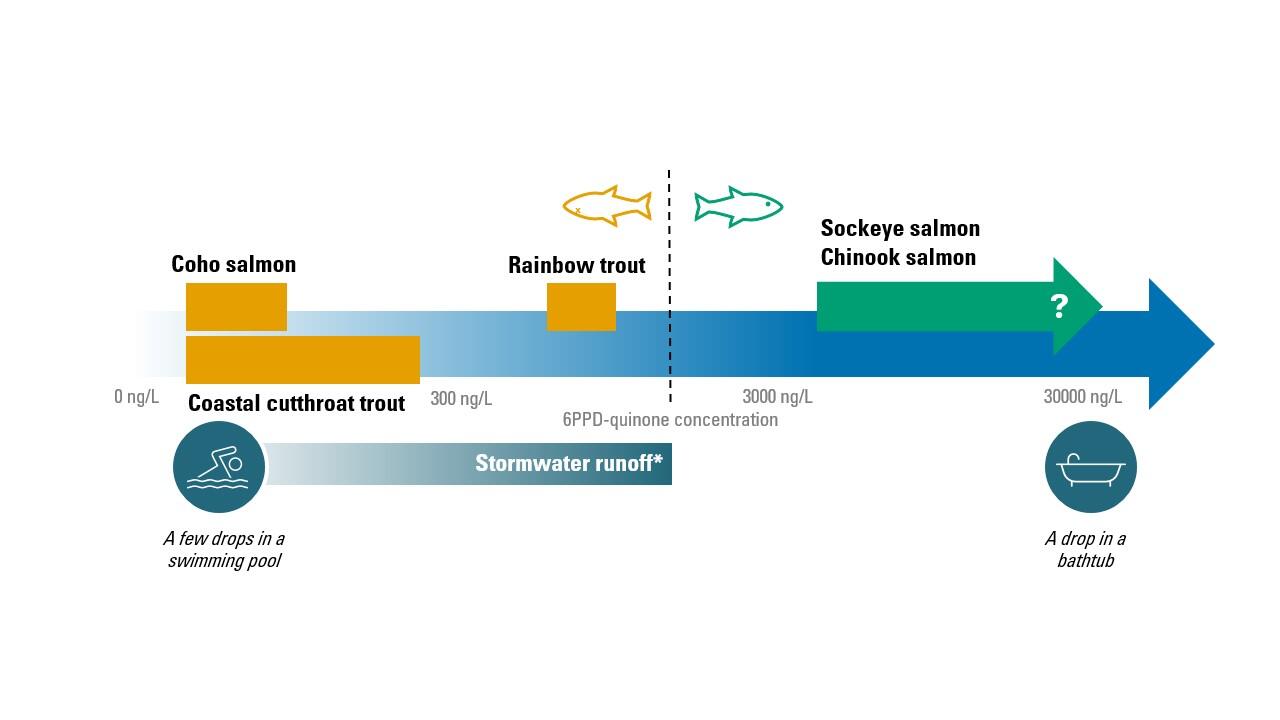
In this study, USGS scientists evaluated how 6PPDQ affects CCT at different life stages, such as when they hatch and as young trout. USGS scientists found that 6PPDQ can cause CCT mortality at concentrations often found in PNW streams and creeks during and after rainfall events, especially effecting young trout like swim-up fry and 5-month parr, which are as sensitive to 6PPDQ as coho salmon. Both coho salmon and CCT spend significant time in freshwater streams from birth through juvenile development before going to sea and later returning as adults to natal streams to spawn for the next generation. Given the frequent nature of rainfall and busy roadways in the PNW, 6PPDQ represents a significant threat for both coho salmon and cutthroat trout on a population-wide basis.
The research also examined potential effects on disease resistance and swimming ability. Understanding how these fish might be more vulnerable to diseases upon exposure to stormwater runoff, such as the infectious hematopoietic necrosis virus (IHNV), and how their swimming skills are impacted, is important for their overall health and survival. If fish can’t swim well, they may have a higher chance of dying, which can upset the balance of aquatic ecosystems. Additionally, if fish become more susceptible to diseases, this could lead to significant declines in their populations, which would affect both the fish species and the fishing industries that rely on them. The scientists discovered that exposure to 6PPDQ can also weaken their swimming ability, which is essential for survival. However, they found that sublethal levels of exposure did not make the fish more vulnerable to IHNV. While the long-term effects of 6PPDQ on CCT populations in urban streams are still unclear, this research highlights the importance of finding safer alternatives in tire manufacturing to help protect aquatic environments and the economy. Ongoing USGS research includes assessing toxicity of potential 6PPD alternatives in collaboration with state, federal and industrial partners.
Through this study, the USGS aimed to better understand the dangers that 6PPDQ posed to the health and survival of a native salmonid species. The findings can help guide strategies for managing fish populations. This research is crucial for maintaining healthy fish populations, as they play a key role in maintaining ecological balance and are important for cultural and economic activities like commercial and recreational fishing.
This research was funded by the USGS Ecosystems Mission Area through the Environmental Health Program (specifically the Contaminant Biology and Toxic Substances Hydrology components) and the Biological Threats and Invasive Species Research Program. Additional funding was provided by the U.S. Environmental Protection Agency's Puget Sound Geographic Program through Interagency Agreements DW-014-92581001 and DW-014-92596001.
The research also explored potential effects on disease resistance and swimming ability. Understanding how exposure to stormwater runoff affects fish vulnerability to diseases like infectious hematopoietic necrosis virus (IHNV) and their swimming performance is crucial for their overall health. Impaired swimming can increase mortality risk and disrupt aquatic ecosystems. While exposure to 6PPDQ weakened swimming ability, sublethal levels did not increase susceptibility to IHNV.
Although the long-term effects of 6PPDQ on CCT populations remain unclear, this research underscores the need for safer alternatives in tire manufacturing to protect aquatic ecosystems and the economy. Ongoing USGS research includes evaluating the toxicity of potential alternatives in collaboration with state, federal, and industrial partners.
This study aims to better understand the risks that 6PPDQ poses to native salmonid health and survival, providing insights to guide fish population management. Maintaining healthy fish populations is essential for ecological balance and supports cultural and economic activities like fishing.
Funding for this research comes from the USGS Ecosystems Mission Area through the Environmental Health Program (Contaminant Biology and Toxic Substances Hydrology Programs) and the Biological Threats and Invasive Species Research Program, with additional support from the U.S. Environmental Protection Agency’s Puget Sound Geographic Program.

USGS Research on 6PPD-quinone: Where the Rubber Meets the Road

Preliminary Research Sheds Light on Proper Analysis and Sample Handling for the Tire-Derived Contaminants 6PPD and 6PPD-quinone

From Tread to Watershed: How Tire Wear Particle Chemicals 6PPD and 6PPD-quinone Are Impacting Waterways

6PPDQ
The USGS is investigating the effects of 6PPD-quinone (6PPDQ), a harmful contaminant found in urban stormwater runoff, on fish and wildlife health, particularly in salmonids. Recent studies have shown that 6PPDQ poses acute toxicity risks, especially to coho salmon, with sensitivity varying by life stage. New research evaluated the lethal and sublethal impacts of 6PPDQ exposure on coastal cutthroat trout (aka sea-run cutthroat trout) whose range overlaps coho salmon, and how 6PPDQ may affect their susceptibility to disease, and swimming performance. Ultimately, the findings will enhance understanding of the risks 6PPDQ poses to salmonid populations, informing conservation and management strategies in urban-impacted aquatic ecosystems.
The USGS is conducting this research to address threats to fish and wildlife by habitat loss and pollution, especially from urban stormwater runoff, which can carry harmful substances into waterways. One contaminant of particular concern is 6PPD-quinone (6PPDQ), which is the oxidized form of the chemical compound 6PPD used to prevent tires from degrading and cracking, shed from tires during normal wear. Previous findings from USGS have highlighted the acute toxicity of 6PPDQ in coho salmon hatchlings, linked to urban runoff mortality syndrome, where juvenile coho salmon exhibit increased mortality at concentrations commonly found in urban stormwater runoff.
As cities expand, it's important to understand how different fish species respond to harmful substances like 6PPDQ. This is especially true because vehicle tires are found everywhere around the world, making 6PPDQ a global issue that affects us all. Research indicates that some salmonids (salmon and trout) are especially sensitive to 6PPDQ, and their sensitivity can vary depending on life stage. This is important in the Pacific Northwest (PNW), where many salmon and trout live in areas affected by urban development. One native species, the coastal cutthroat trout (CCT), is a popular sport fish and serves as an important food source for birds, mammals, and humans. They are very sensitive to environmental changes, making them good indicators of ecosystem health.
In this study, USGS scientists evaluated how 6PPDQ affects CCT at different life stages, such as when they hatch and as young trout. USGS scientists found that 6PPDQ can cause CCT mortality at concentrations often found in PNW streams and creeks during and after rainfall events, especially effecting young trout like swim-up fry and 5-month parr, which are as sensitive to 6PPDQ as coho salmon. Both coho salmon and CCT spend significant time in freshwater streams from birth through juvenile development before going to sea and later returning as adults to natal streams to spawn for the next generation. Given the frequent nature of rainfall and busy roadways in the PNW, 6PPDQ represents a significant threat for both coho salmon and cutthroat trout on a population-wide basis.
The research also examined potential effects on disease resistance and swimming ability. Understanding how these fish might be more vulnerable to diseases upon exposure to stormwater runoff, such as the infectious hematopoietic necrosis virus (IHNV), and how their swimming skills are impacted, is important for their overall health and survival. If fish can’t swim well, they may have a higher chance of dying, which can upset the balance of aquatic ecosystems. Additionally, if fish become more susceptible to diseases, this could lead to significant declines in their populations, which would affect both the fish species and the fishing industries that rely on them. The scientists discovered that exposure to 6PPDQ can also weaken their swimming ability, which is essential for survival. However, they found that sublethal levels of exposure did not make the fish more vulnerable to IHNV. While the long-term effects of 6PPDQ on CCT populations in urban streams are still unclear, this research highlights the importance of finding safer alternatives in tire manufacturing to help protect aquatic environments and the economy. Ongoing USGS research includes assessing toxicity of potential 6PPD alternatives in collaboration with state, federal and industrial partners.
Through this study, the USGS aimed to better understand the dangers that 6PPDQ posed to the health and survival of a native salmonid species. The findings can help guide strategies for managing fish populations. This research is crucial for maintaining healthy fish populations, as they play a key role in maintaining ecological balance and are important for cultural and economic activities like commercial and recreational fishing.
This research was funded by the USGS Ecosystems Mission Area through the Environmental Health Program (specifically the Contaminant Biology and Toxic Substances Hydrology components) and the Biological Threats and Invasive Species Research Program. Additional funding was provided by the U.S. Environmental Protection Agency's Puget Sound Geographic Program through Interagency Agreements DW-014-92581001 and DW-014-92596001.
The research also explored potential effects on disease resistance and swimming ability. Understanding how exposure to stormwater runoff affects fish vulnerability to diseases like infectious hematopoietic necrosis virus (IHNV) and their swimming performance is crucial for their overall health. Impaired swimming can increase mortality risk and disrupt aquatic ecosystems. While exposure to 6PPDQ weakened swimming ability, sublethal levels did not increase susceptibility to IHNV.
Although the long-term effects of 6PPDQ on CCT populations remain unclear, this research underscores the need for safer alternatives in tire manufacturing to protect aquatic ecosystems and the economy. Ongoing USGS research includes evaluating the toxicity of potential alternatives in collaboration with state, federal, and industrial partners.
This study aims to better understand the risks that 6PPDQ poses to native salmonid health and survival, providing insights to guide fish population management. Maintaining healthy fish populations is essential for ecological balance and supports cultural and economic activities like fishing.
Funding for this research comes from the USGS Ecosystems Mission Area through the Environmental Health Program (Contaminant Biology and Toxic Substances Hydrology Programs) and the Biological Threats and Invasive Species Research Program, with additional support from the U.S. Environmental Protection Agency’s Puget Sound Geographic Program.
USGS Research on 6PPD-quinone: Where the Rubber Meets the Road
Preliminary Research Sheds Light on Proper Analysis and Sample Handling for the Tire-Derived Contaminants 6PPD and 6PPD-quinone
From Tread to Watershed: How Tire Wear Particle Chemicals 6PPD and 6PPD-quinone Are Impacting Waterways