U.S. flag

An official website of the United States government

Images

Images intro.
Filter Total Items: 139
Public-supply well in an arid area
Public-supply well tapping the High Plains aquifer, Texas

This public-supply well taps groundwater in the High Plains aquifer in Texas. The strontium concentration in the sample from this well was 4,630 micrograms per liter, exceeding the health-based screening level of 4,000 micrograms per liter.

This public-supply well taps groundwater in the High Plains aquifer in Texas. The strontium concentration in the sample from this well was 4,630 micrograms per liter, exceeding the health-based screening level of 4,000 micrograms per liter.
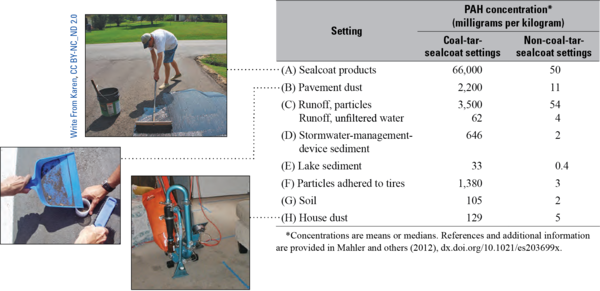
Photo of the Colorado River near Moab, Utah
Colorado River Near Moab, Utah.

Water flowing on the Colorado River near Moab, Utah. 

The entire Colorado River Basin currently supports 50 million people, and that amount is expected to increase by 23 million between 2000 and 2030. A new USGS study shows more than half of the streamflow in the Upper Colorado River Basin originates as groundwater. 

Water flowing on the Colorado River near Moab, Utah. 

The entire Colorado River Basin currently supports 50 million people, and that amount is expected to increase by 23 million between 2000 and 2030. A new USGS study shows more than half of the streamflow in the Upper Colorado River Basin originates as groundwater. 

Instrumentation at a groundwater well
Real-time measurement of variability in groundwater properties

Instrumentation for measuring real-time groundwater properties at the SGW-93 bedrock-aquifer public-supply well pump house in Seabrook, NH. Read the journal article.

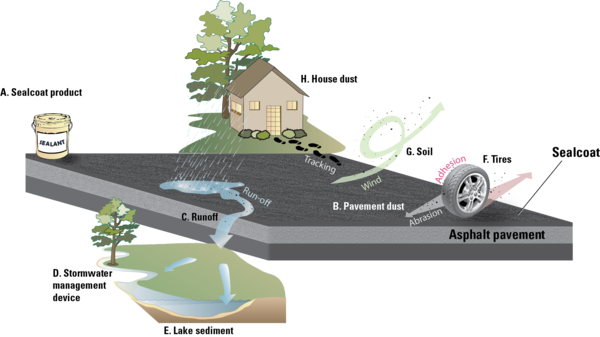
Diagram indicating pathways for transport of PAHs from coal-tar sealcoat
Transport pathways for PAHs from coal-tar-based sealcoat

Coal-tar-based sealcoat is a potent source of PAHs and related chemicals. Worn particles of coal-tar-based sealcoat are transported by rain, wind, tires, and even our feet from pavement to other environmental settings. Sealcoat product (A), after it dries, gradually abrades to a powder and becomes part of the dust on the pavement (B).

Coal-tar-based sealcoat is a potent source of PAHs and related chemicals. Worn particles of coal-tar-based sealcoat are transported by rain, wind, tires, and even our feet from pavement to other environmental settings. Sealcoat product (A), after it dries, gradually abrades to a powder and becomes part of the dust on the pavement (B).

Table of PAH concentrations near coal-tar-sealcoated pavement
PAHs near pavement sealed or not sealed with coal-tar sealant

Concentrations of polycyclic aromatic hydrocarbons (PAHs) in settings near pavement sealed with coal-tar-based sealants were substantially higher than concentrations in settings where coal-tar sealant was not used.

Concentrations of polycyclic aromatic hydrocarbons (PAHs) in settings near pavement sealed with coal-tar-based sealants were substantially higher than concentrations in settings where coal-tar sealant was not used.

Diagram describing coal tar process
Flow diagram of coal to coal-tar-pitch process

Coal tar is a byproduct of the coking, liquefaction, or gasification of coal. Coal-tar pitch is the residue that remains after the distillation of coal tar. Coal tar and coal-tar pitch are used in coal-tar-based sealcoat products, although use of coal-tar pitch is more common than use of coal tar. Both coal tar and coal-tar pitch are known human carcinogens.

Coal tar is a byproduct of the coking, liquefaction, or gasification of coal. Coal-tar pitch is the residue that remains after the distillation of coal tar. Coal tar and coal-tar pitch are used in coal-tar-based sealcoat products, although use of coal-tar pitch is more common than use of coal tar. Both coal tar and coal-tar pitch are known human carcinogens.

A rainbow arc over a large-volume public-supply well
Rainbow and public-supply well

A large-volume public supply well in San Antonio, Texas.  This well is being sampled for water-quality constituents as part of the NAWQA Enhanced Trend Network project.

A large-volume public supply well in San Antonio, Texas.  This well is being sampled for water-quality constituents as part of the NAWQA Enhanced Trend Network project.

National maps of atrazine use and predicted concentrations of atrazine in shallow groundwater beneath agricultural land
U.S. maps of atrazine use and predicted concentrations in groundwater

Atrazine use (left) (left) is one of the most important factors used to predict atrazine and deethylatrazine concentrations in

Map of predicted concentrations of nitrate in groundwater of the U.S. in a color gradient ranging from blue (low) to red (high)
Predicted concentrations of nitrate in U.S. groundwater

Nitrate concentrations greater than the Maximum Contaminant Level (MCL) of 10 mg/L as N are predicted to occur primarily in the High Plains, northern Midwest, and areas of intense agriculture in the eastern and western United States.

Nitrate concentrations greater than the Maximum Contaminant Level (MCL) of 10 mg/L as N are predicted to occur primarily in the High Plains, northern Midwest, and areas of intense agriculture in the eastern and western United States.

The sampling point on a large-volume public-supply well is designated
Sampling point for a large-volume public-supply well

A large-volume public supply well in San Antonio, Texas.  This well is being sampled for water-quality constituents as part of the NAWQA Enhanced Trend Network project.

A USGS hydrotech stands below the sampling point of a high-volume public-supply well
Sampling point for a large-volume public-supply well

A large-volume public supply well in San Antonio, Texas.  This well is being sampled for water-quality constituents as part of the NAWQA Enhanced Trend Network project.

Two men collecting groundwater samples at a public well in the middle of a grassy field in Texas
Scientists Sampling Groundwater from a Public Supply Well in Texas
Signs warn public of dangers of harmful algal blooms
Salmonids are inventoried during the ecosurveys done for the Regional Stream Quality Assessment (RSQA)
Salmonid in a Pacific Northwest Stream
Photograph showing San Pedro Riparian National Conservation Area.
San Pedro Riparian National Conservation Area

Photograph showing San Pedro Riparian National Conservation Area, residential development southeast of Sierra Vista, Arizona, and the Huachuca Mountains from Hereford Road, Cochise County, Arizona. 

Photograph showing San Pedro Riparian National Conservation Area, residential development southeast of Sierra Vista, Arizona, and the Huachuca Mountains from Hereford Road, Cochise County, Arizona. 

Equipment for collecting a groundwater sample is spread on a table
Groundwater sample collection

Collecting a groundwater-quality sample from a public-supply well. This well is being sampled for water-quality constituents as part of the NAWQA Enhanced Trend Network project.

Collecting a groundwater-quality sample from a public-supply well. This well is being sampled for water-quality constituents as part of the NAWQA Enhanced Trend Network project.

Columbia River flows by highway in Portland, OR, with Mt. Hood in background
Columbia River in Portland, OR, with Mt. Hood
Public-supply well
A chain-link fence encloses a public-supply well.

A large-volume public supply well in San Antonio, Texas.  This well is being sampled for water-quality constituents as part of the NAWQA Enhanced Trend Network project.

Was this page helpful?