
U.S. flag

An official website of the United States government

Migratory Birds

Filter Total Items: 127

Landbird Research in Alaska

On this page, learn about USGS work with the Alaska Landbird Monitoring Survey (ALMS), Beak Deformities in Landbirds, and Boreal Partners in Flight (BPIF).
Landbird Research in Alaska

Landbird Research in Alaska

On this page, learn about USGS work with the Alaska Landbird Monitoring Survey (ALMS), Beak Deformities in Landbirds, and Boreal Partners in Flight (BPIF).
Learn More

Waterfowl Research

Scientists at the USGS Alaska Science Center have conducted research on waterfowl species (ducks, geese, and swans) in Alaska since the 1970s. Because Alaska is an international crossroads of migratory bird flyways, with millions of birds from Asia and North America breeding in Alaska each summer, USGS research has also taken place in adjacent countries (Russia, Japan, Canada, Mexico) and in the...
Waterfowl Research

Waterfowl Research

Scientists at the USGS Alaska Science Center have conducted research on waterfowl species (ducks, geese, and swans) in Alaska since the 1970s. Because Alaska is an international crossroads of migratory bird flyways, with millions of birds from Asia and North America breeding in Alaska each summer, USGS research has also taken place in adjacent countries (Russia, Japan, Canada, Mexico) and in the...
Learn More

Sea Duck Research

USGS research on sea ducks is designed to anticipate and address priority information needs of management agencies. Additionally, work is focused on individual species biology, migration and population status and trends because until recently, very little was known about sea ducks in Alaska.
Sea Duck Research

Sea Duck Research

USGS research on sea ducks is designed to anticipate and address priority information needs of management agencies. Additionally, work is focused on individual species biology, migration and population status and trends because until recently, very little was known about sea ducks in Alaska.
Learn More

Shorebird Research

With its vast size and geographic position at the northern end of several migration pathways, Alaska is a critically important site for the world’s shorebirds. Thirty-seven shorebird species regularly breed in Alaska. Most of these species conduct epically long migrations to take advantage of Alaska’s abundant food resources and breeding habitat, making Alaska a global resource for shorebirds...
Shorebird Research

Shorebird Research

With its vast size and geographic position at the northern end of several migration pathways, Alaska is a critically important site for the world’s shorebirds. Thirty-seven shorebird species regularly breed in Alaska. Most of these species conduct epically long migrations to take advantage of Alaska’s abundant food resources and breeding habitat, making Alaska a global resource for shorebirds...
Learn More

Seabirds and Forage Fish Ecology

Alaska's coastal and offshore waters provide foraging habitat for an estimated 100 million birds comprising more than 90 different species; from loons and seaducks that nest inland, to petrels and puffins that breed on islands off shore. All these birds depend on the sea to provide a wide variety of food types— from clams, crabs and urchins nearshore— to krill, forage fish, and squid offshore. The...
Seabirds and Forage Fish Ecology

Seabirds and Forage Fish Ecology

Alaska's coastal and offshore waters provide foraging habitat for an estimated 100 million birds comprising more than 90 different species; from loons and seaducks that nest inland, to petrels and puffins that breed on islands off shore. All these birds depend on the sea to provide a wide variety of food types— from clams, crabs and urchins nearshore— to krill, forage fish, and squid offshore. The...
Learn More

North Pacific Pelagic Seabird Database

The North Pacific Pelagic Seabird Database (NPPSD) contains survey transect data designed and conducted by numerous partners primarily to census seabirds at sea. The NPPSD includes more than 486,000 transect segments and includes observations of over 20 million birds of 258 species collected over the span of 50 years (from 1973 to 2022).
North Pacific Pelagic Seabird Database

North Pacific Pelagic Seabird Database

The North Pacific Pelagic Seabird Database (NPPSD) contains survey transect data designed and conducted by numerous partners primarily to census seabirds at sea. The NPPSD includes more than 486,000 transect segments and includes observations of over 20 million birds of 258 species collected over the span of 50 years (from 1973 to 2022).
Learn More

USGS Northern Rocky Mountain Science Center Fiscal Year 2025 Highlights

The USGS Northern Rocky Mountain Science Center (NOROCK) proudly supports Federal, State, Tribal, and other partners by delivering high-quality data, cutting-edge science, and practical tools to support natural resource management. Below are some of NOROCK’s highlights during fiscal year 2025.
USGS Northern Rocky Mountain Science Center Fiscal Year 2025 Highlights

USGS Northern Rocky Mountain Science Center Fiscal Year 2025 Highlights

The USGS Northern Rocky Mountain Science Center (NOROCK) proudly supports Federal, State, Tribal, and other partners by delivering high-quality data, cutting-edge science, and practical tools to support natural resource management. Below are some of NOROCK’s highlights during fiscal year 2025.
Learn More

Tracking Data for Spectacled Eiders (Somateria fischeri)

Available here are tracking data of Spectacled Eider, a sea duck species that breeds only in Alaska and Russia and spends the winter exclusively in the Bering Sea. The Alaska breeding population is listed as threatened under provisions of the Endangered Species Act. These data were collected to better understand the winter distribution in the Bering Sea and locate birds for winter aerial surveys...
Tracking Data for Spectacled Eiders (Somateria fischeri)

Tracking Data for Spectacled Eiders (Somateria fischeri)

Available here are tracking data of Spectacled Eider, a sea duck species that breeds only in Alaska and Russia and spends the winter exclusively in the Bering Sea. The Alaska breeding population is listed as threatened under provisions of the Endangered Species Act. These data were collected to better understand the winter distribution in the Bering Sea and locate birds for winter aerial surveys...
Learn More

Tracking Data for Common Eiders (Somateria mollissima)

Available here are tracking data of Common Eider, a sea duck species found across Alaska and the Arctic. Some populations migrate between distant breeding and wintering areas while others are essentially nonmigratory. These data were collected to better understand the migration of the different populations in Alaska and migratory connectivity to adjacent regions, such as Russia.
Tracking Data for Common Eiders (Somateria mollissima)

Tracking Data for Common Eiders (Somateria mollissima)

Available here are tracking data of Common Eider, a sea duck species found across Alaska and the Arctic. Some populations migrate between distant breeding and wintering areas while others are essentially nonmigratory. These data were collected to better understand the migration of the different populations in Alaska and migratory connectivity to adjacent regions, such as Russia.
Learn More

Changing Arctic Ecosystems

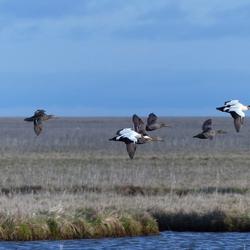
Arctic regions of Alaska are important for cultural and economic sustainability and host a wide variety of wildlife species, many of which are of conservation and management interest to the U.S. Department of the Interior. The USGS and collaborators provide information about Arctic ecosystems that are used by Arctic residents, management agencies, and industry.
Changing Arctic Ecosystems

Changing Arctic Ecosystems

Arctic regions of Alaska are important for cultural and economic sustainability and host a wide variety of wildlife species, many of which are of conservation and management interest to the U.S. Department of the Interior. The USGS and collaborators provide information about Arctic ecosystems that are used by Arctic residents, management agencies, and industry.
Learn More

USGS Avian Research: Collaborative Science for Bird Management and Conservation

USGS scientists lead activities that are central to bird conservation and support both wildlife and communities. Through close collaboration with conservation partners, our scientists are meeting real-world needs—from maintaining sustainable harvest opportunities to advancing species recovery efforts.
USGS Avian Research: Collaborative Science for Bird Management and Conservation

USGS Avian Research: Collaborative Science for Bird Management and Conservation

USGS scientists lead activities that are central to bird conservation and support both wildlife and communities. Through close collaboration with conservation partners, our scientists are meeting real-world needs—from maintaining sustainable harvest opportunities to advancing species recovery efforts.
Learn More

Science in Flight: Seven Ways Bird Science Serves Society

Explore seven case studies highlighting how USGS bird research informs real-world decisions.
Science in Flight: Seven Ways Bird Science Serves Society

Science in Flight: Seven Ways Bird Science Serves Society

Explore seven case studies highlighting how USGS bird research informs real-world decisions.
Learn More
Was this page helpful?