



Water use
Water is everywhere, which is fortunate for all of humanity, as water is essential for life. Even though water is not always available in the needed quantity and quality for all people everywhere, people have learned to get and use water for all of their needs, from drinking, cleaning, irrigating crops, producing electricity, and for just having fun.
-
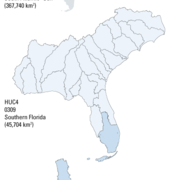
What is a HUC? What is a HUC?
A Hydrologic Unit Code (HUC) is a numerical ID that acts like a “zip code for your watershed.” It is part of a hierarchical system created by the U.S. Geological Survey (USGS) to classify land areas based on where water flows. Each hydrologic unit represents an area where all rainfall, snow, and surface water drains to a common outlet. USGS organizes water regions by Hydrologic Unit Codes (HUCs),
Water Use in the United States, 2015
Summaries
Summaries
-

Accessing Water Use Data
The USGS provides historic and recent water use data for the United States including the District of Columbia, Puerto Rico, and the U.S. Virgin Islands. This page provides an up-to-date guide to accessing, downloading, and using USGS water use data.
-

Total Water Use in the United States
The water in the Nation's rivers, lakes, reservoirs, and underground aquifers are vitally important to our everyday life. These water bodies supply the water to serve the needs of every human and for the world's ecological systems, too. Here in the United States, every 5 years the U.S. Geological Survey (USGS) compiles county, state, and National water withdrawal and use data for a number of water...
Groundwater Use in the United States
Groundwater is one of our most valuable resource—even though you probably never see it or even realize it is there. Groundwater is essential for irrigation and human use in many parts of the country. The use of groundwater in the United States in 2015 is described below.
Surface Water Use in the United States
The Nation's surface-water resources—the water in the nation's rivers, streams, creeks, lakes, and reservoirs—are vitally important to our everyday life.
Saline Water Use in the United States
Do you wear contact lenses? If so, you most likely use a saline water solution to clean them. But what else do we use saline water for and do we really use that much? Read on to learn all about the use of saline water.
Freshwater Withdrawals in the United States
The freshwater in the Nation's rivers, streams, creeks, lakes, reservoirs, and in underground aquifers are vitally important to our everyday life, and, indeed, to all life on Earth.
Water Use by Category
Water Use by Category
-

Aquaculture Water Use
Aquaculture water use is water associated with raising organisms that live in water—such as finfish and shellfish—for food, restoration, conservation, or sport. Aquaculture production occurs under controlled feeding, sanitation, and harvesting procedures primarily in ponds, flowthrough raceways, and, to a lesser extent, cages, net pens, and closed-recirculation tanks.
Domestic Self-Supplied Water Use
Domestic self-supplied water is water used at home that does not come from a public water utility. This can include potable and non-potable water. The most common source of self-supplied water is a well. Other self-supplied water sources include capturing rainwater in a cistern, private surface water diversions (intakes), piping spring water to a home or outdoor faucet, or hauling jugs of water...
Industrial Water Use
The industries that produce metals, wood and paper products, chemicals, gasoline and oils, and those invaluable grabber utensils you use to get your ring (which also needed water to manufacture) out of the garbage disposal are major users of water.
Livestock Water Use
Livestock water use is water associated with livestock watering, feedlots, dairy operations, and other on-farm needs. Livestock includes dairy cows and heifers, beef cattle and calves, sheep and lambs, goats, hogs and pigs, horses, and poultry. Other livestock water uses include cooling of facilities for the animals and products, dairy sanitation and wash down of facilities, animal waste-disposal...
Mining Water Use
Mining water use is water used for the extraction of minerals that may be in the form of solids, such as coal, iron, sand, and gravel; liquids, such as crude petroleum; and gases, such as natural gas. The category includes quarrying, milling of mined materials, injection of water for secondary oil recovery or for unconventional oil and gas recovery (such as hydraulic fracturing), and other...
Public Supply Water Use
Public supply refers to water withdrawn by public and private water suppliers that provide water to at least 25 people or have a minimum of 15 connections to users. Public supply water is delivered for domestic (residential), commercial, and industrial purposes.
Thermoelectric Power Water Use
Much of the electricity used in the United States and worldwide comes from thermoelectric power plants, which use water for both steam generation and cooling. Thermoelectric power consumes, or loses water via evaporation, at rates that can be significant—especially in water-stressed regions.
Wastewater Treatment Water Use
Wastewater is used water. It includes substances such as human waste, food scraps, oils, soaps and chemicals. In homes, this includes water from sinks, showers, bathtubs, toilets, washing machines and dishwashers. Businesses and industries also contribute their share of used water that must be cleaned.
Irrigation Water Use
Throughout the world, irrigation (water for agriculture) is essential for keeping fruits, vegetables, and grains growing to feed the world's population. In addition, irrigation can alleviate crop stress from droughts, decrease soil erosion, and can reduce water pollution. USGS scientists provide estimates of irrigation water use to help water managers make informed decisions.
Historical Trends
Historical Trends
-
-
Trends in Water Use in the United States, 1950 to 2015
How has America's water use changed over the last 65 years? Are we using more or less water, and are there trends for different kinds of water use?
Water Use Information Topics
Hydroelectric Power
Hydroelectric Power
-

Hydroelectric Power Water Use
Hydropower, or hydroenergy, is a form of renewable energy that uses the water stored in dams, as well as flowing in rivers to create electricity in hydropower plants. The falling water rotates blades of a turbine, which then spins a generator that converts the mechanical energy of the spinning turbine into electrical energy. Hydroelectric power is a significant component of electricity production...
Hydroelectric Power: How it Works
So just how do we get electricity from water? Actually, hydroelectric and coal-fired power plants produce electricity in a similar way. In both cases a power source is used to turn a propeller-like piece called a turbine.-
Hydroelectric Power: Advantages of Production and Usage
Nothing is perfect on Earth, and that includes the production of electricity using flowing water. Hydroelectric-production facilities are indeed not perfect (a dam costs a lot to build and also can have negative effects on the environment and local ecology), but there are a number of advantages of hydroelectric-power production as opposed to fossil-fuel power production. 
Three Gorges Dam: The World's Largest Hydroelectric Plant
The Three Gorges Dam on the Yangtze River in China is the world's biggest hydroelectric facility.
Wastewater and Sewage Treatment
Wastewater and Sewage Treatment
-
-
Wastewater Treatment Water Use
Wastewater is used water. It includes substances such as human waste, food scraps, oils, soaps and chemicals. In homes, this includes water from sinks, showers, bathtubs, toilets, washing machines and dishwashers. Businesses and industries also contribute their share of used water that must be cleaned. 
A Visit to a Wastewater Treatment Plant
Have you ever wondered what happens to that water and waste after you flush? How about after you pull the plug on your tub? The modern wastewater-treatment plant employs basic physics and high technology to purify the dirtiest of water so it can go back into the environment as a member in good standing of the water cycle.
Reclaimed Wastewater
Thirsty? How about a refreshing cup of reclaimed wastewater? No, we're kidding. You probably don't drink much reclaimed wastewater (although some people do - see below)! But reclaimed wastewater has many uses, with more promise of usage in the future.
Informational Pages
Informational Pages
-

Desalination
Humans cannot drink saline water but saline water can be made into fresh water, for which there are many uses. The process is called "desalination", and it is being used more and more around the world to provide people with needed fresh water.
A Million Gallons of Water - How much is it?
If you look at our U.S. Geological Survey (USGS) water-use data, you see it is presented in "million gallons per day" (Mgal/d). We will help you visualize how much a millions gallon is so you can better understand our water-use information.
Aqueducts Move Water in the Past and Today
An aqueduct has been and continues to be an imporant way to get water from one place to another. Be it 2,000 years ago in ancient Rome, Italy or today in California, aqueducts were and are essential to get water from a place where it exists in ample supply to where it is scarce. Find out how these "ancient marvels" work.
The Story of Water in Dryville
Read on about our fictional tale of how YOU establish a new town in the desert and the role water plays in all aspects of the process.
Activities and resources
Activities and resources
-


Water Use Questions & Answers
Water is everywhere, which is fortunate for all of humanity, as water is essential for life. Even though water is not always available in the needed quantity and quality for all people everywhere, people have learned to get and use water for all of their water needs, from drinking, cleaning, irrigating crops, producing electricity, and for just having fun.
Water shortage! How would you fix it, mayor?
Water shortage! How would you fix it, mayor?
How much water does it take to grow a...
How much water does it take to grow a...
How much water do you use at home?
How much water do you use at home?
How much water does a dripping faucet waste?