



These Elkhorn corals (Acropora palmata) near Buck Island, U.S. Virgin Islands have died and collapsed into rubble. As coral reef structure degrades, valuable habitat for marine life is lost and nearby coastlines become more susceptible to storms, waves and erosion.
Curt Storlazzi, PhD
My interests span the coastal zone, from coastal erosional processes to sediment dynamics in the shallow coastal ocean. My research focuses on the quantitative study of hydrodynamics, sediment transport, and geomorphology in coastal and marine environments.
Current Research Topics
- Coral reef morphology, hydrodynamics, and sediment, nutrient, contaminant, and larval transport
- The role of coral reefs and other coastal ecosystems in coastal hazard risk reduction
- The interplay between geologic structure, climatic fluctuations, and coastal processes
- High-resolution oceanographic instrumentation and coastal mapping techniques
The role of coral reefs in tropical coastal hazard risk reduction
The restoration of coastal habitats, particularly coral reefs, decreases the exposure of coastal communities to flooding hazards. We developed an integrated modeling system composed of oceanographic, coastal engineering, ecologic, geospatial, social, and economic tools and data to provide a rigorous valuation of where coral reef restoration could decrease the coastal flooding hazards faced in reef-fronted coastal communities. We follow risk-based valuation approaches to quantify the coastal flood risk reduction using information from the U.S. Census Bureau, U.S. Federal Emergency Management Agency, and U.S. Bureau of Economic Analysis. These data provide stakeholders and decision-makers with spatially explicit, rigorous valuation of how, where, when, and to whom coral reef restoration will increase critical coastal storm flood reduction benefits and has led to federal, state, and territorial actions to declare their coral reefs as natural infrastructure worthy of pre-disaster mitigation or post-disaster recovery funding. The overall goal is to ultimately reduce the risk to, and increase the resiliency of, the Nation’s tropical coastal communities while boosting their economies through tourism, fisheries, and recreational activities.
See: The Value of U.S. Coral Reefs for Risk Reduction (links below)
The influence of geophysical processes on coral reef ecosystems
Many tropical coastal environments have been impacted by development, nutrient and contaminant delivery, and natural and human-induced sedimentation. The high geomorphic and hydrodynamic complexity both within and between coral reefs, in conjunction with past technical restrictions, has limited our understanding of the nature of flow and the resulting flux of physical, chemical, and biologic material in these ecosystems. Understanding the physical controls on the timing and magnitude of flow and sediment, larvae, nutrient, and contaminant transport, along with their impact on seafloor geomorphology, stability, and sedimentation in these refugia are essential to assessing modern anthropogenic impacts on these ecosystems and help guide how to best protect and preserve these valuable ecosystems that provide billions of dollars per year to the Nation’s economy.
See: Coral Reef Project (links below)
Science and Products
Filter Total Items: 27

Using Video Imagery to Study Wave Dynamics: Tres Palmas
To study wave dynamics along an active coastline, video cameras were installed on the west coast of Puerto Rico at Tres Palmas in Rincón.

Quantifying Flood Risk and Reef Risk Reduction Benefits in Florida and Puerto Rico: The Consequences of Hurricane Damage, Long-term Degradation, and Restoration Opportunities
Coastal flooding and erosion from extreme weather events affect thousands of vulnerable coastal communities; the impacts of coastal flooding are predicted to worsen during this century because of population growth and climate change. Hurricanes Irma and Maria in 2017 were particularly devasting to humans and natural communities. The coral reefs off the State of Florida and the Commonwealth of...

The Value of U.S. Coral Reefs for Risk Reduction The Value of U.S. Coral Reefs for Risk Reduction
Summary of the report, “Rigorously valuing the role of U.S. coral reefs in coastal hazard risk reduction”

Coral Reef Project: Kauaʻi
As part of the USGS Coral Reef Project, the USGS is working on the island of Kauaʻi to identify circulation patterns and a sediment budget for Hanalei Bay to help determine any effects to the coastal marine ecosystem.
Coral Reef Project: Puerto Rico
To better understand how waves move across coral reefs and cause flooding on tropical shorelines, USGS scientists have installed video cameras and oceanographic instruments off San Juan and Rincón, Puerto Rico. Their work is part of a study funded by USGS after Hurricanes Irma and María. The offshore instruments measure wave heights and speeds; the onshore video cameras show where waves break on...

Coral Reef Project: Oʻahu
As part of the Coral Reef Project, the USGS is working closely with other local groups to investigate poor water quality issues in Maunalua Bay on the southeast coast of Oʻahu.

Coral Reef Project: Guam
As part of the USGS Coral Reef Project, the USGS is working on the west coast of Guam to help determine the effects of sedimentation in nearshore waters.

Coral Reef Project: Hawaiʻi
As part of the USGS Coral Reef Project, the USGS is working on the Kona (west) coast of Hawaiʻi to evaluate geologic resources at two historical parks.

Coral Reef Project: Lānaʻi
Little is actually known about the overall extent, biodiversity, morphology, or health of Lānaʻi’s reef tracks. As part of the USGS Coral Reef Project, the USGS collected high-resolution swath bathymetry data and underwater video and photography in early 2013 in order to develop high-resolution seafloor habitat and reef morphology maps of the coral reef systems off of eastern Lānaʻi.

Coral Reef Project: Kahoʻolawe
As part of the USGS Coral Reef Project, the USGS is trying to better understand how nearshore processes impact the deeper, scattered coral reef communities of Kahoʻolawe.

Coral Reef Project: Tutuila
As part of the USGS Coral Reef Project, the USGS is working on Tutuila with its partners: 1.) in Faga’alu Bay to better understand the impacts of land-based pollutants on the coral reefs, and 2.) on the north coast to help determine the effects of circulation on nearshore waters.

A Prioritization Plan for Coastal Wetland Restoration on Moloka‘i
Moloka‘i has great wetland restoration potential in Hawaiʻi, but most remaining sites are highly degraded. The future of several endangered waterbirds and insects relies on restoring coastal wetland habitat that is resilient under sea-level rise and coastal flooding. Currently, managers lack background data on Molokaʻi to prioritize sites for restoration. In this project, researchers...
Filter Total Items: 29

Corals die, turn to rubble
These Elkhorn corals (Acropora palmata) near Buck Island, U.S. Virgin Islands have died and collapsed into rubble. As coral reef structure degrades, valuable habitat for marine life is lost and nearby coastlines become more susceptible to storms, waves and erosion.

Coral reefs, Kwajalein Atoll, Republic of the Marshall Islands
Coral reefs, Kwajalein Atoll, Republic of the Marshall IslandsUnderwater image of a wave breaking over a coral reef on Kwajalein Atoll in the Republic of the Marshall Islands. This image shows how the high hydrodynamic roughness of live, healthy corals causes friction that induces breaking of waves over coral reefs, reducing wave energy at the shoreline that can cause flooding and island overwash.
Coral reefs, Kwajalein Atoll, Republic of the Marshall Islands
Coral reefs, Kwajalein Atoll, Republic of the Marshall IslandsUnderwater image of a wave breaking over a coral reef on Kwajalein Atoll in the Republic of the Marshall Islands. This image shows how the high hydrodynamic roughness of live, healthy corals causes friction that induces breaking of waves over coral reefs, reducing wave energy at the shoreline that can cause flooding and island overwash.

Restored coral reef off Kota Kinabalu, Borneo
A restored coral reef off Kota Kinabalu, Borneo, showing a mix of both concrete “Reef Balls” to rebuild reef topographic complexity and a variety of out-planted natural corals to increase coral coverage and species diversity.
A restored coral reef off Kota Kinabalu, Borneo, showing a mix of both concrete “Reef Balls” to rebuild reef topographic complexity and a variety of out-planted natural corals to increase coral coverage and species diversity.
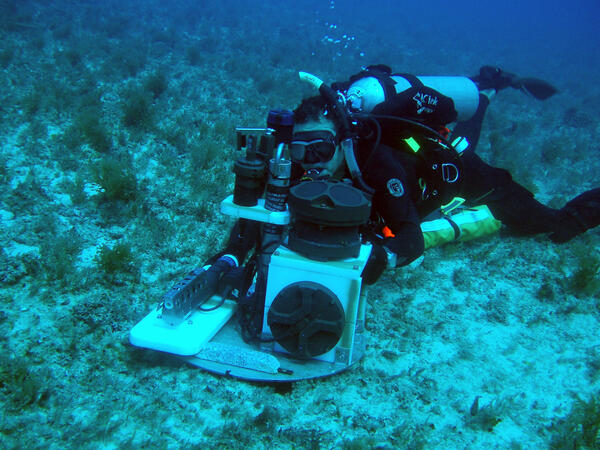
Installing oceanographic monitoring instrumentation on the seafloor
Installing oceanographic monitoring instrumentation on the seafloorUSGS research geologist Curt Storlazzi installs an instrument package on the seafloor of Maunalua Bay, Oʻahu. The platform, called a MiniPROBE, hosts six upward-looking acoustic Doppler current profilers (ADCP), seven conductivity and temperature (CT) sensors, and eight self-logging optical backscatter sensors (SLOBS).
Installing oceanographic monitoring instrumentation on the seafloor
Installing oceanographic monitoring instrumentation on the seafloorUSGS research geologist Curt Storlazzi installs an instrument package on the seafloor of Maunalua Bay, Oʻahu. The platform, called a MiniPROBE, hosts six upward-looking acoustic Doppler current profilers (ADCP), seven conductivity and temperature (CT) sensors, and eight self-logging optical backscatter sensors (SLOBS).

Fish and coral in Tumon Bay Marine Reserve, Guam
Underwater photograph of Tumon Bay Marine Reserve, Guam, showing some of the amazing biologic diversity of coral reefs.
Underwater photograph of Tumon Bay Marine Reserve, Guam, showing some of the amazing biologic diversity of coral reefs.

Bleached coral in Tumon
Underwater photo of a stressed coral mound in Tumon Bay Marine Preserve in Guam.
Underwater photo of a stressed coral mound in Tumon Bay Marine Preserve in Guam.

Island-hopping Coral Larvae in Hawaii
Large-scale poster describing USGS work.

Coral Larvae
Underwater photograph of larvae being released into the water column from reef-building coral spawning off Maui the night of June 30, 2003. The white larvae are about 0.5 to 1.5 mm across.
Underwater photograph of larvae being released into the water column from reef-building coral spawning off Maui the night of June 30, 2003. The white larvae are about 0.5 to 1.5 mm across.
Science and Products
Filter Total Items: 27
Using Video Imagery to Study Wave Dynamics: Tres Palmas
To study wave dynamics along an active coastline, video cameras were installed on the west coast of Puerto Rico at Tres Palmas in Rincón.
Quantifying Flood Risk and Reef Risk Reduction Benefits in Florida and Puerto Rico: The Consequences of Hurricane Damage, Long-term Degradation, and Restoration Opportunities
Coastal flooding and erosion from extreme weather events affect thousands of vulnerable coastal communities; the impacts of coastal flooding are predicted to worsen during this century because of population growth and climate change. Hurricanes Irma and Maria in 2017 were particularly devasting to humans and natural communities. The coral reefs off the State of Florida and the Commonwealth of...
The Value of U.S. Coral Reefs for Risk Reduction The Value of U.S. Coral Reefs for Risk Reduction
Summary of the report, “Rigorously valuing the role of U.S. coral reefs in coastal hazard risk reduction”
Coral Reef Project: Kauaʻi
As part of the USGS Coral Reef Project, the USGS is working on the island of Kauaʻi to identify circulation patterns and a sediment budget for Hanalei Bay to help determine any effects to the coastal marine ecosystem.
Coral Reef Project: Puerto Rico
To better understand how waves move across coral reefs and cause flooding on tropical shorelines, USGS scientists have installed video cameras and oceanographic instruments off San Juan and Rincón, Puerto Rico. Their work is part of a study funded by USGS after Hurricanes Irma and María. The offshore instruments measure wave heights and speeds; the onshore video cameras show where waves break on...
Coral Reef Project: Oʻahu
As part of the Coral Reef Project, the USGS is working closely with other local groups to investigate poor water quality issues in Maunalua Bay on the southeast coast of Oʻahu.
Coral Reef Project: Guam
As part of the USGS Coral Reef Project, the USGS is working on the west coast of Guam to help determine the effects of sedimentation in nearshore waters.
Coral Reef Project: Hawaiʻi
As part of the USGS Coral Reef Project, the USGS is working on the Kona (west) coast of Hawaiʻi to evaluate geologic resources at two historical parks.
Coral Reef Project: Lānaʻi
Little is actually known about the overall extent, biodiversity, morphology, or health of Lānaʻi’s reef tracks. As part of the USGS Coral Reef Project, the USGS collected high-resolution swath bathymetry data and underwater video and photography in early 2013 in order to develop high-resolution seafloor habitat and reef morphology maps of the coral reef systems off of eastern Lānaʻi.
Coral Reef Project: Kahoʻolawe
As part of the USGS Coral Reef Project, the USGS is trying to better understand how nearshore processes impact the deeper, scattered coral reef communities of Kahoʻolawe.
Coral Reef Project: Tutuila
As part of the USGS Coral Reef Project, the USGS is working on Tutuila with its partners: 1.) in Faga’alu Bay to better understand the impacts of land-based pollutants on the coral reefs, and 2.) on the north coast to help determine the effects of circulation on nearshore waters.
A Prioritization Plan for Coastal Wetland Restoration on Moloka‘i
Moloka‘i has great wetland restoration potential in Hawaiʻi, but most remaining sites are highly degraded. The future of several endangered waterbirds and insects relies on restoring coastal wetland habitat that is resilient under sea-level rise and coastal flooding. Currently, managers lack background data on Molokaʻi to prioritize sites for restoration. In this project, researchers...
Filter Total Items: 29
Corals die, turn to rubble
These Elkhorn corals (Acropora palmata) near Buck Island, U.S. Virgin Islands have died and collapsed into rubble. As coral reef structure degrades, valuable habitat for marine life is lost and nearby coastlines become more susceptible to storms, waves and erosion.
These Elkhorn corals (Acropora palmata) near Buck Island, U.S. Virgin Islands have died and collapsed into rubble. As coral reef structure degrades, valuable habitat for marine life is lost and nearby coastlines become more susceptible to storms, waves and erosion.
Coral reefs, Kwajalein Atoll, Republic of the Marshall Islands
Coral reefs, Kwajalein Atoll, Republic of the Marshall IslandsUnderwater image of a wave breaking over a coral reef on Kwajalein Atoll in the Republic of the Marshall Islands. This image shows how the high hydrodynamic roughness of live, healthy corals causes friction that induces breaking of waves over coral reefs, reducing wave energy at the shoreline that can cause flooding and island overwash.
Coral reefs, Kwajalein Atoll, Republic of the Marshall Islands
Coral reefs, Kwajalein Atoll, Republic of the Marshall IslandsUnderwater image of a wave breaking over a coral reef on Kwajalein Atoll in the Republic of the Marshall Islands. This image shows how the high hydrodynamic roughness of live, healthy corals causes friction that induces breaking of waves over coral reefs, reducing wave energy at the shoreline that can cause flooding and island overwash.
Restored coral reef off Kota Kinabalu, Borneo
A restored coral reef off Kota Kinabalu, Borneo, showing a mix of both concrete “Reef Balls” to rebuild reef topographic complexity and a variety of out-planted natural corals to increase coral coverage and species diversity.
A restored coral reef off Kota Kinabalu, Borneo, showing a mix of both concrete “Reef Balls” to rebuild reef topographic complexity and a variety of out-planted natural corals to increase coral coverage and species diversity.
Installing oceanographic monitoring instrumentation on the seafloor
Installing oceanographic monitoring instrumentation on the seafloorUSGS research geologist Curt Storlazzi installs an instrument package on the seafloor of Maunalua Bay, Oʻahu. The platform, called a MiniPROBE, hosts six upward-looking acoustic Doppler current profilers (ADCP), seven conductivity and temperature (CT) sensors, and eight self-logging optical backscatter sensors (SLOBS).
Installing oceanographic monitoring instrumentation on the seafloor
Installing oceanographic monitoring instrumentation on the seafloorUSGS research geologist Curt Storlazzi installs an instrument package on the seafloor of Maunalua Bay, Oʻahu. The platform, called a MiniPROBE, hosts six upward-looking acoustic Doppler current profilers (ADCP), seven conductivity and temperature (CT) sensors, and eight self-logging optical backscatter sensors (SLOBS).
Fish and coral in Tumon Bay Marine Reserve, Guam
Underwater photograph of Tumon Bay Marine Reserve, Guam, showing some of the amazing biologic diversity of coral reefs.
Underwater photograph of Tumon Bay Marine Reserve, Guam, showing some of the amazing biologic diversity of coral reefs.
Bleached coral in Tumon
Underwater photo of a stressed coral mound in Tumon Bay Marine Preserve in Guam.
Underwater photo of a stressed coral mound in Tumon Bay Marine Preserve in Guam.
Island-hopping Coral Larvae in Hawaii
Large-scale poster describing USGS work.
Coral Larvae
Underwater photograph of larvae being released into the water column from reef-building coral spawning off Maui the night of June 30, 2003. The white larvae are about 0.5 to 1.5 mm across.
Underwater photograph of larvae being released into the water column from reef-building coral spawning off Maui the night of June 30, 2003. The white larvae are about 0.5 to 1.5 mm across.