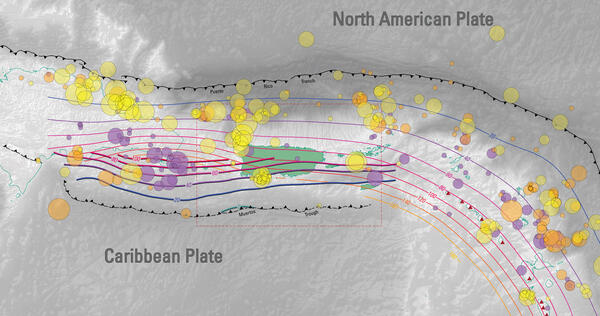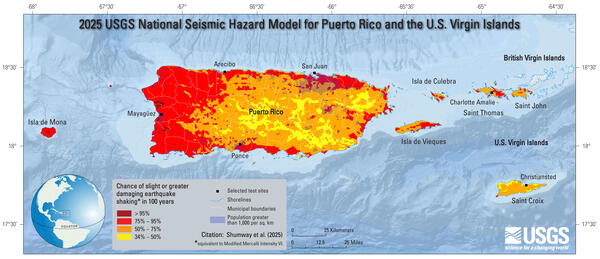
The Puerto Rico and U.S. Virgin Islands USGS National Seismic Hazard Model (NSHM) includes updated geologic and geophysical model inputs ready for the 2025 release.
Images
The Puerto Rico and U.S. Virgin Islands USGS National Seismic Hazard Model (NSHM) includes updated geologic and geophysical model inputs ready for the 2025 release.
USGS studies the growth rates of corals at a network of coral growth assessment stations throughout Buck Island National Monument in St. Croix, U.S. Virgin Islands. These data provide resource managers with information needed to understand how coral populations are doing in the park.
Rigorously Valuing the Role of the U.S. Virgin Islands’ Coral Reefs in Coastal Hazard Risk Reduction
Estimated Annual Benefits
Rigorously Valuing the Role of the U.S. Virgin Islands’ Coral Reefs in Coastal Hazard Risk Reduction
Estimated Annual Benefits
USGS studies the growth rates of corals at a network of coral growth assessment stations throughout Buck Island National Monument in St. Croix, U.S. Virgin Islands. These data provide resource managers with information needed to understand how coral populations are doing in the park.
Perspective view of coastal bathymetry looking onshore, St. Thomas, US Virgin Islands, mapped using lidar and depicted with false-color, showing detailed submerged features, including coral reefs.
Boat owners sought protection for their vessels in sheltered Hurricane Hole, but Hurricane Irma sunk and beached many boats, likely damaging corals. Photo: Caroline Rogers, USGS, 2017
Hawksbill sea turtle swimming over elkhorn coral, St. John, U.S. Virgin Islands.
These Elkhorn corals (Acropora palmata) near Buck Island, U.S. Virgin Islands have died and collapsed into rubble. As coral reef structure degrades, valuable habitat for marine life is lost and nearby coastlines become more susceptible to storms, waves and erosion.
Healthy Elkhorn coral (Acropora palmata) near unpopulated Buck Island, U.S. Virgin Islands. Elkhorn coral is one of many important reef-building species that create 3D structure on the seafloor. Coral reef structure provides habitat for marine life and helps break up waves as they approach the coastline.
Perspective view of coastal bathymetry looking onshore, St. Thomas, US Virgin Islands, mapped using lidar and depicted with false-color, showing detailed submerged features, including coral reefs.
The Buffalo Trunkfish (Lactophrys trigonus) is larger and less abundant than the Spotted and Smooth Trunkfishes seen frequently in the mangroves.
Sediment can smother corals, but Hurricane Hole has no sediment-bearing freshwater streams. Its clear waters are habitat for an entire community of marine life, including Montastrea corals and squirrelfish. Photo: Caroline Rogers, USGS, 2009
A queen angelfish peers through the safety of the mangrove roots across the rich colors and textures of corals, sponges, urchins, and algae. Queen angelfish feed almost exclusively on sponges, which are abundant in these mangroves.
A Diversity of Corals Growing in the Mangroves Within Virgin Islands Coral Reef National Monument
linkThis photo shows a mangrove ecosystem that may be unique in the Caribbean in terms of the abundance and diversity of corals.
A Diversity of Corals Growing in the Mangroves Within Virgin Islands Coral Reef National Monument
linkThis photo shows a mangrove ecosystem that may be unique in the Caribbean in terms of the abundance and diversity of corals.
A Diversity of Corals Growing in the Mangroves Within Virgin Islands Coral Reef National Monument
linkThis photo shows a mangrove ecosystem that may be unique in the Caribbean in terms of the abundance and diversity of corals.
A Diversity of Corals Growing in the Mangroves Within Virgin Islands Coral Reef National Monument
linkThis photo shows a mangrove ecosystem that may be unique in the Caribbean in terms of the abundance and diversity of corals.
This coral (Mycetophyllia sp.) is not abundant in coral reefs of the Virgin Islands. It most commonly grows in water deeper than 40 ft., and it is surprising to find it growing in the shade of the mangroves in 3 ft of water.
In Hurricane Hole, Red Mangrove trees extend from land into the water, anchoring the trees along the shoreline and creating a rich marine ecosystem.
A Queen Angelfish Swims in Front of Coral Colonies of Several Species Growing in Mangroves Within Virgin Islands Coral Reef National Monument
linkThis photo shows a mangrove ecosystem that may be unique in the Caribbean in terms of the abundance and diversity of corals.
A Queen Angelfish Swims in Front of Coral Colonies of Several Species Growing in Mangroves Within Virgin Islands Coral Reef National Monument
linkThis photo shows a mangrove ecosystem that may be unique in the Caribbean in terms of the abundance and diversity of corals.
An Endangered Red Hawksbill Sea Turtle Swims Over a Threatened Elkhorn Coral in Virgin Islands National Park
linkThis photo shows an endangered hawksbill (Eretmochelys imbricata) swimming over a colony of elkhorn coral (Acropora palmata).
USGS scientists are doing research on sea turtles and corals in Florida and the US Virgin Islands.
An Endangered Red Hawksbill Sea Turtle Swims Over a Threatened Elkhorn Coral in Virgin Islands National Park
linkThis photo shows an endangered hawksbill (Eretmochelys imbricata) swimming over a colony of elkhorn coral (Acropora palmata).
USGS scientists are doing research on sea turtles and corals in Florida and the US Virgin Islands.
A view toward the ocean, featuring a white sand beach, the ocean, and a Seagrape tree partially blocking a palm tree.
Shallow coral reefs in the U.S. Virgin Islands are in jeopardy due to climate warming and ocean acidification.