



A sea otter mom nursing her pup. Photo taken in Prince William Sound, Alaska. A new born sea otter needs to stay with its mother for six months to learn how to survive on its own.
Images
Browse images from a wide range of science topics covered by USGS. All items in this gallery are considered public domain unless otherwise noted.
Filter Total Items: 1631

A sea otter mom nursing her pup
A sea otter mom nursing her pup. Photo taken in Prince William Sound, Alaska. A new born sea otter needs to stay with its mother for six months to learn how to survive on its own.
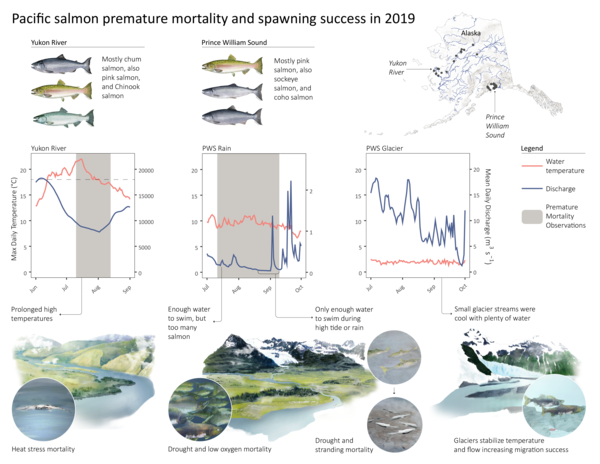
Infographic showing Pacific salmon premature mortality and spawning success in Alaska
Infographic showing Pacific salmon premature mortality and spawning success in AlaskaInfographic showing water temperature and discharge (flow) data from rivers with heat-related salmon mortality, drought-related salmon mortality, and normal salmon survival in Alaska during 2019.

Red plumes burst out from the tops of these chemosynthetic tubeworms
Red plumes burst out from the tops of these chemosynthetic tubewormsRed plumes burst out from the tops of these chemosynthetic tubeworms, capturing hydrogen sulfide and oxygen from the surrounding water to feed their bacterial endosymbionts. The tubeworm tubes provide a habitat for several benthic animals, including the pale pink branching octocorals seen here

Early Morning on the Stikine River, Alaska
The USGS crew heads upriver early one winter day and sees an increible sunrise on the Stikine River.
The USGS crew heads upriver early one winter day and sees an increible sunrise on the Stikine River.

USGS boat at the Stikine River gage site, Alaska
The USGS boat at the Stikine River gage site, Alaska. The Stikine River is one of the transboundary watersheds of Southeast Alaska. Visit USGS Transboundary River Monitoring in Southeast Alaska for more information about our research.
The USGS boat at the Stikine River gage site, Alaska. The Stikine River is one of the transboundary watersheds of Southeast Alaska. Visit USGS Transboundary River Monitoring in Southeast Alaska for more information about our research.

Scientist collects eDNA samples at Izembek NWR, Alaska
Scientist collects eDNA samples at Izembek NWR, AlaskaUSGS Geneticist Damian Menning is performing eDNA sampling at Grant Point in Izembek National Wildlife Refuge, Alaska. This eDNA sampling is part of a project looking for eelgrass (Zostera marina) pathogens in the North Pacific. Izembek NWR is on the Alaska Peninsula located between the Bering Sea and the Gulf of Alaska.

Keychain in Inupiaq for USGS outreach activities about bird banding
Keychain in Inupiaq for USGS outreach activities about bird bandingKeychain developed for USGS outreach activities about bird banding and reporting in Inupiaq and English. Inupiaq translation provided by Qaiyaan and Jana Harcharek.
Keychain in Inupiaq for USGS outreach activities about bird banding
Keychain in Inupiaq for USGS outreach activities about bird bandingKeychain developed for USGS outreach activities about bird banding and reporting in Inupiaq and English. Inupiaq translation provided by Qaiyaan and Jana Harcharek.

Sampling the Unuk River, Alaska
USGS Hydrologist Randy Host performs compass calibrations for discharge measurements at the Unuk River. The Unuk River is one of the transboundary watersheds of Southeast Alaska. This site has a Super Gage which is a conventional streamflow gage equipped with continuous water-quality monitors.
USGS Hydrologist Randy Host performs compass calibrations for discharge measurements at the Unuk River. The Unuk River is one of the transboundary watersheds of Southeast Alaska. This site has a Super Gage which is a conventional streamflow gage equipped with continuous water-quality monitors.

Scientists necropsy Common Murres
USGS scientists Matthew Smith, Caitlin Marsteller, and Danielle Gerik necropsy Common Murres and harvest tissues to test for harmful algal bloom toxins.
USGS scientists Matthew Smith, Caitlin Marsteller, and Danielle Gerik necropsy Common Murres and harvest tissues to test for harmful algal bloom toxins.

Tundra swan on the Colville River Delta, Alaska
Tundra swan on the Colville River Delta, Alaska 2013.
Tundra swan on the Colville River Delta, Alaska 2013.

Beaver dam complex and lodge at the confluence
Beaver dam complex and lodge at the confluence of Wrench Creek and Kelly River, Noatak National Preserve
Beaver dam complex and lodge at the confluence of Wrench Creek and Kelly River, Noatak National Preserve

Beaver dam and lodge on the Wrench Creek, Noatak National Preserve
Beaver dam and lodge on the Wrench Creek, Noatak National PreserveBeaver dam and lodge on the Wrench Creek, Noatak National Preserve
Beaver dam and lodge on the Wrench Creek, Noatak National Preserve
Beaver dam and lodge on the Wrench Creek, Noatak National PreserveBeaver dam and lodge on the Wrench Creek, Noatak National Preserve

Adult Pacific salmon caught in impounded water above beaver dam
Adult Pacific salmon caught in impounded water above beaver damAdult Pacific salmon (Oncorhynchus nerka) caught in impounded water above beaver dam. >25 rKM (river KM) from coast.
Adult Pacific salmon caught in impounded water above beaver dam
Adult Pacific salmon caught in impounded water above beaver damAdult Pacific salmon (Oncorhynchus nerka) caught in impounded water above beaver dam. >25 rKM (river KM) from coast.

Caitlin Marsteller stands on top of Duck Island
Caitlin Marsteller stands on top of Duck Island, on the west side of lower Cook Inlet, after collecting time lapse cameras. Duck island is home to a breeding colony of Common Murres where time lapse cameras collect data, such as the number of eggs laid and the number of chicks hatched, to help estimate breeding productivity.
Caitlin Marsteller stands on top of Duck Island, on the west side of lower Cook Inlet, after collecting time lapse cameras. Duck island is home to a breeding colony of Common Murres where time lapse cameras collect data, such as the number of eggs laid and the number of chicks hatched, to help estimate breeding productivity.

Forage species caught in trawl net, Prince William Sound, Alaska
Forage species caught in trawl net, Prince William Sound, AlaskaSquid, adult walleye pollock, herring, eulachon, northern smoothtongue, capelin, juvenile walleye pollock, krill, and shrimp are forage species that are caught by a modified-herring trawl in Prince William Sound, Alaska during the Fall Integrated Predator-Prey Survey.

young of the year walleye pollock
Photo of young of the year walleye pollock, Prince William Sound, Alaska. Although adults are targeted in one of the largest commercial fisheries in the world, young of the year walleye pollock are important in diets of many marine predators.
Photo of young of the year walleye pollock, Prince William Sound, Alaska. Although adults are targeted in one of the largest commercial fisheries in the world, young of the year walleye pollock are important in diets of many marine predators.

Pacific herring in Prince William Sound, Alaska
Pacific herring in Prince William Sound, Alaska
Pacific herring in Prince William Sound, Alaska

Sending the trawl overboard, Prince William Sound, Alaska
Sending the trawl overboard, Prince William Sound, AlaskaCaitlin Marsteller (USGS) and April Sturgess (USGS) throw the cod end of the modified herring trawl overboard on the USGS R/V Alaskan Gyre during the Fall Integrated Predator-Prey survey in Prince William Sound, Alaska.
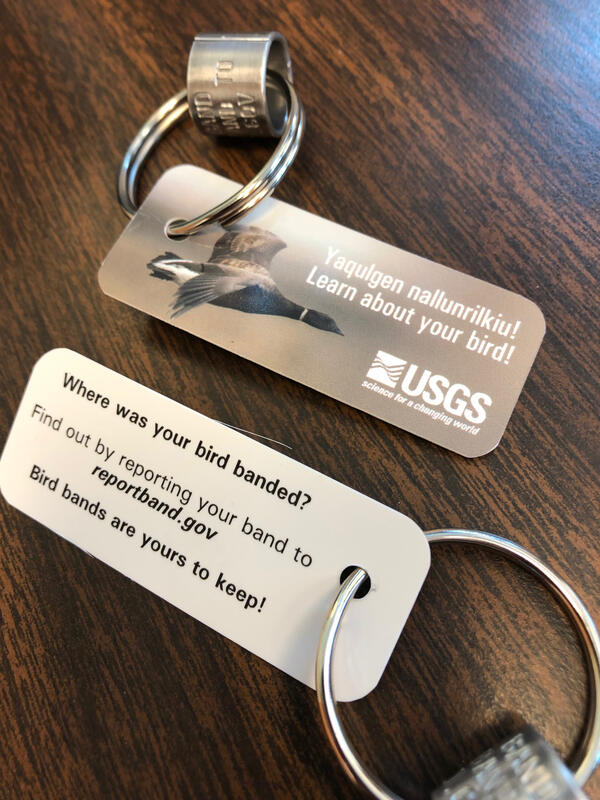
Keychain for USGS outreach activities about bird banding and reporting
Keychain for USGS outreach activities about bird banding and reportingKeychain developed for USGS outreach activities about bird banding and reporting in Yup'ik and English. Yup'ik translation provided by Jakob Sipary, Alaska Native Science and Engineering Program (ANSEP).
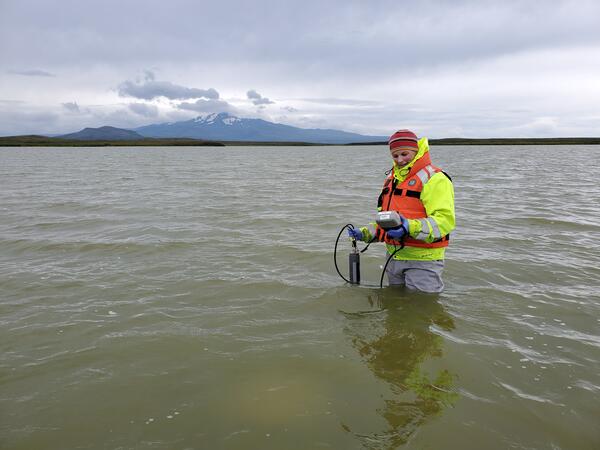
Hydrologist takes water chemistry measures on the Alaska Peninsula
Hydrologist takes water chemistry measures on the Alaska PeninsulaLaura Hubbard of the USGS Upper Midwest Water Science Center takes water chemistry measures on the Alaska Peninsula as part of research to understand how long influenza viruses remain viable in the environment.

Harbor seals in Russell Creek, Cold Bay, Alaska.
Harbor seals poking their heads above water near shore in Russell Creek, Cold Bay, Alaska.
Harbor seals poking their heads above water near shore in Russell Creek, Cold Bay, Alaska.